Gold IRA vs Gold ETF in a Regular IRA
A Gold IRA is a self-directed IRA that owns physical coins or bars held by a trustee or custodian. A gold ETF or other exchange-traded product is a share you can often buy in an existing IRA. The IRA tax rules are the same either way. Costs, custody, trading and what you actually own differ.
If you want gold in a retirement account, there are two common routes. One is a Gold IRA: a self-directed IRA that buys physical coins or bars. The other is buying shares of a gold exchange-traded product inside the IRA you may already have at a brokerage. This page is part of our wider look at Gold IRA vs Other Retirement Investments.
Federal regulators point to both routes. A joint CFTC and FINRA advisory on physical metals notes: "There are financial products such as commodity exchange traded products (ETP) or pools that offer exposure to metals prices." It adds: "While these products come with their own fees and costs, you might be able to add them to your existing IRA, and they are fully regulated" (CFTC advisory; FINRA version).
Neither route is right for everyone. This page lays out the trade-offs. It does not recommend one over the other, and it does not compare specific funds or companies.
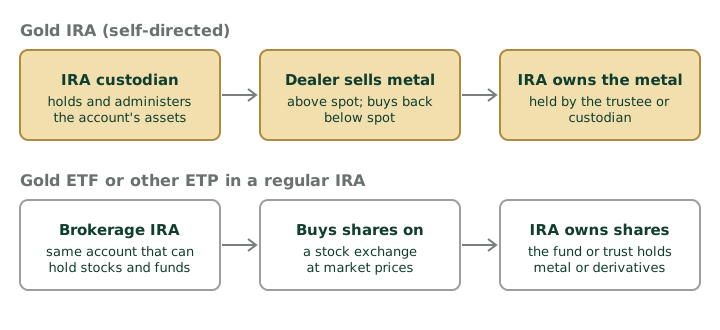
What is the difference between a Gold IRA and a gold ETF?
The difference is what the IRA owns.
- Gold IRA. The IRA owns specific physical metal. The IRS allows "gold, silver, platinum, or palladium bullion of a certain fineness if a bank or approved non-bank trustee keeps physical possession of it," plus certain U.S. Mint coins and state-issued coins (IRS collectibles page). Our guide to the collectibles rule explains which metal qualifies.
- Gold ETF or other ETP. The IRA owns shares. Investor.gov defines exchange-traded products (ETPs) as "investment products that are listed and traded on national securities exchanges." The category includes exchange-traded funds (ETFs), exchange-traded commodity trusts and exchange-traded notes (Investor.gov ETP glossary).
People often say "gold ETF" for any of these, but the structure matters. Investor.gov explains that these trusts hold assets made up mainly of commodities, currencies or derivatives, and that they are not registered under the Investment Company Act of 1940, the law that governs most mutual funds and ETFs (Investor.gov ETP glossary).
Is a gold ETF share the same as owning gold?
No. Buying a share is not buying metal. The fund or trust owns its assets, and you own a share of the fund. Some products hold metal. Others hold derivatives, such as futures contracts, rather than metal. The product's prospectus explains what it holds and the risks.
Investor.gov also warns about one ETP type, exchange-traded notes. It calls them "unsecured debt obligations of financial institutions." It says they "are complex, involve many risks for investors, and can result in the loss of the entire investment" (Investor.gov ETP glossary). A product with "gold" in its name could be an ETN, so check the structure before buying.
How do the costs compare?
The cost structures are different, so compare them item by item.
Gold IRA costs. The biggest cost is often the dealer's markup. The CFTC says: "A dealer will always sell metal above the spot price and buy it back below the spot price. The difference between the dealer's buy and sell price is known as the dealer's spread." It lists other costs too: "storage, insurance, administrative fees, and possibly additional taxes and penalties" (CFTC advisory). FINRA adds that "SDIRA fees are typically higher than directed-IRA fees" (FINRA bulletin). See dealer premiums and markups, custodian fees and storage fees for detail.
ETF and ETP costs. Funds charge ongoing operating expenses. The SEC explains that "both mutual funds and ETFs pay for operating expenses out of fund assets." Total annual operating expenses, shown as a percentage of the fund's average net assets, are called the expense ratio. You find it in the prospectus fee table. Separately, "ETF investors may pay their brokers sales commissions with each purchase or sale of ETF shares" (SEC fees bulletin). Because the expense comes out of fund assets, you won't see a separate bill for it.
There is also a trading spread. For ETFs, the SEC notes that "The bid price will be lower than the ask price and the difference between two prices is called the spread" (SEC ETF bulletin).
Small fees add up. The SEC puts it plainly: "Fees and expenses reduce the value of your fund's investment returns" (SEC fees bulletin). The same is true of storage and custodian fees in a Gold IRA.
We do not list fee figures for specific funds or dealers here. Fees vary and change. Get each current number in writing from the fund's prospectus, the custodian's fee schedule and the dealer's quote. Our total cost of ownership guide shows how to add them up.
Side-by-side comparison
| Factor | Gold IRA (physical metal) | Gold ETF or ETP in a regular IRA |
|---|---|---|
| What the IRA owns | Specific coins or bars | Shares of a fund, trust or note |
| Who holds it | Bank or IRS-approved non-bank trustee or custodian | Your brokerage holds the shares; the fund holds its assets |
| Account needed | Self-directed IRA | Often an existing brokerage IRA |
| Main upfront cost | Dealer markup above spot | Bid-ask spread and any broker commission |
| Ongoing costs | Custodian, storage and insurance fees | Expense ratio, paid from fund assets |
| Cost to sell | Dealer buys below spot | Bid-ask spread and any commission |
| How you sell | Through the custodian and a buyer, often a dealer | On an exchange during the trading day |
| Value shown | Statement shows "melt" value | Market price, which can differ from net asset value |
| Regulation of the product | Dealers sell metal; the CFTC warns of fraud in this market | ETPs are "fully regulated," per CFTC and FINRA |
| IRA tax rules | Same | Same |
Sources: CFTC advisory, IRS collectibles page, SEC ETF bulletin, SEC fees bulletin.
Who holds the gold, and what does custody mean?
Custody means who keeps the asset on your behalf.
In a Gold IRA, the rules are strict. "Metals in a self-directed IRA must be held by the IRA trustee or custodian" (CFTC advisory). You can't keep IRA metal at home. Our page on home storage explains why. The custodian, dealer and depository guide shows how the three roles fit together.
A self-directed IRA custodian does not check your investments for you. The SEC says these custodians are only responsible for holding and administering the assets in the account. They do not evaluate whether an investment or its promoter is legitimate (SEC self-directed IRA alert). The CFTC also warns that "Some fraudulent dealers have charged storage and insurance fees for metal that never existed" (CFTC advisory). Our page on verifying your metals covers what to ask.
With an ETF or ETP, your brokerage holds your shares. The fund or trust arranges custody of its own assets. Its prospectus explains how that works.
How easy is it to sell?
ETF or ETP shares. "ETF shares are traded throughout the day on national stock exchanges and at market prices" (SEC ETF bulletin). You place a sell order in your brokerage IRA, just as you would for a stock.
Physical metal. The IRA has to find a buyer, often a dealer, and the custodian handles the paperwork. The dealer pays below spot. The CFTC suggests you "Ask how much you would receive if you had to sell back the metal tomorrow" (CFTC advisory). FINRA notes that semi-numismatic coins are "likely less liquid—harder to sell—than bullion" (FINRA bulletin). See buyback costs and bullion vs numismatic coins.
Selling can matter at withdrawal time too. Our guides to required minimum distributions and in-kind distributions explain the options for metal.
How closely does each track the price of gold?
Neither route gives you exactly the spot price.
In a Gold IRA, the custodian's statement "shows the 'melt' value of the metals" (CFTC advisory). If you paid a large premium, melt value can be well below what you paid. That gap is a cost, not a loss in the gold market.
An exchange-traded share has a market price. For ETFs, the SEC explains that "An ETF's market price typically will be more or less than the fund's NAV per share (called selling at a premium or discount)" (SEC ETF bulletin). NAV, or net asset value, is the value of the fund's assets per share. The expense ratio also reduces the fund's results over time. Note that this SEC bulletin says it does not cover commodity products such as exchange-traded commodity funds. For a gold product, read its own prospectus on how it values its holdings and what can cause it to differ from the gold price.
How are taxes handled inside an IRA?
The IRA tax rules are the same whichever route you choose. The account type sets the tax treatment, not the asset inside it.
- Growth. "Generally, amounts in your IRA, including earnings and gains, aren't taxed until they are distributed" (Publication 590-A).
- Traditional IRA withdrawals. "Distributions from a traditional IRA are taxed as ordinary income, but if you made nondeductible contributions, not all of the distribution is taxable" (Publication 590-B).
- Roth IRA withdrawals. "Distributions from a Roth IRA aren't taxed as long as you meet certain criteria" (Publication 590-B).
- Early withdrawals. "A 10% additional tax generally applies if you withdraw or use IRA assets before you reach age 59½" (Publication 590-B).
One rule applies only to the physical route. If an IRA buys a collectible, the IRS treats it as a distribution of the cost in the year bought (IRS collectibles page). Metal that meets the fineness and custody rules avoids that result. This page does not address how the IRS treats shares of gold products under the collectibles rule. Ask a tax professional or the product sponsor if that matters to you. Our Gold IRA taxes guide covers the rules in more depth.
Examples of how the trade-offs play out
These are illustrations, not recommendations.
- Someone who wants to hold metal itself. A Gold IRA gives the account specific coins or bars, held by a trustee. The price is the dealer markup, a separate custodian and storage fees, and a slower sale process.
- Someone who wants gold price exposure in an existing account. An exchange-traded product may be available in the brokerage IRA they already have. There's no separate custodian to open. But they own shares, not metal, and they pay an expense ratio every year the shares are held.
- Someone comparing total cost. They gather the dealer's written quote and buyback terms, the custodian and storage fee schedules, and the fund's prospectus fee table and broker commissions. Then they compare totals over the years they expect to hold.
Common mistakes to avoid
- Assuming "gold ETF" means physical gold. Check whether the product holds metal, holds futures, or is a note.
- Comparing only the headline fee. A low storage fee can sit next to a large dealer markup. A low expense ratio can sit next to trading costs.
- Assuming an IRA custodian has vetted the dealer. Self-directed IRA custodians don't evaluate the quality or legitimacy of investments or their promoters, as the SEC alert above explains.
- Moving retirement money because of a sales pitch. The CFTC and FINRA advisory covers warning signs. See our Gold IRA scams and Gold IRA risks pages.
Which route fits depends on your goals, other holdings, time horizon and costs. A fee-only financial planner with no ties to dealers or fund sponsors can help you weigh it.
Related questions
How does this compare with buying gold outside an IRA?
Buying outside a retirement account is a separate comparison with its own tax questions. See Gold IRA vs Buying Physical Gold Outside an IRA and IRA gold vs taxable gold.
What about other metals?
The same physical-versus-shares question applies to silver, platinum and palladium. See Gold vs Platinum and Palladium in an IRA and our silver IRA guide.
Is a Gold IRA different from a regular IRA?
A Gold IRA uses the same Traditional or Roth tax rules as any IRA. See Gold IRA vs Traditional or Roth IRA.
Sources
- Customer Advisory: 10 Things to Ask Before Buying Physical Gold, Silver, or Other Metals, Commodity Futures Trading Commission. Accessed Invalid Date.
- Investor Bulletin: 10 Things to Ask Before Buying Physical Gold, Silver or Other Metals, FINRA and CFTC. Accessed Invalid Date.
- Exchange-Traded Products (ETPs), U.S. Securities and Exchange Commission, Investor.gov. Accessed Invalid Date.
- Updated Investor Bulletin: Exchange-Traded Funds (ETFs), U.S. Securities and Exchange Commission, Investor.gov. Accessed Invalid Date.
- Mutual Fund and ETF Fees and Expenses - Investor Bulletin, U.S. Securities and Exchange Commission, Investor.gov. Accessed Invalid Date.
- Investor Alert: Self-Directed IRAs and the Risk of Fraud, U.S. Securities and Exchange Commission, Investor.gov. Accessed Invalid Date.
- Investments in collectibles in individually directed qualified plan accounts, Internal Revenue Service. Accessed Invalid Date.
- Publication 590-A (2025), Contributions to Individual Retirement Arrangements (IRAs), Internal Revenue Service. Accessed Invalid Date.
- Publication 590-B (2025), Distributions from Individual Retirement Arrangements (IRAs), Internal Revenue Service. Accessed Invalid Date.
This guide is general education, not personalized financial, tax or legal advice. See our financial disclaimer, editorial policy and advertising disclosure.