Gold IRA Withdrawal Rules: Cash or Metal, Taxes and Timing
You can withdraw from a Gold IRA at any time in one of two ways: have the custodian sell metal and pay you cash, or take the coins or bars themselves as an in-kind distribution. Both are taxed under normal IRA rules, and withdrawals before age 59½ may face a 10% additional tax unless an exception applies.
The IRS says you "can take distributions from your IRA ... at any time" (IRS). With a Gold IRA, the extra question is whether you want cash or the metal itself, and the answer changes your costs, your paperwork and when you pay tax. This page is the overview. It covers the two ways to take a withdrawal, how each account type is taxed, the 10% additional tax and its exceptions, withholding, required minimum distributions, partial withdrawals, closing the account and what beneficiaries face. For the wider picture of how these accounts work, start with the Gold IRA Guide.
This page explains rules. It is not advice about what you should do, and the right answer for you depends on your age, account type, other income and goals. A CPA or enrolled agent can review a plan before you act.
How can you withdraw from a Gold IRA?
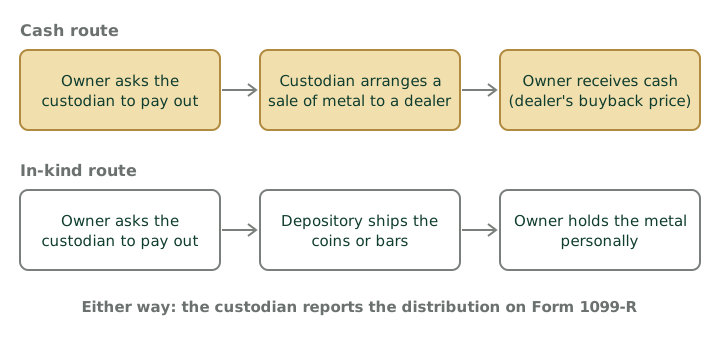
You have two basic choices. The custodian can sell metal and pay you cash, or the custodian can have the coins or bars shipped to you. Either one is a distribution.
| Cash withdrawal | In-kind withdrawal | |
|---|---|---|
| What happens | The custodian sells metal (for example, to a dealer) and pays you | The custodian ships the coins or bars to you |
| How it's valued for tax | The amount distributed | The metal's fair market value on the distribution date |
| Costs to expect (varies by custodian, so ask) | The dealer's buyback spread and any custodian fees | Possibly shipping, insurance and custodian fees |
| What you have afterwards | Cash | Metal you now own personally |
How does a cash withdrawal work?
- Ask your custodian for its distribution form.
- Decide how much metal to sell and get a buyback price from the dealer.
- The custodian completes the sale, then pays you the amount you requested.
The price you get is the dealer's bid, its buyback price, which is lower than its selling price for the same product. That gap is part of what a Gold IRA costs. See selling metal inside a Gold IRA and dealer premiums and markups.
How does an in-kind withdrawal work?
You take the metal itself. For tax purposes it is valued at fair market value (FMV). The IRS instructions for Form 1099-R say: "If you distribute employer securities or other property, include in box 1 the FMV of the securities or other property on the date of distribution" (IRS). Those instructions don't give a method for valuing coins or bars, so ask your custodian how it will set the figure it reports.
Once the metal leaves the IRA, you own it personally. If you later sell coins at a gain, the IRS says "Net capital gains from selling collectibles (such as coins or art) are taxed at a maximum 28% rate" (IRS Topic 409). The same page says a gain is generally long-term if you hold the asset "for more than one year." See taking physical possession of your metals.
Why is home storage a different thing?
Taking metal in a reported distribution is not the same as keeping IRA-owned metal at home. In McNulty v. Commissioner (2021), the Tax Court treated an owner's personal possession of IRA-bought coins as a taxable distribution. See home storage.
Which is simpler, cash or in kind?
Neither is better for everyone. The comparison below shows the trade-offs, not a recommendation.
| Question | Cash | In kind |
|---|---|---|
| Do I end up with money to pay the tax? | Yes, from the proceeds | No, the tax comes from other money |
| Do I give up the dealer's spread? | Yes, on the metal sold | Not at the time of the distribution |
| Do I need to arrange shipping and insurance? | No | Yes |
| Do I take on the market price risk of the metal? | Not after the sale completes | Yes, after delivery you hold the metal |
A worked example: the same $20,000, two ways
These numbers are made up to show the arithmetic. They are not a forecast, and the tax rate is an assumption, not a statement about anyone's bracket.
Assume a 66-year-old owner has a Traditional Gold IRA with no nondeductible contributions. The owner takes $20,000 of distributions in one year. Assume the owner's marginal federal rate is 22% and leaves the IRS's default withholding in place.
| Cash | In kind | |
|---|---|---|
| Amount distributed | $20,000 (gross cash from sale) | Coins with an FMV of $20,000 on the distribution date |
| Added to taxable income | $20,000 | $20,000 |
| Default 10% withholding | $2,000 | Ask the custodian how it applies |
| Cash the owner receives | $18,000 | $0 from the IRA |
| Illustrative tax at 22% | $4,400 | $4,400 |
| Illustrative tax still due after any withholding | $2,400 | $4,400 if nothing is withheld, paid from other money |
The tax is the same on paper. The practical difference is that in the cash case the money to pay it can come from the sale, and in the in-kind case it can't. In the cash case, the dealer's buyback price also determines how much metal has to be sold to produce the $20,000.
How are Gold IRA withdrawals taxed?
Traditional Gold IRA
"Distributions from a traditional IRA are taxed as ordinary income, but if you made nondeductible contributions, not all of the distribution is taxable" (Publication 590-B). If you made nondeductible contributions, Publication 590-B points to Form 8606 for working out the taxable and nontaxable parts. See Traditional Gold IRAs.
Roth Gold IRA
The law says "Any qualified distribution from a Roth IRA shall not be includible in gross income" (26 U.S.C. 408A(d)(1)). A distribution is qualified when it meets two tests:
- It is made on or after age 59½, after the owner's death, because the owner is disabled, or as a "qualified special purpose distribution" (Publication 590-B describes this as a first-time home purchase, up to a $10,000 lifetime limit).
- It is not made within the five-taxable-year period beginning with the first year you made a contribution to a Roth IRA (408A(d)(2)).
See Roth Gold IRAs for the five-year rule in detail.
What if a Roth withdrawal isn't qualified?
It isn't automatically taxable. Treasury's regulation says a Roth distribution is not included in income "if it is a qualified distribution or to the extent that it is a return of the owner's contributions" (26 CFR 1.408A-6, Q&A-1). The ordering rules say what is treated as coming out first. By statute, a distribution is treated as made "from contributions" until total distributions reach total contributions, and contributions other than conversions come before converted amounts (26 U.S.C. 408A(d)(4)). The regulation lists the sequence as regular contributions, then conversion contributions (first in, first out), then earnings (Q&A-8).
Another made-up example. A 62-year-old first contributed to a Roth Gold IRA two years ago, so the five-year period isn't over. The owner has contributed $20,000 in total, has no conversions, and the account is now worth $26,000.
| Withdrawal | Treated as coming from | Income tax result | 10% additional tax |
|---|---|---|---|
| $12,000 | Contributions | Not included in income | Not applicable, the owner is past 59½ |
| $24,000 | $20,000 contributions, then $4,000 earnings | $4,000 included in income | Not applicable, the owner is past 59½ |
The first row works because the withdrawal is within contributions. The second shows the earnings taking the tax hit because the five-year period isn't over. Conversions carry their own details, which are covered in Roth Gold IRAs. More on taxes overall: Gold IRA taxes.
What is the 10% additional tax before age 59½?
The IRS says: "To discourage the use of IRA distributions for purposes other than retirement, you'll be assessed a 10% additional tax on early distributions from traditional and Roth IRAs, unless an exception applies" (Topic 557). The same page says the tax "applies to the part of the distribution that you have to include in gross income." The statute puts it as an increase in your tax equal to "10 percent of the portion of such amount which is includible in gross income" (26 U.S.C. 72(t)(1)).
So the additional tax comes on top of regular income tax. The IRS describes the early distributions as amounts withdrawn "before reaching age 59½" (IRS). It is reported on Form 5329 and Schedule 2 (Form 1040) (Topic 557).
Which exceptions does the IRS list for IRAs?
The IRS exceptions page lists these among the exceptions that can apply to IRAs (IRS):
| Exception | Limit or condition the IRS states |
|---|---|
| Disability | Total and permanent disability of the owner |
| Death | After the owner's death |
| Substantially equal payments | A series of substantially equal payments |
| Unreimbursed medical expenses | The part above 7.5% of adjusted gross income |
| Health insurance while unemployed | Health insurance premiums paid while unemployed (the IRS row refers to someone unemployed for 12 weeks) |
| Higher education | Qualified higher education expenses |
| First home | Qualified first-time homebuyers, up to $10,000 |
| Birth or adoption | Up to $5,000 per child |
| Domestic abuse victim | Lesser of $10,000 or 50% of the account |
| Emergency personal expense | One distribution per calendar year, up to the lesser of $1,000 or the vested account balance over $1,000 |
| Federally declared disaster | Up to $22,000 for qualified individuals |
| IRS levy | Distribution because of an IRS levy |
| Military reservists | Certain distributions to reservists called to active duty |
| Returned IRA contributions | If withdrawn by the extended due date of the return (not including earnings on the returned contributions) |
The IRS page also lists exceptions that apply only to workplace plans, such as separation from service at age 55. Each exception has its own conditions. If your Form 1099-R doesn't show an exception that applies, Topic 557 explains that you claim it on Form 5329. See Gold IRA early withdrawal penalty and exceptions.
How does tax withholding work on a Gold IRA distribution?
The IRS says "An IRA distribution paid to you is subject to 10% withholding unless you elect out of withholding or choose to have a different amount withheld" (IRS). The form for this election is Form W-4R, which the IRS says applies to payments from an IRA. Its instructions say "Your payer must withhold at a default 10% rate from the taxable amount of nonperiodic payments unless you enter a different rate on line 2," and that you can choose no withholding by entering "-0-" on line 2.
Withholding is a prepayment, not the final bill. The W-4R instructions warn: "If you have too little tax withheld, you will generally owe tax when you file your tax return and may owe a penalty unless you make timely payments of estimated tax." If too much is withheld, you are generally due a refund.
With an in-kind distribution there is no cash payment to withhold from. Ask the custodian how it handles that before you sign. Questions to put to the custodian:
- Will you withhold anything on an in-kind distribution, and if so, how do I fund it?
- Can I send a check, or do you sell a small amount of metal for it?
- What do I need to file to elect a different percentage?
What are the rules for required minimum distributions?
Traditional IRA owners must start taking required minimum distributions (RMDs) once they reach a set age. The IRS says: "You generally have to start taking withdrawals from your IRA ... when you reach age 73" (IRS). The first one is due by April 1 of the year after the year you reach that age. Under 26 U.S.C. 401(a)(9)(C)(v), the applicable age is 73 for people who reach age 73 before 2033 and 75 for people who reach age 74 after 2032, so check which applies to you with the IRS or a tax professional; our Gold IRA RMD page goes into the details.
Each year's amount is "the account balance as of the end of the immediately preceding calendar year divided by a distribution period from the IRS's 'Uniform Lifetime Table'" (same IRS page). If you take too little, "a 25% excise tax on the amount not distributed as required (10% if withdrawn within 2 years)" can apply. Roth owners aren't covered: "You're not required to take withdrawals from Roth IRAs ... while the account owner is alive."
How does a metals-only IRA meet an RMD?
A Gold IRA often holds little or no cash, so each year something has to be sold or shipped. The options are:
- Sell metal. The custodian sells enough metal and pays you cash.
- Take metal in kind. The IRS instructions for Form 1099-R report property distributions at FMV on the distribution date. Coins come in fixed sizes, so the value shipped rarely matches the RMD to the cent. Ask how your custodian handles the difference.
- Take it from another Traditional IRA. The IRS says "An IRA owner must calculate the RMD separately for each IRA they own but can withdraw the total amount from one or more of the IRAs" (IRS RMD FAQs). Ask a tax professional how that applies to your mix of IRAs.
Start early. Selling metal or arranging a shipment takes time, and the December 31 deadline applies to every later year. See Gold IRA required minimum distributions for the worked calculation and liquidity risk for why a metals-only account needs planning.
Can you take a partial withdrawal?
Yes, if your custodian's process allows it. You can request a dollar amount, or you can name specific coins or bars. You can also split the payment into cash from one sale and metal in kind. Ask the custodian how each part will be reported. A few things to check first:
- Is there a minimum or maximum distribution amount?
- Does the custodian charge a fee per distribution or per shipment?
- What happens to the remaining metal's year-end value, which sets next year's RMD?
- If you ask for a dollar amount, which metal does the custodian sell, and who chooses?
Taking only part of the account does not close it, and the remaining metal stays in the IRA.
How do you close a Gold IRA?
Closing means getting everything out. There are three common routes:
| Route | What happens | Is it a taxable distribution? |
|---|---|---|
| Transfer to another IRA | The custodian sends the account directly to another custodian | Handled differently from a distribution, see rollover vs. transfer |
| Sell all and withdraw the cash | The custodian sells the metal and pays you | Yes, the amount distributed |
| Take all the metal in kind | The depository ships everything to you | Yes, the FMV on the distribution date |
A rollover you complete yourself is different from a direct transfer. The IRS says "You have 60 days from the date you receive an IRA or retirement plan distribution to roll it over," and that "you can make only one rollover from an IRA to another (or the same) IRA in any 12-month period, regardless of the number of IRAs you own" (IRS). A transfer between custodians has a different set of mechanics. See rollover vs. transfer and how to close a Gold IRA.
Ask the custodian about any closing or termination fee, and whether your final-year fees come out of the account.
What happens to a Gold IRA when the owner dies?
The rules for heirs depend on who the beneficiary is. Based on IRS Publication 590-B and the IRS beneficiary page:
What can a surviving spouse do?
Publication 590-B says: "If you inherit a traditional IRA from your spouse, you generally have the following two choices": treat it as your own IRA by designating yourself as the account owner, or treat it as your own by rolling it over into your IRA. The IRS beneficiary page also lists, for some deaths in 2020 or later after the required beginning date, taking distributions based on the spouse's own life expectancy. Which option is open depends on the facts.
What is the 10-year rule?
Publication 590-B says: "The 10-year rule requires the IRA beneficiaries who are not taking life expectancy payments to withdraw the entire balance of the IRA by December 31 of the year containing the 10th anniversary of the owner's death." The IRS beneficiary page puts it as emptying the account "by the end of the 10th year following the year of the account owner's (or eligible designated beneficiary's) death."
Who is exempt from the 10-year rule?
Eligible designated beneficiaries may use life expectancy payments. Publication 590-B says an IRA beneficiary is an eligible designated beneficiary "if the beneficiary is the owner's surviving spouse, the owner's minor child, a disabled individual, a chronically ill individual, or any other individual who is not more than 10 years younger than the IRA owner."
What does this mean for metal?
Money or metal leaves an inherited IRA through distributions, by sale or in kind. Whether a beneficiary must also take annual amounts before year ten depends on facts such as when the owner died relative to the required beginning date. Ask a tax professional. Beneficiaries of Roth IRAs are also covered by RMD rules: "RMD rules do apply to the beneficiaries of Roth IRA and Designated Roth accounts" (IRS RMD FAQs).
See inherited Gold IRA rules and naming beneficiaries on a Gold IRA.
What is the typical timing and paperwork?
Every custodian has its own forms and processing times, so treat this as a typical sequence and confirm the details with yours.
- Start early. Metal sales and shipments take time. Don't wait until late December if a deadline applies.
- Request the distribution form and choose cash, in kind or a mix.
- Name the amount or the items, including whether the custodian or you chooses which metal to sell.
- Make your withholding election (Form W-4R or the custodian's equivalent).
- Give delivery details for in-kind shipments, and ask who bears the risk of loss in transit.
- Keep the confirmation, the sale record or the shipment list, and the custodian's valuation.
- Watch for Form 1099-R after the year ends. Check the box 1 figure against your records, and give it to whoever prepares your return.
- File what applies. That can include Form 8606 if you have nondeductible contributions and Form 5329 if the 10% additional tax or an exception needs to be reported.
What mistakes should you avoid?
- Treating possession as storage. In McNulty, an owner who took possession of IRA-purchased coins held through an IRA-owned LLC was held to have received taxable distributions.
- Forgetting the tax bill on an in-kind distribution. It adds income but gives no cash.
- Assuming withholding covers the tax. The IRS describes it as a prepayment.
- Missing an RMD. The excise tax can be 25% of the shortfall, and metal sales take time.
- Mixing up transfers and rollovers. A 60-day rollover and the once-in-12-months rule apply to rollovers.
- Assuming a Roth withdrawal is tax-free. It depends on the qualified-distribution tests and the ordering rules.
- Ignoring the 59½ rule. The 10% additional tax applies to metal the same as to cash unless an exception applies.
- Not checking the Form 1099-R. Compare the reported value with the custodian's statement.
Related questions
When can I withdraw without penalty?
From age 59½, or earlier if an exception applies. Income tax still applies to Traditional IRA withdrawals. See Gold IRA taxes.
Can I take part cash and part coins?
If your custodian allows it, yes. Each part is reported as a distribution.
Can I close my Gold IRA?
Yes, by transferring it to another IRA, selling everything and withdrawing the cash, or taking all the metal in kind. See closing a Gold IRA.
Which metals can I take out?
Whatever the IRA holds. For what an IRA can hold in the first place, see IRA-eligible precious metals.
Who can check my situation?
A CPA or enrolled agent, since the tax result depends on your age, account type, basis and income that year.
Guides in this section
- Gold IRA Early Withdrawal Penalty and ExceptionsThe 10% additional tax on early IRA distributions, IRS exceptions, and how SEPP payments are complicated when the IRA holds metals.
- Taking Physical Possession: In-Kind Distributions from a Gold IRAHow the legal route to holding your IRA metal works - an in-kind distribution - valuation, taxes, shipping and your cost basis afterwards.
- Selling Metals Inside a Gold IRA: Buybacks and LiquidationHow liquidation inside a Gold IRA works, who can buy the metal, bid prices and spreads, settlement timing, and why sales inside the IRA are not taxed.
- Gold IRA Required Minimum Distributions (RMDs)Required minimum distributions for Gold IRAs: starting age, calculation from year-end value, aggregating across IRAs, and paying in cash or in kind.
- Inherited Gold IRA Rules: Spouses, 10-Year Rule and OptionsBeneficiary options for inherited Gold IRAs: spouses, eligible designated beneficiaries, the 10-year rule, annual RMDs and in-kind vs cash choices.
- Naming Beneficiaries on a Gold IRAHow beneficiary designations work for Gold IRAs, why the custodian form controls, and questions for an estate attorney.
- How to Close a Gold IRAWays to exit a Gold IRA - transfer to another IRA, liquidate, or distribute in kind - the tax impact of each, and closing fees to check.
Sources
- 26 U.S.C. 401, Qualified pension, profit-sharing, and stock bonus plans (see (a)(9)(C)), Legal Information Institute, Cornell Law School (U.S. Code). Accessed Invalid Date.
- Retirement plans FAQs regarding IRAs distributions (withdrawals), Internal Revenue Service. Accessed Invalid Date.
- Publication 590-B (2025), Distributions from Individual Retirement Arrangements (IRAs), Internal Revenue Service. Accessed Invalid Date.
- Retirement topics - Tax on early distributions, Internal Revenue Service. Accessed Invalid Date.
- Retirement topics - Exceptions to tax on early distributions, Internal Revenue Service. Accessed Invalid Date.
- Topic no. 557, Additional tax on early distributions from traditional and Roth IRAs, Internal Revenue Service. Accessed Invalid Date.
- Retirement topics - Required minimum distributions (RMDs), Internal Revenue Service. Accessed Invalid Date.
- Retirement plan and IRA required minimum distributions FAQs, Internal Revenue Service. Accessed Invalid Date.
- Retirement topics - Beneficiary, Internal Revenue Service. Accessed Invalid Date.
- Rollovers of retirement plan and IRA distributions, Internal Revenue Service. Accessed Invalid Date.
- Form W-4R, Withholding Certificate for Nonperiodic Payments and Eligible Rollover Distributions, Internal Revenue Service. Accessed Invalid Date.
- Instructions for Forms 1099-R and 5498, Internal Revenue Service. Accessed Invalid Date.
- Topic no. 409, Capital gains and losses, Internal Revenue Service. Accessed Invalid Date.
- 26 U.S.C. 72, Annuities; certain proceeds of endowment and life insurance contracts, Legal Information Institute (Cornell Law School), copy of the U.S. Code. Accessed Invalid Date.
- 26 U.S.C. 408A, Roth IRAs, Legal Information Institute (Cornell Law School), copy of the U.S. Code. Accessed Invalid Date.
- 26 CFR 1.408A-6, Distributions, Legal Information Institute (Cornell Law School), copy of the Code of Federal Regulations. Accessed Invalid Date.
- McNulty v. Commissioner, 157 T.C. No. 10 (Nov. 18, 2021), opinion text, United States Tax Court (copy hosted by KPMG). Accessed Invalid Date.
This guide is general education, not personalized financial, tax or legal advice. See our financial disclaimer, editorial policy and advertising disclosure.