Gold IRA Rules: IRS Requirements Explained
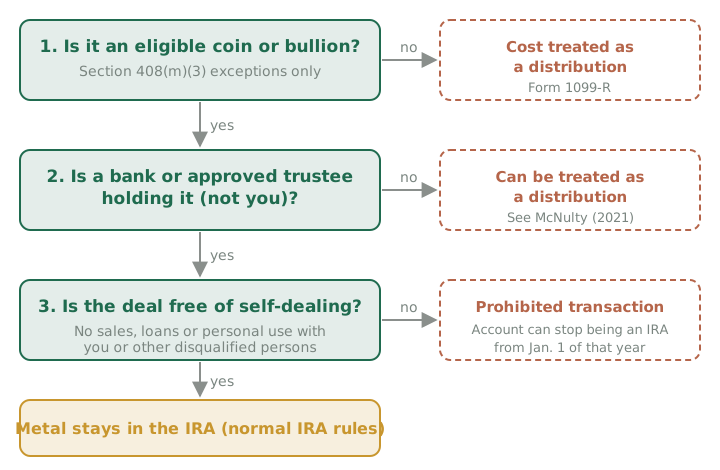
A Gold IRA follows the normal IRA rules plus two extra ones. It may hold only the coins and bullion the tax code exempts from the collectibles rule, and bullion must stay in the physical possession of a bank or IRS-approved trustee. Breaking these rules can turn the purchase into a taxable distribution.
There's no separate "Gold IRA law." A Gold IRA is an ordinary individual retirement account under section 408 of the Internal Revenue Code, so all the usual IRA rules apply. What makes it different is two extra rules: one about what it can buy, and one about who must hold it. A third set of rules, on self-dealing, matters more than usual because physical metal is easy to touch, move and use.
This page is the hub for those rules within our Gold IRA Guide. For how the account works day to day, see what is a Gold IRA? How precious metals IRAs work. The same rules apply to silver, platinum and palladium held in an IRA.
What are the Gold IRA rules at a glance?
| Rule | What it says | Main source |
|---|---|---|
| Eligible metals only | Buying a collectible is treated as a distribution of its cost. Only coins and bullion in the 408(m)(3) exceptions avoid that. | 26 U.S.C. 408(m) |
| Trustee custody | Qualifying bullion must be in the physical possession of a trustee: a bank or IRS-approved nonbank trustee | IRS IRA FAQs |
| Qualified custodian | The trustee or custodian must be a bank, federally insured credit union, savings and loan, or an IRS-approved entity | Publication 590-A |
| Contribution limits | $7,500 for 2026 across all your IRAs, plus $1,100 if you're 50 or older; never more than your taxable compensation | IR-2025-111 |
| Rollovers | 60 days to complete; one IRA-to-IRA rollover per 12 months; transfers between trustees aren't limited | IRS rollover page |
| No self-dealing | No selling to, borrowing from, pledging, or personally using IRA assets | IRS prohibited transactions |
| Distributions | 10% additional tax generally applies before 59½; RMDs from traditional IRAs generally start at 73 or 75, depending on birth year | Publication 590-B |
| Reporting | Distributions go on Form 1099-R; metal paid out in kind is reported at its fair market value | Form 1099-R instructions |
Rule 1: Which metals can a Gold IRA hold?
Under section 408(m), when an IRA acquires a collectible, the cost is treated as a distribution to you. Collectibles include art, rugs, antiques, gems, stamps, alcoholic beverages and, with limited exceptions, metals and coins (IRS). The IRS puts it bluntly: "The law does not permit IRA funds to be invested in life insurance or collectibles" (IRS IRA FAQs). The metals exceptions are what make a Gold IRA possible. That's the IRA collectibles rule in one sentence.
These are not treated as collectibles:
| Exception | What it means in practice |
|---|---|
| Certain gold, silver or platinum coins described in 31 U.S.C. 5112 (paragraphs (a)(7)-(10), (e) and (k)) | The U.S. Mint's American Eagle gold, silver and platinum coins |
| Coins issued under the laws of a U.S. state | State-issued coins |
| Gold, silver, platinum or palladium bullion "of a certain fineness" held by a bank or approved non-bank trustee | Bars and bullion coins that meet the fineness standard and stay with the trustee |
The statute sets that fineness by reference to commodity markets. Bullion must equal or exceed "the minimum fineness that a contract market ... requires for metals which may be delivered in satisfaction of a regulated futures contract" (26 U.S.C. 408(m)(3)(B)). The tax code itself doesn't print a fineness number. It points to the standards of regulated futures markets.
If an IRA buys something that isn't covered, the IRS says the acquisition is a distribution equal to the cost. It's reported on Form 1099-R, generally taxed as ordinary income, and may face a 10% additional tax before age 59½ (IRS).
Whether a specific product fits these exceptions is a question to settle with your custodian before you buy. Rare or "numismatic" coins deserve extra care: unless a coin fits one of the exceptions, collector value doesn't make it eligible. See IRA-eligible precious metals and bullion vs. numismatic coins.
Example: the IRA buys a coin that doesn't qualify
This is a made-up example to show the mechanics. Your traditional IRA pays $5,000 for a coin that isn't an American Eagle, isn't state-issued and doesn't meet the bullion test. Under section 408(m), that $5,000 is treated as distributed to you in the year of the purchase. The coin is still in the account, but for tax purposes the cost has left it. The IRS says that amount is reported on Form 1099-R and generally taxed as ordinary income. If you're under 59½, a 10% additional tax may apply on top (IRS). In other words, a $5,000 mistake can create a tax bill even though no money reached you.
Rule 2: Who has to hold the metal?
The bullion exception has a custody condition attached. The statute applies it "if such bullion is in the physical possession of a trustee" that meets the IRA trustee requirements (26 U.S.C. 408(m)(3)). The IRS says the same thing in its FAQs: there is an exception for certain highly refined bullion "provided it is in the physical possession of a bank or an IRS-approved nonbank trustee" (IRS IRA FAQs).
In McNulty v. Commissioner, 157 T.C. No. 10 (2021), IRA owners used IRA-owned LLCs to buy American Eagle coins and kept them in a safe at home. The Tax Court held that Mrs. McNulty "received taxable distributions from her self-directed IRA equal to the cost of the AE coins upon her receipt of the coins," and said that "an owner of a self-directed IRA may not take actual and unfettered possession of the IRA assets" (opinion). Mr. McNulty had conceded the same issue for his own IRA, and the court also upheld accuracy-related penalties.
Notice that the coins in that case were American Eagles, which are on the eligible list. Eligibility alone didn't protect them. Our reading of the case is that possession by the owner, not the type of coin, was the problem. That's an interpretation, and we cover it in depth in McNulty v. Commissioner. For setups that promise you can keep IRA metal yourself, see the home storage rules and checkbook IRA LLCs and precious metals.
Who can be your Gold IRA custodian?
Every IRA needs a trustee or custodian. Section 408(a)(2) requires the trustee to be a bank "or such other person who demonstrates to the satisfaction of the Secretary" that it will administer the account as the law requires (26 U.S.C. 408). IRS Publication 590-A says the trustee or custodian must be "a bank, a federally insured credit union, a savings and loan association, or an entity approved by the IRS to act as trustee or custodian."
The IRS publishes a list of approved nonbank trustees and custodians. Entities on it were approved under Treasury Regulation section 1.408-2(e) after a written application. Checking that list, or confirming a bank charter, is a simple first step before opening an account.
A Gold IRA usually involves three separate roles: the custodian that holds the account, the dealer that sells the metal, and the depository that stores it. See custodian, dealer and depository: who does what and our Gold IRA custodians hub.
How much can you contribute to a Gold IRA?
Contributions follow the regular IRA limits. For 2026, the limit is $7,500 across all your IRAs, plus a $1,100 catch-up at age 50 or older, for $8,600 in total (IR-2025-111). You also can't contribute more than your taxable compensation for the year (Publication 590-A).
Roth IRA contributions are also limited by income. For 2026, the phase-out range is $153,000 to $168,000 of modified adjusted gross income for singles and heads of household, and $242,000 to $252,000 for married couples filing jointly (IR-2025-111).
Two timing and limit rules catch people out:
- Deadline. Contributions for a year can be made during that year or "by the due date for filing your return for that year, not including extensions" (Publication 590-A).
- Excess contributions. Putting in too much costs money every year it stays. The IRS says: "Excess contributions are taxed at 6% per year for each year the excess amounts remain in the IRA" (IRS).
Rollover contributions aren't held to the annual limit. Publication 590-A says rollover contributions "can be more than this amount." Full detail, with examples, is in Gold IRA contribution limits for 2026.
Example: a 2026 contribution at age 55
Made-up numbers again. You're 55 and earn $40,000 in 2026. Your combined limit for all IRAs is $8,600 ($7,500 plus the $1,100 catch-up). If you've already put $3,000 into a Roth IRA for 2026, you have $5,600 left for your Gold IRA, not $8,600. If your taxable compensation were only $5,000, your limit would be $5,000, because the limit can't exceed compensation (Publication 590-A; IR-2025-111).
What are the rollover and transfer rules?
A Gold IRA can also be funded with money from another retirement account. There are three ways to move it (IRS):
| Method | How it works | Withholding | Limits |
|---|---|---|---|
| Direct rollover | Your employer plan pays the new IRA directly | None | — |
| Trustee-to-trustee transfer | Your IRA custodian sends the money to the new custodian | None | Not limited by the one-per-year rule |
| 60-day rollover | The money is paid to you and you redeposit it | 20% from employer plans; 10% from IRAs unless you elect out | 60 days; one IRA-to-IRA rollover per 12 months |
The 60-day clock is strict. You have 60 days from the date you receive the distribution to roll it over (same source). The one-rollover-per-year rule counts all your IRAs together, including traditional, Roth, SEP and SIMPLE IRAs. A second IRA-to-IRA rollover inside 12 months must be included in income, may face the 10% early withdrawal tax, and can be treated as an excess contribution taxed at 6% a year while it stays in the IRA (same source). The IRS says a direct trustee-to-trustee transfer "isn't a rollover," so the one-per-year limit doesn't apply to it (IRS).
If an IRA pays you metal instead of cash, the rule in Publication 590-A's IRA-to-IRA rollover section is that "the same property must be rolled over." The option to sell distributed property and roll over the proceeds appears in its section on employer plan distributions. That difference matters if you're thinking of taking coins out and putting money back. See rollover vs. transfer, the 60-day rollover rule and the Gold IRA Rollover Guide.
Example: counting 60 days
Say the check from your old IRA arrives on March 2. The IRS says: "You have 60 days from the date you receive an IRA or retirement plan distribution to roll it over to another plan or IRA" (IRS). Counting from March 3, the 60th day is May 1. If the money isn't in the new IRA by then, the distribution is generally taxable. The IRS may waive the 60-day requirement when you missed it because of circumstances beyond your control (IRS), but you can't count on a waiver. A trustee-to-trustee transfer avoids the clock altogether.
Which prohibited transactions matter most with metals?
IRAs can't be used for self-dealing. A prohibited transaction is a transaction between a retirement plan and a "disqualified person." For an IRA, the IRS says disqualified persons include the owner's fiduciary and family members: spouse, ancestor, lineal descendant, and any spouse of a lineal descendant (IRS). The statute behind this is 26 U.S.C. 4975. Among other things, it covers sales, exchanges, leases, loans and transfers of plan assets between a plan and a disqualified person.
The IRS gives these examples for IRAs (same source), shown here with how they could arise with metal:
| IRS example | How it could arise in a Gold IRA |
|---|---|
| Selling property to it | Selling coins you already own, or your parents' coins, to your IRA |
| Borrowing money from it | Taking a loan from the IRA, or having it lend to a family member |
| Using it as security for a loan | Pledging the IRA's bars or coins as collateral |
| Buying property for personal use (present or future) with IRA funds | Buying metal through the IRA to keep, wear or display at home |
The IRS collectibles page adds that buying a collectible for personal use may also be a prohibited transaction under section 4975 (IRS).
The penalty is severe. If the owner or a beneficiary engages in a prohibited transaction during the year, "the account stops being an IRA as of the first day of that year." It's then treated as distributing all its assets at fair market value on that day (IRS). This comes from section 408(e)(2), and custodians report it on Form 1099-R with code 5 in box 7a (Form 1099-R instructions). Section 4975 also sets excise taxes of 15% and, if uncorrected, 100% of the amount involved on disqualified persons. As we read section 4975(c)(3), an IRA owner whose account loses IRA status this way isn't also charged those excise taxes on that transaction. Edge cases here are complex, and a tax professional should look at any specific situation. More in prohibited transactions and self-dealing in a Gold IRA.
What are the rules for taking money or metal out?
Withdrawals follow the usual IRA rules:
- Age 59½. "A 10% additional tax generally applies if you withdraw or use IRA assets before you reach age 59½," unless an exception applies (Publication 590-B). See early withdrawals.
- Cash or metal. A custodian can sell metal inside the IRA and pay out cash, or distribute the metal itself (an "in-kind" distribution). For property, the custodian reports "the FMV of the securities or other property on the date of distribution" as the gross distribution (Form 1099-R instructions). FMV means fair market value. See in-kind distributions of metal.
Do required minimum distributions apply to a Gold IRA?
Yes, for traditional IRAs. You generally must start taking required minimum distributions (RMDs) when you reach age 73, with the first one due by April 1 of the following year. Roth IRAs have no RMDs while the owner is alive (IRS). The starting age is different for people who reach age 74 after 2032; see RMDs from a Gold IRA.
The RMD is based on the account balance at the end of the previous year, divided by a factor from an IRS life expectancy table (same source). For a metals IRA, the balance depends on how the metal is valued at year end; ask your custodian how it values holdings. Missing an RMD can mean a 25% excise tax on the amount not taken, reduced to 10% if the shortfall is withdrawn within two years (same source).
Two points are specific to metal-heavy accounts:
- You may not need to sell metal. If you own more than one traditional IRA, Publication 590-B says "you can total these minimum amounts and take the total from any one or more of the IRAs." That lets some owners take the RMD from a cash IRA instead.
- In-kind RMDs. Ask the custodian whether it can distribute coins or bars for an RMD and how it values them on the distribution date.
See RMDs for Gold IRAs and Gold IRA withdrawal rules.
What are the most common Gold IRA rule mistakes?
These are the patterns the rules above are built to catch:
- Buying a coin that doesn't qualify. Collector value doesn't make a coin eligible. The cost becomes a distribution (section 408(m)).
- Taking possession of IRA metal. Storing it at home, even through an IRA-owned LLC, was a taxable distribution in McNulty (opinion).
- Selling your own metal to the IRA. Selling property to your IRA is a prohibited transaction (IRS).
- Missing the 60-day window, or doing two rollovers in 12 months. Both can make the money taxable (IRS).
- Contributing more than the limit. The 6% tax repeats each year the excess stays in (IRS).
- Forgetting RMDs on an illiquid account. Plan ahead if the IRA holds mostly metal (IRS).
Sales pitches that blur these rules are a known warning sign. Regulators warn about precious metals fraud (CFTC; FINRA). See Gold IRA scams.
How are Gold IRA transactions reported?
The custodian handles most reporting. Distributions, including deemed distributions from collectible purchases, are reported on Form 1099-R (IRS). Property distributions are reported at fair market value on the date of distribution, and a prohibited transaction that ends IRA status uses code 5 (Form 1099-R instructions). Additional taxes on missed RMDs are reported on Form 5329 (IRS RMD page). More in Gold IRA reporting. Recent law changes, such as the RMD age, are covered in SECURE Act and SECURE 2.0 changes that affect Gold IRAs.
Related questions
Is a Gold IRA legal?
Yes. Section 408(m)(3) exempts certain coins and bullion from the collectibles rule, so an IRA can hold them (26 U.S.C. 408). The account must still meet the eligibility, custody and self-dealing rules described above.
Who regulates Gold IRAs?
The IRS enforces the tax rules. The CFTC and FINRA publish warnings about precious metals fraud. See Gold IRA scams.
Does the IRS approve Gold IRA companies?
The IRS approves nonbank entities to act as IRA trustees or custodians and publishes the list. That approval is about the custodian, not about a dealer or the products it sells.
Can I keep my Gold IRA coins at home?
The IRS says qualifying bullion must be "in the physical possession of a bank or an IRS-approved nonbank trustee" (IRS IRA FAQs). In McNulty, keeping IRA coins at home led to taxable distributions. See home storage rules.
Do the same rules apply to a Silver IRA?
Yes. The 408(m)(3) exceptions cover gold, silver, platinum and palladium bullion, plus the listed U.S. Mint and state coins. The custody, contribution and distribution rules are the same.
Guides in this section
- The IRA Collectibles Rule: IRC 408(m) and Its Metals ExceptionHow IRC 408(m) treats collectibles as distributions, the statutory exception for certain coins and bullion, and what happens if an IRA buys a collectible.
- Gold IRA Contribution Limits for 20262026 IRA contribution limits that apply to Gold IRAs: $7,500 plus a $1,100 catch-up at 50+, how the combined limit works, and rollovers vs contributions.
- Prohibited Transactions and Self-Dealing in a Gold IRAWhich dealings with a Gold IRA are prohibited under IRC 4975, who counts as a disqualified person, and the consequences for the IRA.
- Checkbook IRA LLCs and Precious Metals: What the Courts SaidHow IRA-owned LLC structures interact with precious-metals custody rules, and what the Tax Court held in McNulty v. Commissioner (2021).
- McNulty v. Commissioner (2021): The Home-Storage Gold IRA CaseA plain-English summary of McNulty v. Commissioner, 157 T.C. No. 10 (2021), sourced to the opinion, and what it means for home-storage marketing.
- Gold IRA Reporting: Annual Valuation, Form 5498 and Form 1099-RWhat custodians report for Gold IRAs - year-end fair market value on Form 5498, distributions on Form 1099-R - and what account owners need to keep.
- SECURE Act and SECURE 2.0 Changes That Affect Gold IRAsThe SECURE Act and SECURE 2.0 provisions most relevant to Gold IRA owners: RMD ages, inherited IRA 10-year rule, catch-up and penalty changes.
Sources
- Retirement topics - IRA contribution limits, Internal Revenue Service. Accessed Invalid Date.
- 26 U.S.C. 408, Individual retirement accounts, U.S. Government Publishing Office (govinfo). Accessed Invalid Date.
- 26 U.S. Code 4975, Tax on prohibited transactions, Legal Information Institute, Cornell Law School. Accessed Invalid Date.
- Investments in collectibles in individually directed qualified plan accounts, Internal Revenue Service. Accessed Invalid Date.
- Retirement plans FAQs regarding IRAs, Internal Revenue Service. Accessed Invalid Date.
- Publication 590-A (2025), Contributions to Individual Retirement Arrangements (IRAs), Internal Revenue Service. Accessed Invalid Date.
- Publication 590-B (2025), Distributions from Individual Retirement Arrangements (IRAs), Internal Revenue Service. Accessed Invalid Date.
- Retirement topics - Prohibited transactions, Internal Revenue Service. Accessed Invalid Date.
- Approved nonbank trustees and custodians, Internal Revenue Service. Accessed Invalid Date.
- IR-2025-111: 401(k) limit increases to $24,500 for 2026, IRA limit increases to $7,500, Internal Revenue Service. Accessed Invalid Date.
- Rollovers of retirement plan and IRA distributions, Internal Revenue Service. Accessed Invalid Date.
- IRA one-rollover-per-year rule, Internal Revenue Service. Accessed Invalid Date.
- Retirement topics - Required minimum distributions (RMDs), Internal Revenue Service. Accessed Invalid Date.
- Instructions for Forms 1099-R and 5498 (2026), Internal Revenue Service. Accessed Invalid Date.
- McNulty v. Commissioner, 157 T.C. No. 10 (2021), United States Tax Court (opinion copy hosted by KPMG). Accessed Invalid Date.
- Precious Metal Frauds, Commodity Futures Trading Commission. Accessed Invalid Date.
- Investor Bulletin: 10 Things to Ask Before Buying Physical Gold, Silver or Other Metals, FINRA and CFTC. Accessed Invalid Date.
This guide is general education, not personalized financial, tax or legal advice. See our financial disclaimer, editorial policy and advertising disclosure.