What Is a Gold IRA? How Precious Metals IRAs Work
A Gold IRA is a self-directed individual retirement account that holds physical gold, and often silver, platinum or palladium, instead of only stocks, bonds or funds. It follows normal IRA tax rules, but the metal must be IRS-eligible and held by a bank or IRS-approved custodian, not by you.
"Gold IRA" isn't a separate kind of account in the tax code. It's the everyday name for a self-directed IRA whose custodian lets it buy physical precious metals. The same account is often called a precious metals IRA, and when it holds mostly silver, a Silver IRA. The rules on this page apply to gold and silver alike.
This guide explains what a Gold IRA is, how the pieces fit together, what the IRS allows, what it costs and what can go wrong. It is the starting point of our wider Gold IRA guide, with deeper pages linked in each section.
How a Gold IRA works
Three different businesses are usually involved. Knowing who does what is the most useful thing you can learn before you start.
| Role | What it does | Who it answers to |
|---|---|---|
| Custodian (or trustee) | Holds the IRA legally, keeps records, sends IRS forms, and pays for metal on the IRA's behalf | Must be a bank, federally insured credit union, savings and loan, or an entity approved by the IRS |
| Dealer | Sells metal to the IRA and may buy it back later | Is a business selling a product; not usually a financial adviser |
| Depository | Stores the metal in a vault for the custodian | Works under its agreement with the custodian |
The IRS describes the custodian requirement in Publication 590-A: the trustee or custodian must be "a bank, a federally insured credit union, a savings and loan association, or an entity approved by the IRS to act as trustee or custodian."
The money flows like this:
- You open a self-directed IRA with a custodian that handles precious metals.
- You fund it by contribution, rollover or transfer from another retirement account.
- You choose eligible metal from a dealer and agree on a price.
- The custodian pays the dealer from your IRA.
- The metal ships to a depository, where it is stored for your IRA.
For the step-by-step version, see how a Gold IRA works and how to open a Gold IRA. Our guide to the custodian, dealer and depository roles explains each party in more depth, and the Gold IRA custodians section covers how custodians work. Before opening an account, check who can open a Gold IRA.
What the life of a Gold IRA looks like
The account has a beginning, a long middle and an end. The picture below shows the five stages most owners go through.
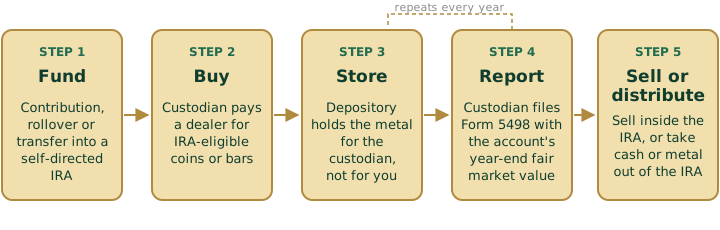
- Fund. Money arrives by contribution, rollover or transfer (see the worked example below).
- Buy. The custodian pays a dealer for eligible coins or bars.
- Store. A depository holds the metal for the custodian.
- Report. Each year the custodian files Form 5498, which includes a box for the fair market value of the account at year end (IRS Instructions for Forms 1099-R and 5498). That value matters later for required minimum distributions.
- Sell or distribute. The IRA can sell metal back to a dealer and pay out cash, or hand you the metal itself. Either way, money or metal leaving the IRA is a distribution under the normal IRA tax rules.
What a Gold IRA can hold
Most coins and metals are collectibles in the eyes of the tax code, and an IRA that buys a collectible is treated as if it paid that money out to you. The IRS explains that the amount treated as distributed "is the cost of the collectible at the time it is acquired," is reported on Form 1099-R, and is generally taxed as ordinary income (IRS; see also the IRS IRA FAQs).
There are narrow exceptions. According to the same IRS page, these are not treated as collectibles:
- certain gold, silver or platinum coins described in 31 U.S.C. 5112 (under 26 U.S.C. 408(m)(3), these are coins described in specific paragraphs of that law, such as the U.S. Mint's American Eagles)
- coins issued under the laws of a U.S. state
- gold, silver, platinum or palladium bullion "of a certain fineness if a bank or approved non-bank trustee keeps physical possession of it"
That's why Gold IRA dealers sell bullion coins and bars, not rare or "collector" coins. Our guide to IRA-eligible precious metals covers which products qualify and how to check one, and the collectibles rule page explains the tax rule behind it.
What does "IRA-eligible" mean?
"IRA-eligible" is shorthand used by dealers and custodians. In plain terms it means a product fits one of the exceptions above, so the IRA can buy it without the purchase being treated as a payout to you. It is not a stamp or a certificate. It comes down to two questions.
1. Is the product itself covered by an exception? Either it is one of the specific coins named in the law, or it is bullion that meets the required purity. The IRS IRA FAQs put it this way: gold and other bullion are collectibles, with an exception for "certain highly refined bullion." Our page on fineness and purity explains how purity is measured.
2. Is it held the right way? The bullion exception only works while the metal is "in the physical possession of a bank or an IRS-approved nonbank trustee," according to the same FAQ. The FAQ adds that the rule still applies when an IRA-owned LLC buys the bullion.
So a coin can be "eligible" in a dealer's catalogue and still cause a tax problem if the IRA doesn't hold it properly. And a rare or graded coin can be genuine gold and still not qualify. See coins that are not IRA-eligible and bullion vs numismatic coins for common examples.
Who holds the gold
Not you. The IRS says the bullion exception applies only while the metal "is in the physical possession of a bank or an IRS-approved nonbank trustee" (IRS IRA FAQs). In practice the custodian arranges storage at a depository.
Some promoters sell "home storage" Gold IRAs. The U.S. Tax Court looked at one such setup in McNulty v. Commissioner (2021) and held that taking personal possession of IRA-bought coins, kept at home through an IRA-owned LLC, was a taxable distribution. Read whether you can store Gold IRA metals at home before you agree to anything like that. For how title, custody and control are split, see do you own the gold in your IRA?
Traditional, Roth and other types
A Gold IRA can be any of the usual IRA types. The tax treatment comes from the type, not from the metal.
| Type | Money going in | Money coming out |
|---|---|---|
| Traditional Gold IRA | May be tax-deductible | Generally taxed as ordinary income |
| Roth Gold IRA | After-tax money | Qualified distributions are tax-free |
| SEP Gold IRA | Employer contributions only; "Any employer, including self-employed individuals, can establish a SEP" (IRS SEP FAQs) | "A SEP-IRA account is a traditional IRA and follows the same investment, distribution, and rollover rules as traditional IRAs" (IRS SEP FAQs) |
IRS Publication 590-B explains that Traditional IRA distributions are generally taxed as ordinary income. A Roth distribution is "qualified," and tax-free, when two things are true: at least five years have passed since the start of the first year you contributed to any Roth IRA, and the payment is made after you reach 59½, because you are disabled, to a beneficiary after your death, or for a first-time home purchase (up to a $10,000 lifetime limit).
Other account types have their own pages: the SIMPLE IRA and precious metals, whether you can hold gold in a 401(k), the solo 401(k) and precious metals, and whether you can buy gold in a Fidelity, Schwab or Vanguard IRA. See also our guide to the SEP Gold IRA for self-employed people and business owners.
How you fund a Gold IRA
There are three ways in. They follow different rules.
| Method | Annual limit? | Key rule |
|---|---|---|
| Contribution (new money) | Yes: $7,500 for 2026, plus $1,100 if 50 or older | Can't exceed your taxable compensation for the year; must be in cash |
| Direct rollover from a workplace plan such as a 401(k) | No | The plan pays the new IRA directly, with no tax withheld |
| Indirect rollover (paid to you first) | No | You have 60 days to deposit it; plan payouts have 20% withheld |
| Trustee-to-trustee transfer from another IRA | No | Not counted under the one-rollover-per-year rule |
Sources: the 2026 limits come from IR-2025-111. The compensation cap, the cash rule and the note that "rollover contributions" can exceed the yearly amount come from Publication 590-A. The rollover rules come from the IRS page on rollovers of retirement plan and IRA distributions.
Publication 590-A also notes that the old rule barring Traditional IRA contributions from age 70½ on was repealed for tax years after 2019. People of any age can contribute if they have taxable compensation.
A worked example
Take a 56-year-old with wages well above the limit and $120,000 in a former employer's 401(k). These figures are for illustration only.
- New contributions in 2026. The most this person can put in across all their IRAs is $7,500 + $1,100 = $8,600. If their wages for the year were lower than that, the cap would be their wages instead.
- Direct rollover of the 401(k). If the plan allows it, the plan sends the full $120,000 to the Gold IRA custodian. Nothing is withheld, and the annual limit doesn't apply.
- Indirect rollover of the 401(k). If the plan pays the person instead, it must withhold 20%, which is $24,000. They receive $96,000. To roll over the full $120,000 within 60 days, they would have to add $24,000 from other savings. Any amount not rolled over in time becomes taxable, and the IRS says the 10% additional tax on early distributions may also apply unless an exception fits.
The direct route avoids the withholding problem. That's why the 401(k) to Gold IRA rollover guide and the page on direct vs indirect rollovers go through it in detail. Our page on Gold IRA contribution limits covers the contribution side.
Gold IRA vs owning gold yourself vs a gold fund
A Gold IRA is not the only way to hold gold. The table compares three common routes. It describes how each one works, not which is better. That depends on your situation.
| Gold IRA (physical metal) | Gold you own personally | Gold fund shares in a regular IRA | |
|---|---|---|---|
| What you own | The IRA owns the metal; you own the IRA | You own the coins or bars | Shares of an exchange-traded product |
| Who stores it | A depository, for the custodian | You (home, safe or vault service) | The fund, as described in its prospectus |
| Ongoing costs | Custodian and storage fees, plus dealer premiums and spreads | Your own storage and insurance, plus dealer premiums and spreads | The fund's operating expenses and any brokerage commissions |
| Selling | Dealer bid, then custodian settles | Sell to a dealer or buyer yourself | Traded on an exchange through your broker |
| Tax while held | None, under normal IRA rules | None until you sell | None, under normal IRA rules |
| Tax on the way out | IRA distribution rules (ordinary income for Traditional; tax-free if a qualified Roth distribution) | Long-term gains on collectibles taxed at up to 28% | IRA distribution rules |
Sources: the 28% figure is from IRS Topic 409, which says "Net capital gains from selling collectibles (such as coins or art) are taxed at a maximum 28% rate". Under the same page, a gain is long-term only if you held the asset for more than one year. Investor.gov defines exchange-traded products as "investment products that are listed and traded on national securities exchanges," a group that includes exchange-traded commodity trusts (Investor.gov). For ETFs, the SEC suggests you understand "annual operating fees and expenses" and any brokerage commissions, and read the prospectus (Investor.gov ETF bulletin).
For a deeper look, see IRA gold vs taxable gold and alternatives to a Gold IRA.
Why people choose a Gold IRA
People who open Gold and Silver IRAs usually give a few reasons:
- Physical assets. The IRA owns real metal rather than a promise or a fund share.
- Diversification. Gold and silver may behave differently from stocks and bonds, so some savers hold a portion of their retirement money in metal.
- Normal IRA tax treatment. Gains inside the account aren't taxed each year, and a Roth version can pay out tax-free under the Roth rules.
Our Gold IRA pros and cons guide weighs these against the costs and risks below.
What it costs
A Gold IRA usually costs more to run than a regular brokerage IRA. Expect some combination of:
- a custodian setup fee and an annual fee
- a storage fee charged by or through the depository
- the dealer's premium over the metal's spot price when you buy
- the spread when you sell, since dealers buy back below the price they sell at
Regulators warn that markups, commissions and spreads can be very large. The CFTC describes a complaint in which "a gold dealer and IRA custodian charged nearly $150,000 in commissions and fees to a customer who rolled over a $300,000 retirement account" (CFTC). See Gold IRA fees and costs and try the break-even calculator.
The main risks
- Price risk. Gold and silver prices can fall. The CFTC says "precious metals prices are just as volatile as those of other assets" (CFTC).
- No income. Metal doesn't pay interest or dividends, so costs come straight out of any gain.
- Liquidity. Selling means getting a dealer bid, then waiting for the custodian to settle.
- Sales pressure. The CFTC notes that precious metals salespeople "typically are not qualified or legally allowed to provide investment advice."
The Gold IRA risks guide covers each of these in detail, and our Gold IRA scams section explains common sales tactics to watch for.
What happens when you retire and take money out
Metal in an IRA has to leave the account in one of two ways.
- Sell inside the IRA, then withdraw cash. The custodian arranges a sale to a dealer, and the cash is paid out to you. See selling gold in an IRA.
- Take the metal itself (an in-kind distribution). The coins or bars are shipped to you. The custodian reports "the FMV of the securities or other property on the date of distribution" on Form 1099-R (IRS instructions). For a Traditional IRA, that value is generally taxed as ordinary income even though you received metal, not cash. See in-kind distributions.
Withdrawals before 59½ have an extra cost. Publication 590-B says "A 10% additional tax generally applies if you withdraw or use IRA assets before you reach age 59½," with listed exceptions. See early withdrawals.
Required minimum distributions with metal
Traditional, SEP and SIMPLE IRAs must start paying out required minimum distributions (RMDs) by "April 1 of the year following the calendar year in which you reach age 73" (IRS RMD page). Roth IRAs have no RMDs while the owner is alive. The starting age is different for people who reach age 74 after 2032; see RMDs from a Gold IRA.
The IRS says an RMD is generally figured "by dividing the prior December 31 balance of that IRA or retirement plan account by a life expectancy factor" that it publishes in Publication 590-B (IRS RMD FAQs). For a Gold IRA, that balance includes the value of the metal.
Metal can make RMDs awkward. You can't sell a fraction of a bar, and a sale takes time to settle. Options people use include:
- selling enough metal early in the year to cover the RMD in cash
- taking coins or bars out in kind (ask the custodian how it values these and counts them toward the RMD)
- taking the amount from a different Traditional IRA. Publication 590-B says you figure each IRA's RMD separately, "However, you can total these minimum amounts and take the total from any one or more of the IRAs."
Missing an RMD is expensive. The IRS RMD page lists "a 25% excise tax on the amount not distributed as required (10% if withdrawn within 2 years)." Our Gold IRA RMD guide and Gold IRA withdrawals section go further.
What happens if you inherit a Gold IRA
The person who inherits a Gold IRA inherits an IRA. The metal stays with the custodian until it is sold or distributed. The main rules come from the IRS page Retirement topics - Beneficiary:
| Beneficiary | Main options (per the IRS) |
|---|---|
| Spouse | Can treat the account as their own (Pub. 590-B), keep it as an inherited account, or roll it over into their own IRA |
| Other "eligible designated beneficiaries" (a minor child of the owner; a disabled or chronically ill person; someone not more than 10 years younger than the owner) | Special payout options |
| Other individual beneficiaries | Generally must follow the 10-year rule (for owners who died in 2020 or later), emptying the account by the end of the tenth year after the death |
A beneficiary who isn't the spouse can't add new contributions to an inherited IRA or roll it into their own IRA. Taxable distributions count as the beneficiary's income. Distributions to a beneficiary after the owner's death are an exception to the 10% additional tax (Publication 590-B).
These rules have many details and depend on the date of death and the type of beneficiary. A tax professional can help. See inheriting a Gold IRA and naming Gold IRA beneficiaries.
Common Gold IRA mistakes
| Mistake | What the rules say |
|---|---|
| Keeping IRA metal at home or in your own safe deposit box | Bullion must be in the physical possession of a bank or IRS-approved nonbank trustee (IRS FAQs); in McNulty, personal possession was held to be a taxable distribution |
| Buying collectible or rare coins in the IRA | The cost is treated as distributed, and "you may have to pay a 10% additional tax on early distributions" (IRS FAQs) |
| Missing the 60-day rollover deadline | The amount becomes taxable income and may face the 10% additional tax (IRS rollovers page) |
| Doing two IRA-to-IRA rollovers within 12 months | "You can make only one rollover from an IRA to another (or the same) IRA in any 12-month period"; trustee-to-trustee transfers don't count |
| Taking a 401(k) payout yourself to "roll it over later" | The plan must withhold 20%, which you must make up from other money to roll over the full amount |
| Forgetting an RMD because the account holds only metal | 25% excise tax on the shortfall, 10% if withdrawn within 2 years (IRS RMD page) |
More detail is in Gold IRA rollover mistakes, the 60-day rule and Gold IRA tax mistakes.
How to check a Gold IRA offer
FINRA and the CFTC suggest questions every buyer should ask, including what the spot price is, what the spread is and what fees and commissions you'll pay (FINRA). Before you sign anything:
- Ask for the price per ounce and the spot price on the same day, in writing.
- Ask what the dealer would pay to buy the same metal back today.
- Get the custodian's and depository's fee schedules.
- Confirm the metal is IRA-eligible and will be held by the custodian.
- Search the company's name with "CFTC" and your state securities regulator.
Our guides on how to evaluate a Gold IRA company and scam warning signs go further. The Gold IRA due-diligence checklist puts these questions in one place.
Related questions
Is a Gold IRA legal?
Yes. IRAs are allowed to hold certain coins and bullion under the exception in section 408(m) of the tax code, as long as the rules on eligibility and custody are followed. See Gold IRA rules.
Is a precious metals IRA the same thing?
Yes. "Gold IRA," "precious metals IRA" and "Silver IRA" all describe a self-directed IRA holding eligible physical metal. The name usually reflects what it mostly holds.
Can I move my 401(k) into a Gold IRA?
It depends on your plan's rules, so ask the plan administrator what it allows and when. See the 401(k) to Gold IRA rollover guide.
Can I roll over metal I already own into a Gold IRA?
Not coins you bought yourself. New contributions must be in cash, according to Publication 590-A. Only rollover contributions are exempt from the cash rule, and those must come from a retirement account, not from metal you bought on your own.
Guides in this section
- How a Gold IRA Works: Dealer, Custodian and Depository RolesThe three parties in every Gold IRA - dealer, custodian and depository - what each does, how money and metal move, and where fees come from.
- How to Open a Gold IRA: Step-by-Step Process and ChecklistThe steps to open a Gold IRA: choosing a custodian, funding by contribution, rollover or transfer, selecting eligible metals and approving storage.
- Who Can Open a Gold IRA? Eligibility and Age RulesWho can open and fund a Gold IRA: contribution eligibility, earned income, Roth income limits, age rules, and funding by rollover instead of contribution.
- What Is a Self-Directed IRA (SDIRA)?A self-directed IRA lets you hold assets like physical metals through a specialized custodian. What it is, what it can hold and the extra rules.
- Traditional Gold IRA: Tax Treatment and RulesHow a Traditional Gold IRA works: pre-tax funding, deductibility limits, tax-deferred holding, taxable withdrawals and required minimum distributions.
- Roth Gold IRA: How It Works, Rules and WithdrawalsA Roth Gold IRA holds eligible metals with after-tax money. Contribution limits, income limits, the five-year rule and qualified withdrawals.
- SEP Gold IRA for Self-Employed People and Business OwnersHow SEP IRAs can hold eligible precious metals through a self-directed custodian, employer contribution rules, and moving an existing SEP.
- SIMPLE IRA and Precious Metals: Rules and the Two-Year RestrictionWhether SIMPLE IRA money can hold physical metals, the two-year participation restriction and the 25% additional tax risk when moving funds early.
- Gold IRA Pros and Cons: Benefits, Drawbacks and Trade-OffsAn evidence-based look at Gold IRA benefits and drawbacks, including costs, liquidity, tax treatment and how it differs from other ways to own gold.
- Alternatives to a Gold IRA: ETFs, Mining Stocks and Physical GoldOther ways to get gold exposure in or out of retirement accounts - ETFs, funds, mining stocks and physical bullion - and how costs and rules compare.
- Do You Own the Gold in Your IRA? Title, Custody and ControlHow title and custody work in a Gold IRA: the IRA owns the metal, the custodian holds it for your benefit, and what that means for access and control.
- Can You Hold Gold in a 401(k)? Plan Options ExplainedWhy most 401(k) plans do not offer physical metals, what gold exposure plans may offer, and when people consider rolling eligible money to an IRA.
- Solo 401(k) and Precious Metals: Rules and StorageHow the collectibles rule applies to self-directed solo 401(k) plans, storage and trustee considerations, and how this differs from a Gold IRA.
- Can You Buy Gold in a Fidelity, Schwab or Vanguard IRA?What mainstream brokerage IRAs typically allow for gold exposure, verified from each firm's own documentation, and when a self-directed custodian is needed.
- Gold IRA Due-Diligence Checklist (Printable)A printable checklist covering eligibility of metals, fee disclosures, custodian and depository verification, buyback terms and sales-pressure red flags.
Sources
- Retirement plans FAQs regarding SEPs, Internal Revenue Service. Accessed Invalid Date.
- Investments in collectibles in individually directed qualified plan accounts, Internal Revenue Service. Accessed Invalid Date.
- Retirement plans FAQs regarding IRAs, Internal Revenue Service. Accessed Invalid Date.
- Publication 590-A (2025), Contributions to Individual Retirement Arrangements (IRAs), Internal Revenue Service. Accessed Invalid Date.
- Publication 590-B (2025), Distributions from Individual Retirement Arrangements (IRAs), Internal Revenue Service. Accessed Invalid Date.
- IR-2025-111: 401(k) limit increases to $24,500 for 2026, IRA limit increases to $7,500, Internal Revenue Service. Accessed Invalid Date.
- Rollovers of retirement plan and IRA distributions, Internal Revenue Service. Accessed Invalid Date.
- Retirement topics - Required minimum distributions (RMDs), Internal Revenue Service. Accessed Invalid Date.
- Retirement plan and IRA required minimum distributions FAQs, Internal Revenue Service. Accessed Invalid Date.
- Retirement topics - Beneficiary, Internal Revenue Service. Accessed Invalid Date.
- Instructions for Forms 1099-R and 5498 (2026), Internal Revenue Service. Accessed Invalid Date.
- Topic no. 409, Capital gains and losses, Internal Revenue Service. Accessed Invalid Date.
- 26 U.S.C. 408, Individual retirement accounts, U.S. Government Publishing Office (govinfo). Accessed Invalid Date.
- McNulty v. Commissioner, 157 T.C. No. 10 (Nov. 18, 2021), opinion text, United States Tax Court (copy hosted by KPMG). Accessed Invalid Date.
- Precious Metal Frauds, Commodity Futures Trading Commission. Accessed Invalid Date.
- Investor Bulletin: 10 Things to Ask Before Buying Physical Gold, Silver or Other Metals, FINRA and CFTC. Accessed Invalid Date.
- Exchange-Traded Products (ETPs), U.S. Securities and Exchange Commission (Investor.gov). Accessed Invalid Date.
- Updated Investor Bulletin: Exchange-Traded Funds (ETFs), U.S. Securities and Exchange Commission (Investor.gov). Accessed Invalid Date.
This guide is general education, not personalized financial, tax or legal advice. See our financial disclaimer, editorial policy and advertising disclosure.