Dealer Premiums, Markups and Spreads in Gold IRAs
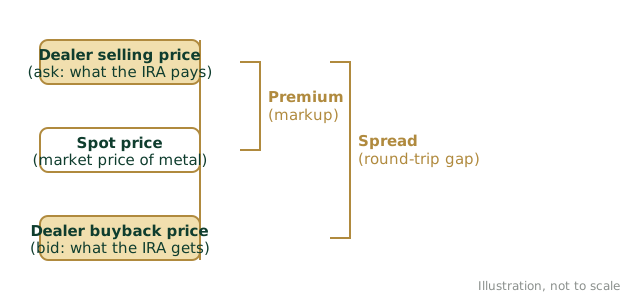
A dealer sells metal above the spot price and buys it back below spot. The amount above spot is the premium, or markup; the gap between the dealer's selling and buyback prices is the spread. Regulators say spreads vary widely, so get the price, spot price and buyback price in writing before you buy.
When a Gold IRA buys coins or bars, part of what you pay is not metal. It is the dealer's premium. When the IRA later sells, the dealer pays less than the market price. Together, these two gaps can be a large part of what a Gold IRA costs, on top of the account fees covered in our guide to Gold IRA Fees and Costs. This page explains the terms, shows how to work out what you are really paying, and lists what to ask for in writing.
What do spot price, premium, markup and spread mean?
These words come up in every metals quote. Here is what each one means.
| Term | What it means | Who sets it |
|---|---|---|
| Spot price | The market price for one ounce of the metal for immediate delivery | The market |
| Ask (selling price) | What the dealer charges you per coin or bar | The dealer |
| Premium or markup | The amount of the ask above the metal's spot value | The dealer |
| Bid (buyback price) | What the dealer will pay to buy the same item back | The dealer |
| Spread | The gap between the dealer's selling price and its buyback price | The dealer |
| Melt value | Pure metal content times the spot price | Arithmetic |
The CFTC defines the spot price as "the cash price for immediate delivery of physical metal," and says it "should be easy to get from financial news or quote providers" (CFTC).
The CFTC uses "markup" and "premium" for the same thing. The CFTC's example: "If the current spot price is $2,000, for example, a half-ounce coin would be worth $1,000, plus the dealer's markup or 'premium'" (CFTC). That $2,000 figure is the CFTC's illustration, not a market quote.
The spread follows from how dealers price both sides. In the CFTC's words, "A dealer will always sell metal above the spot price and buy it back below the spot price" (CFTC). FINRA's version of the same bulletin adds: "The difference between the dealer's buy and sell price is known as the dealer's spread" (FINRA).
How big can dealer markups and spreads be?
No regulator source we reviewed gives a "typical" Gold IRA markup, so we don't quote one. What regulators do say is that the range is wide:
- The CFTC's IRA scam fact sheet says the spread "can range anywhere from 30 to 300 percent or more" (CFTC, Lies Versus Facts).
- The CFTC's ten-questions advisory says some fraudulent dealers have charged spreads of more than 300 percent, while other dealers may charge less than 20 percent (CFTC).
- On collector coins, the CFTC says most "Numismatic" coins "typically carry higher markups than bullion and are much less liquid" (CFTC). See bullion vs. numismatic coins.
The cost depends on the product, the dealer and the day. The only way to know yours is to ask for it on the exact item, in writing.
What have regulators seen in Gold IRA rollovers?
The CFTC's Precious Metal Frauds page describes one complaint:
"In one recent complaint, a gold dealer and IRA custodian charged nearly $150,000 in commissions and fees to a customer who rolled over a $300,000 retirement account into a gold IRA." (CFTC)
The CFTC's advisory describes the same kind of case as an allegation: "In one case, a customer rolled over a $300,000 IRA, and the dealer allegedly took $150,000 in fees and commissions" (CFTC). The CFTC pages don't name the parties or report a court finding. Treat it as an allegation in one complaint, not a typical cost.
FINRA's bulletin also reports that "Over the past decade, the CFTC has charged numerous companies with selling overpriced precious metals to customers, for an alleged total of more than $500 million in fraudulent sales" (FINRA). For the warning signs, see overpriced coin upsells.
How to work out your effective cost
You need four numbers, all taken at the same time:
- Spot price per ounce.
- Dealer's price per item, plus the item's pure metal weight.
- Dealer's buyback price for the same item today.
- Account fees: custodian, storage, insurance and transaction fees for the years you plan to hold.
Then:
- Melt value = ounces of pure metal x spot price. Our melt value calculator does this for common coins and bars. Purity matters; see fineness and purity.
- Premium % = (dealer's price - melt value) / melt value.
- Spread = dealer's price - buyback price.
- Round-trip cost = what you paid - what you would get selling back today.
The round-trip cost is the clearest number. It is what you would lose if you bought and sold the same day, with no change in the spot price. Our tool to check a dealer quote against spot runs these steps for you.
Worked example: break-even on a hypothetical purchase
All numbers here are made up for easy arithmetic. They are not current market prices, and they are not typical or average dealer charges.
Suppose an IRA puts $50,000 into one-ounce bullion coins:
| Item | Hypothetical figure |
|---|---|
| Spot price | $1,000 per ounce |
| Dealer's price | $1,080 per coin (8% over spot) |
| Coins bought | about 46.3 ($50,000 / $1,080) |
| Melt value on day one | about $46,296 |
| Dealer's buyback price | $970 per coin (3% under spot) |
| Proceeds if sold right away | about $44,907 |
| Round-trip cost | about $5,093 (10.2% of $50,000) |
Break-even ignoring account fees. To get the $50,000 back, the buyback price per coin must reach about $1,080 ($50,000 / 46.3 coins). If the dealer keeps paying 3% under spot, spot must reach about $1,113, a rise of about 11.3%.
Break-even including account fees. Now add a hypothetical $300 a year in custodian and storage fees for five years, or $1,500. You now need $51,500 back. Spot must reach about $1,147, a rise of about 14.7%, or roughly 2.8% a year over five years.
This is the CFTC's point: "The higher the spread, the more the spot price would have to climb simply for you to break even" (CFTC, Lies Versus Facts). It also warns that transaction, storage and insurance costs "may require you to earn well above the rate of inflation just to break even" (CFTC).
Try your own quote in the total cost and break-even calculator. The example says nothing about where gold prices will go. Spot can fall as well as rise, and the break-even can move further away.
What to get in writing before the IRA buys
The CFTC says to "Ask for all fees, costs, commissions, and agreed retail price in writing BEFORE signing a sales agreement or turning over any money" (CFTC). A written breakdown should show:
- the exact product, its metal content and the quantity
- the price per item and the total
- the spot price at the time of the quote, with the time
- any commission or fee charged on top of the price
- the dealer's current buyback price for the same item
The CFTC also suggests asking "how much you would receive if you had to sell back the metal tomorrow" (CFTC). Buyback terms are a topic of their own; see Gold IRA Buyback Policies and Liquidation Costs.
Common mistakes with premiums and spreads
- Comparing only account fees. A low setup fee means little if the metal is priced far above spot. Compare the round-trip cost.
- Ignoring the buyback side. The premium is only half the spread. Ask what the dealer would pay.
- Treating "free" metal as free. FINRA suggests you "Ask how the company earns its profit, especially if it appears to be giving away precious metal or offering other big freebies" (FINRA). See free silver and fee waiver promotions.
- Being steered to collector coins. The CFTC says that if someone tries to sell you higher-priced "collectibles" for an IRA, the coins likely aren't rare (CFTC, Lies Versus Facts). Only certain coins and bullion qualify for an IRA under section 408(m); see IRA-eligible precious metals.
- Using an old spot price. Spot moves during the day. Compare the quote with spot at the same moment.
Related questions
Why are Gold IRA costs higher than regular IRA costs?
FINRA notes that self-directed IRA fees are typically higher than fees on directed IRAs (FINRA). A Gold IRA also pays to store physical metal (see Gold IRA Storage Fees), and each purchase and sale carries a dealer premium and spread.
Is the premium the same as a commission?
Not always. A premium is built into the price. A commission or fee may be charged on top. The CFTC complaint above refers to "commissions and fees," so ask for both in writing.
Do bars and coins carry the same premium?
It varies by product and dealer, and we don't have a regulator source giving figures. Ask for quotes on each product you're considering. See coins vs. bars.
Who can help me judge a quote?
A fee-only financial planner or a tax professional can look at the numbers for your situation. The CFTC says anyone who tells you what to buy, how much, or when to buy or sell is giving investment advice and must be registered with the SEC, FINRA or your state securities regulator (advice on futures or options may also require CFTC registration). It says to check registrations before acting on any advice (CFTC, Lies Versus Facts).
Sources
- Customer Advisory: 10 Things to Ask Before Buying Physical Gold, Silver, or Other Metals, Commodity Futures Trading Commission. Accessed Invalid Date.
- Investor Bulletin: 10 Things to Ask Before Buying Physical Gold, Silver or Other Metals, FINRA and CFTC. Accessed Invalid Date.
- Precious Metal Frauds, Commodity Futures Trading Commission. Accessed Invalid Date.
- Lies Versus Facts: The Truth Behind Gold and Silver IRA Scams, Commodity Futures Trading Commission. Accessed Invalid Date.
This guide is general education, not personalized financial, tax or legal advice. See our financial disclaimer, editorial policy and advertising disclosure.