Bullion vs Numismatic Coins in an IRA
Bullion coins are valued mainly for their metal content; numismatic coins are valued for rarity, condition and age. Under IRC 408(m), most coins count as collectibles in an IRA unless an exception applies, such as certain U.S. Mint coins or bullion of the required fineness held by a trustee. Regulators warn that collectible coin upsells for IRAs are likely scams.
Two gold coins with about the same gold in them can be priced very differently, because one is sold as rare or collectible. Inside an IRA, that difference matters twice: for the price you pay, and for whether the tax code allows the coin at all.
This page explains the difference between bullion and numismatic coins, how the tax code treats each, and why federal regulators flag collectible coin sales for IRAs. It builds on our overview of IRA-Eligible Precious Metals and the IRA collectibles rule.
What is the difference between bullion and numismatic coins?
Bullion is metal valued for its weight and purity. The U.S. Mint puts it this way: "A bullion coin is an investment-grade coin that is valued by its weight and fineness of a specific precious metal" (U.S. Mint). Fineness means the share of pure metal in the coin or bar (see fineness and purity).
Numismatic coins are valued as collector's items. The Mint contrasts its bullion coins with "commemorative or numismatic coins valued by limited mintage, rarity, condition, and age" (U.S. Mint). FINRA and the CFTC give a shorter definition: "'Numismatic' means the coins are rare or collectible" (FINRA and CFTC).
"Semi-numismatic" is a sales label for coins pitched as somewhere in between. Regulators are blunt about it. The joint FINRA and CFTC bulletin says: "'Semi-numismatic' is a made-up industry term that really has no special meaning. These coins are sold as collectible but typically aren't rare and carry no additional value" (FINRA and CFTC).
Proof coins are specially struck versions made mainly for collectors. The Mint says it "launched the American Eagle Coin Program in 1986 with gold and silver bullion coins for investors" and that it "also makes proof and uncirculated versions of the American Eagle coins for collecting" (U.S. Mint).
Graded coins are coins that have been assigned a condition grade. Condition is one of the traits the Mint lists for numismatic value. The tax code doesn't mention grading at all.
| Bullion | Numismatic | "Semi-numismatic" | |
|---|---|---|---|
| What drives the value | Weight and fineness of the metal (U.S. Mint) | Mintage, rarity, condition, age (U.S. Mint) | Sold as collectible, but regulators say such coins "typically aren't rare and carry no additional value" (FINRA and CFTC) |
| Price compared with metal value | Metal value plus a premium | Can be far above metal value | Priced above bullion on collector claims |
| Starting point under IRC 408(m) | Collectible, unless an exception applies | Collectible, unless an exception applies | Collectible, unless an exception applies |
| Usual IRA path | Named U.S. Mint coin, state coin, or bullion of the required fineness held by a trustee | Generally none, unless the coin happens to fit an exception | Only if the coin itself fits an exception; the label adds nothing |
How does IRC 408(m) treat coins in an IRA?
The tax code starts by treating every coin as a collectible. Section 408(m)(2) lists "any metal or gem" and "any stamp or coin" among collectibles.
Then section 408(m)(1) sets the consequence. An IRA's acquisition of a collectible "shall be treated (for purposes of this section and section 402) as a distribution from such account in an amount equal to the cost to such account of such collectible."
The IRS page on collectibles is written for qualified plans but notes that "The restrictions applicable to collectibles also apply to IRAs." It spells out what that means: "The amount of the distribution is the cost of the collectible at the time it is acquired. The amount should be reported to the participant on Form 1099-R. The distribution is generally taxed as ordinary income and the 10% additional tax on early withdrawals may apply if the participant is under age 59½".
The exceptions that let metals in
Section 408(m)(3) excludes two groups from the collectible definition.
The first is a list of specific coins:
"(i) a gold coin described in paragraph (7), (8), (9), or (10) of section 5112(a) of title 31, United States Code, (ii) a silver coin described in section 5112(e) of title 31, United States Code, (iii) a platinum coin described in section 5112(k) of title 31, United States Code, or (iv) a coin issued under the laws of any State"
Title 31, section 5112 sets the specifications of U.S. coins. For example, paragraph (a)(7) describes "A fifty dollar gold coin that is 32.7 millimeters in diameter, weighs 33.931 grams, and contains one troy ounce of fine gold." Subsection (k) lets the Treasury "mint and issue platinum bullion coins and proof platinum coins." The statute doesn't use the name "American Eagle." Our collectibles rule page matches each reference to the U.S. Mint coin it describes, and the proof Eagle example below shows one match.
The second is bullion:
"any gold, silver, platinum, or palladium bullion of a fineness equal to or exceeding the minimum fineness that a contract market (as described in section 5 of the Commodity Exchange Act, 7 U.S.C. 7) requires for metals which may be delivered in satisfaction of a regulated futures contract, if such bullion is in the physical possession of a trustee described under subsection (a) of this section."
The IRS summarizes this as "Any gold, silver, platinum, or palladium bullion of a certain fineness if a bank or approved non-bank trustee keeps physical possession of it" (IRS). No U.S. Mint palladium coin is among the coins the statute lists, so palladium generally qualifies only as bullion under this exception. See palladium IRA.
Can numismatic or rare coins go in an IRA?
Generally, not without tax consequences. A rare coin is a "coin" under 408(m)(2). It escapes the collectible label only if it fits one of the exceptions above: it is one of the coins the statute names, it was issued under a state's laws, or it qualifies as bullion of the required fineness held by a trustee. A coin bought for its rarity usually fits none of these. In that case, an IRA that buys it is treated as making a distribution equal to the price paid.
None of the exceptions mentions rarity, age, condition, a grade or a collector market. Being collectible doesn't help a coin qualify.
The CFTC says the same thing in plain terms. Its "Lies Versus Facts" flyer states that "only certain bullion coins can go in an Individual Retirement Account" and adds: "Check with the Internal Revenue Service to verify eligible bullion" (CFTC).
In practice, your IRA custodian decides which products it will accept and hold. A custodian's acceptance isn't a tax ruling, and a dealer's word that a coin is "IRA eligible" isn't one either. See coins that aren't IRA eligible.
What about proof American Eagles?
Proof American Eagles are the hard case, because they are U.S. Mint coins and also coins the Mint makes "for collecting" (U.S. Mint).
Here is what the sources show. The Mint lists its 2026 one-ounce gold proof American Eagle with a $50 denomination, a 32.70 mm diameter, 1.000 troy ounce of fine gold and a proof finish (U.S. Mint). Those match the $50 denomination, 32.7 mm diameter and one troy ounce of fine gold in 31 U.S.C. 5112(a)(7). The coin exception in 408(m)(3)(A) refers to "a gold coin described in" that paragraph. It says nothing about finish.
That supports a reading under which a proof Eagle meeting the statutory description falls within the coin exception. But this is an interpretation, not a settled rule. We did not find IRS guidance addressing proof coins directly in the sources reviewed for this page. A more cautious view, and our own caution, is that a coin made for collectors sits uneasily with a rule aimed at collectibles. Custodians may also set their own policies.
Two practical points hold either way:
- Eligibility and price are separate questions. Proof coins are made for collectors and are generally priced as collectibles. Whatever a proof coin costs above its metal content doesn't show up in melt value, so compare any quote with melt value.
- Get it in writing. If proof coins are being proposed for your IRA, ask the custodian in writing whether it accepts that exact product, and ask a tax professional how the rule applies to you.
For more detail, see proof Coins in a Gold IRA.
How do premiums and melt value work?
Every coin's price can be split into parts. The diagram shows them; the boxes aren't to scale.
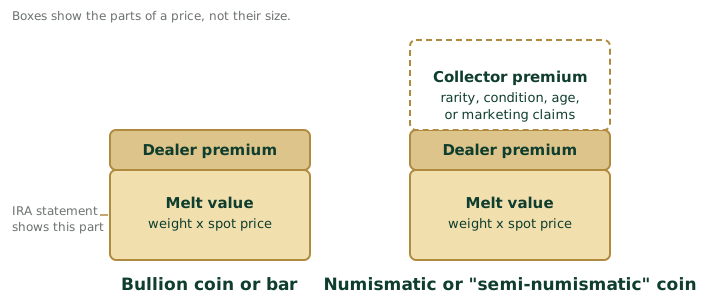
Spot price. FINRA and the CFTC describe the spot price as "the cash price for immediate delivery of physical metal." They add: "The spot price is quoted in dollars per troy ounce" (FINRA and CFTC). See spot price.
Melt value. This is the metal's worth at the spot price. The same bulletin describes an IRA statement that shows "the 'melt' value of the metals—the total bullion weight times the metal's spot price." You can estimate it with our melt value calculator.
Dealer premium. Dealers charge above spot when they sell and pay below spot when they buy back. The CFTC flyer says: "Dealers will always charge more than the current spot price when you buy, and pay less than the spot price when you sell precious metals back" (CFTC). Even at the Mint level, bullion coins are priced above metal value, before any dealer markup. The Mint says they "are sold based on the prevailing market price of gold, silver, platinum, or palladium plus a small premium to cover minting, distribution, and marketing costs" (U.S. Mint). The Mint adds that it "does not sell its bullion coins directly to the public" and instead distributes them "through a network of official distributors called 'authorized purchasers.'"
Collector premium. Numismatic and "semi-numismatic" coins add a further amount for claimed rarity, condition or demand. In an IRA, this is the part most at risk. If the coin is only valued at melt on your statement, the collector premium isn't there.
FINRA and the CFTC suggest a simple check: "Multiply the weight of the metals you're considering to the current spot price, and compare this figure with the retail price you're being charged" (FINRA and CFTC). Their own example: "If the current spot price is $2,000, for example, a half-ounce coin would be worth $1,000, plus the dealer's markup or 'premium.'" That $2,000 figure is their illustration, not a current price.
We don't publish a "normal" premium percentage. Premiums vary by product, dealer and market conditions. The useful habit is to compare the quoted price with melt value and with the dealer's buyback price before you buy. See dealer premiums and markups.
Why do regulators call collectible coin upsells for IRAs a scam signal?
Because the pitch combines a high-margin product with a tax rule that usually doesn't allow it. The CFTC's advisory says:
"Only certain bullion can be kept in an IRA. If someone tries to charge you more for collectible or 'semi-numismatic' coins, it's likely a scam." (CFTC)
The CFTC's "Lies Versus Facts" flyer puts it another way: "If someone tries to sell you higher priced 'collectibles' for an IRA, the coins likely are not rare and you're being scammed" (CFTC).
The same regulators describe how large the costs can get. FINRA and the CFTC say: "Some fraudulent dealers have charged spreads of more than 300 percent while others dealers may charge less than 20 percent" (quoted as written). They also report that "In some cases, gold or silver IRA fraud victims had one-third to one-half of their savings drained by fraudsters' markups, fees and commissions" (FINRA and CFTC). The higher figures describe fraud cases.
For the wider pattern, see numismatic coin markups and warning signs of Gold IRA scams.
Common mistakes to avoid
- Paying a collector premium for a bullion account. If the IRA is meant to hold metal, the extra paid for rarity or grading may not show up in its statement value.
- Assuming home storage is fine. For bullion, the exception itself requires that it be "in the physical possession of a trustee." For coins, see the McNulty case on home storage Gold IRAs.
- Not asking about buyback. A high premium on the way in plus a discount on the way out is the full cost. Ask for both numbers.
Related questions
Can rare coins go in an IRA?
As a rule, a rare coin is a collectible under 408(m)(2). An IRA that buys one is treated as distributing the purchase price, unless the coin fits a specific exception. Rarity itself never qualifies a coin.
Is a graded American Eagle treated differently from an ungraded one?
The statute describes coins by their specifications and doesn't mention grading or holders. Custodians may have their own policies on graded coins, so ask in writing. Either way, compare any price with melt value.
Who should I ask before buying?
Your IRA custodian, about what it accepts and where it will be stored. A tax professional, about how the collectibles rule applies to your purchase. You can also check a dealer or salesperson's background, as the regulators suggest. See how to verify a dealer.
This page explains rules and regulator warnings in general terms. It isn't tax, legal or investment advice. Gold and other metals can lose value, and premiums and fees reduce returns. Whether a specific coin fits an exception depends on the facts, so check with a qualified professional.
Sources
- 26 U.S.C. 408, Individual retirement accounts (2023 edition), U.S. Government Publishing Office (govinfo). Accessed Invalid Date.
- 31 U.S.C. 5112, Denominations, specifications, and design of coins (2023 edition), U.S. Government Publishing Office (govinfo). Accessed Invalid Date.
- Investments in collectibles in individually directed qualified plan accounts, Internal Revenue Service. Accessed Invalid Date.
- Customer Advisory: 10 Things to Ask Before Buying Physical Gold, Silver, or Other Metals, Commodity Futures Trading Commission. Accessed Invalid Date.
- Investor Bulletin: 10 Things to Ask Before Buying Physical Gold, Silver or Other Metals, FINRA and CFTC. Accessed Invalid Date.
- CFTC Lies Versus Facts: The Truth Behind Gold and Silver IRA Scams, Commodity Futures Trading Commission. Accessed Invalid Date.
- Bullion Coins, United States Mint. Accessed Invalid Date.
- American Eagle Coin Program, United States Mint. Accessed Invalid Date.
- American Eagle 2026 One Ounce Gold Proof Coin, United States Mint. Accessed Invalid Date.
This guide is general education, not personalized financial, tax or legal advice. See our financial disclaimer, editorial policy and advertising disclosure.