Taking Physical Possession: In-Kind Distributions from a Gold IRA
Yes, you can take physical possession of Gold IRA metal, but only by taking it out of the IRA as an in-kind distribution. The custodian reports the metal's fair market value on Form 1099-R, and normal IRA tax rules apply. Keeping IRA-owned metal at home without a distribution is a different thing, and in McNulty v. Commissioner (2021) the Tax Court treated it as a taxable distribution.
Many Gold IRA owners eventually want to hold their coins or bars. There is a legal way to do that, and it has a name: an in-kind distribution. "In kind" means the IRA pays you in property (the metal itself) instead of cash. This page explains how it works, how it's taxed and reported, and how it differs from the "home storage IRA" idea that landed one couple in Tax Court. For the wider picture, see Gold IRA Withdrawal Rules.
Can I take physical possession of my Gold IRA metals?
Yes, once the metal leaves the IRA. The IRS says you "can take distributions from your IRA ... at any time" (IRS IRA distributions FAQs). A distribution can be cash or property. When the property is metal and it's shipped to you, you own it personally from then on. It is no longer part of your IRA.
What you can't do is keep the metal at home and keep treating it as IRA property. The tax law's exception that lets an IRA hold gold, silver, platinum and palladium bullion depends on a trustee holding it. The IRS describes the exception as covering bullion "of a certain fineness if a bank or approved non-bank trustee keeps physical possession of it" (IRS). More on that in the collectibles rule.
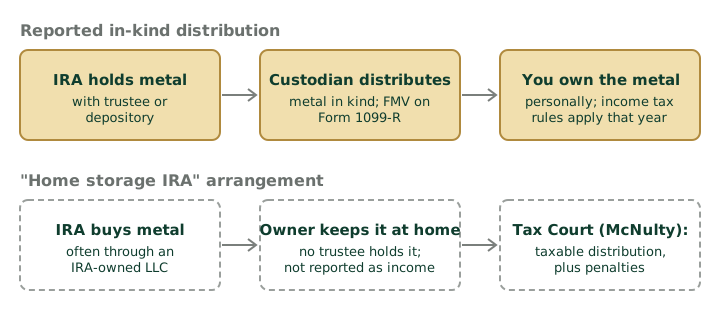
Legal possession vs. a "home storage IRA"
| In-kind distribution | "Home storage IRA" | |
|---|---|---|
| Who holds the metal | You, after the custodian ships it | You, while it's still treated as IRA property |
| Is it still in the IRA? | No | It's claimed to be |
| Reported to the IRS | Yes, on Form 1099-R by the custodian | In McNulty, not reported as income |
| Tax result | Normal distribution rules for that year | In McNulty, the Tax Court held possession was a taxable distribution, and penalties applied |
What happened in McNulty v. Commissioner
In McNulty v. Commissioner, 157 T.C. No. 10 (Nov. 18, 2021), the couple's self-directed IRAs bought American Eagle coins through IRA-owned LLCs. The opinion says "The coins were shipped to petitioners' personal residence and were stored in a safe there." The court quoted the statute's requirement that bullion be "in the physical possession of a trustee described under subsection (a) of this section."
The court held that "Mrs. McNulty's possession of the AE coins is a taxable distribution." It also held the couple "liable for I.R.C. sec. 6662(a) penalties for substantial understatements of income tax attributable to their failure to report taxable distributions from their IRAs." That is, they owed the tax and also an accuracy-related penalty. For the full case, see our page on McNulty v. Commissioner and home storage.
The point for readers: a reported in-kind distribution and home storage can end with metal in the same safe. The difference is whether the metal actually left the IRA, and whether that was reported.
How an in-kind distribution works, step by step
Each custodian has its own forms and fees, so the details vary. The general sequence:
- Ask your custodian for its distribution form. Choose an in-kind (property) distribution and list which coins or bars you want.
- Make a withholding election. The IRS says "An IRA distribution paid to you is subject to 10% withholding unless you elect out of withholding or choose to have a different amount withheld" (IRS). With an in-kind distribution there's no cash in the payment, so ask the custodian how it handles any withholding you choose.
- Arrange delivery. The depository ships the metal, or you collect it if that's offered. Ask who pays for shipping and insurance, and when the risk of loss passes to you.
- Check the metal on arrival against the custodian's list, and keep the paperwork.
- Get Form 1099-R from the custodian for the year of the distribution and use it when you file.
How is the metal valued for tax?
At fair market value (FMV) on the date it's distributed. The IRS instructions to custodians say: "If you distribute employer securities or other property, include in box 1 the FMV of the securities or other property on the date of distribution" (Instructions for Forms 1099-R and 5498).
Those instructions don't set out a method for valuing coins or bars. So it's worth asking your custodian, before you sign, how it will determine the FMV it reports. FMV is not the same as what you paid. It may also differ from what a dealer would pay you if you sold the same metal.
For a traditional IRA, the instructions also say distributions "must be reported in boxes 1 and 2a. Check the 'Taxable amount not determined' box in box 2b." In practice, working out how much is taxable falls to you and your tax preparer, especially if you ever made nondeductible contributions. See Gold IRA tax forms.
How is an in-kind distribution taxed?
The same way a cash distribution of the same value would be. Federal law says amounts distributed from an IRA are included in income "in the manner provided under section 72" (26 U.S.C. 408(d)(1)).
Traditional Gold IRA
"Distributions from a traditional IRA are taxed as ordinary income, but if you made nondeductible contributions, not all of the distribution is taxable" (Publication 590-B). The value of the metal is added to your income for the year, even though you received no cash. Plan for paying that tax from other money.
Roth Gold IRA
The law says "Any qualified distribution from a Roth IRA shall not be includible in gross income" (26 U.S.C. 408A(d)(1)). A distribution is qualified only if both of these are true:
- It is made on or after age 59½, to a beneficiary after the owner's death, because the owner is disabled, or as a "qualified special purpose distribution," which Publication 590-B describes as a first-time home purchase (up to a $10,000 lifetime limit); and
- It is not made within "the 5-taxable year period beginning with the first taxable year for which the individual made a contribution to a Roth IRA" (408A(d)(2)).
A Roth distribution that isn't qualified can still be partly or fully tax-free, depending on how much came from your own contributions. Publication 590-B explains the ordering rules. See Roth Gold IRA.
The 10% additional tax before age 59½
The IRS says "you'll be assessed a 10% additional tax on early distributions from traditional and Roth IRAs, unless an exception applies" (Topic 557). Generally, early means before age 59½. The additional tax is reported on Form 5329. Taking metal instead of cash doesn't change this.
Exceptions the IRS lists for IRAs include (IRS exceptions page; Topic 557):
| Exception | Limit or condition stated by the IRS |
|---|---|
| Total and permanent disability | Applies to the IRA owner |
| Terminal illness | Listed for IRAs in Topic 557 ("Made to you because you are terminally ill") |
| Death | Distributions to beneficiaries or the estate |
| Substantially equal periodic payments | A series of payments based on life expectancy |
| Unreimbursed medical expenses | Above 7.5% of adjusted gross income |
| Health insurance premiums while unemployed | Conditions on unemployment apply |
| Qualified higher education expenses | |
| First-time home purchase | Up to $10,000 |
| Qualified birth or adoption | Up to $5,000 per child |
| Domestic abuse victim | Lesser of $10,000 or 50% of the account; after 12/31/2023 |
| Emergency personal expense | One per calendar year, up to the lesser of $1,000 or the vested balance over $1,000; after 12/31/2023 |
| Federally declared disaster | Up to $22,000 for qualified individuals |
| IRS levy | Distribution because of an IRS levy |
One exception for workplace plans, separating from service in or after the year you turn 55, does not apply to IRAs, according to the IRS page. Each exception has detailed conditions. A tax professional can confirm whether one fits your situation. See Gold IRA Early Withdrawal Penalty and Exceptions.
What happens after the metal is yours?
Once distributed, the metal is ordinary personal property. You decide where to keep it and how to insure it. If you later sell coins at a gain, the IRS says "Net capital gains from selling collectibles (such as coins or art) are taxed at a maximum 28% rate" (Topic 409). Whether a gain is long-term depends on how long you held the asset: generally "more than one year."
Your starting point for figuring a later gain or loss (your basis) matters here. Keep the Form 1099-R and the custodian's distribution statement showing the FMV it reported, and ask your tax preparer how to treat basis for the distributed metal. See IRA gold vs. taxable gold.
In-kind or sell first?
| Take metal in kind | Sell inside the IRA, take cash | |
|---|---|---|
| What you receive | The coins or bars | Cash |
| Tax value | FMV on the distribution date | The amount distributed |
| Costs | Shipping, insurance, custodian fees | Dealer buyback spread, custodian fees |
| Paying the tax | From other money | Can come from the cash |
| Later sale | Your own sale, collectibles rules may apply | Already done |
Neither choice is right for everyone. It depends on whether you want to keep the metal, your tax bracket that year, and your costs. See selling Metals Inside a Gold IRA.
Common mistakes to avoid
- Treating possession as storage. Metal at home that hasn't been distributed is the McNulty problem, not a storage option.
- Forgetting the tax bill. An in-kind distribution produces income but no cash.
- Ignoring the 59½ rule. The 10% additional tax applies to metal the same as to cash unless an exception applies.
- Not checking the FMV figure. Compare the value on Form 1099-R with the custodian's statement.
- Assuming you can put the metal back easily. A 60-day rollover must generally involve the "entire amount received (including money and any other property)" (26 U.S.C. 408(d)(3)), only one IRA-to-IRA rollover is allowed in any 12-month period (IRS), and the receiving custodian would need to accept the metal. Get professional advice before relying on this.
Related questions
Is an in-kind distribution the same as closing my Gold IRA?
Not necessarily. You can take some metal and leave the rest in the IRA. Taking everything is one way of closing a Gold IRA.
Can I use an in-kind distribution for a required minimum distribution?
Ask your custodian how it values and reports in-kind distributions for this purpose. See Gold IRA RMDs.
Does a checkbook IRA LLC let me hold the metal myself?
That was the setup in McNulty, and the Tax Court held the owner's possession was a taxable distribution. See home storage.
Who should review my plans?
Because tax results depend on your age, account type and income, a CPA or enrolled agent can review a planned in-kind distribution before you request it.
Sources
- Instructions for Forms 1099-R and 5498 (2026), Internal Revenue Service. Accessed Invalid Date.
- Publication 590-B (2025), Distributions from Individual Retirement Arrangements (IRAs), Internal Revenue Service. Accessed Invalid Date.
- Retirement plans FAQs regarding IRAs distributions (withdrawals), Internal Revenue Service. Accessed Invalid Date.
- Topic no. 557, Additional tax on early distributions from traditional and Roth IRAs, Internal Revenue Service. Accessed Invalid Date.
- Retirement topics - Exceptions to tax on early distributions, Internal Revenue Service. Accessed Invalid Date.
- 26 U.S. Code 408A, Roth IRAs, Legal Information Institute, Cornell Law School. Accessed Invalid Date.
- 26 U.S. Code 408, Individual retirement accounts, Legal Information Institute, Cornell Law School. Accessed Invalid Date.
- Investments in collectibles in individually directed qualified plan accounts, Internal Revenue Service. Accessed Invalid Date.
- Rollovers of retirement plan and IRA distributions, Internal Revenue Service. Accessed Invalid Date.
- Topic no. 409, Capital gains and losses, Internal Revenue Service. Accessed Invalid Date.
- McNulty v. Commissioner, 157 T.C. No. 10 (Nov. 18, 2021), opinion text, United States Tax Court (copy hosted by KPMG). Accessed Invalid Date.
This guide is general education, not personalized financial, tax or legal advice. See our financial disclaimer, editorial policy and advertising disclosure.