Gold IRA Transfer: Trustee-to-Trustee Transfers Explained
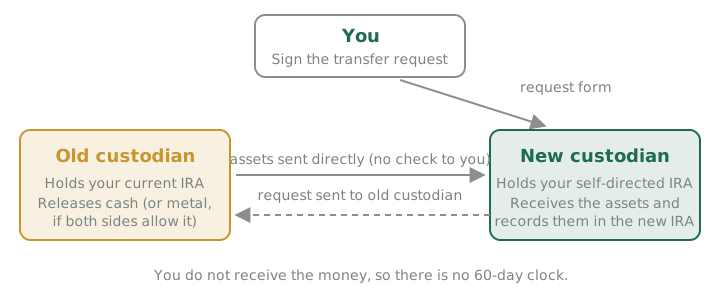
A Gold IRA transfer moves money directly from your current IRA custodian to a new self-directed IRA custodian. Because you never receive the money, no taxes are withheld, and the IRS says it isn't a rollover, so the 60-day rollover deadline and the one-rollover-per-year limit don't apply. It's a common way to fund a Gold IRA from an existing IRA.
If your retirement money is already in an IRA, you usually don't need a rollover at all. You can ask for a trustee-to-trustee transfer, which moves the money from one custodian straight to another. This guide covers how transfers work, which accounts can move, what happens to the investments you hold now, and how to handle delays. For the wider picture, start with the Gold IRA Guide. Moving money from a 401(k) or other workplace plan is a different process, covered in the Gold IRA Rollover Guide.
What is a trustee-to-trustee transfer into a Gold IRA?
A custodian (also called a trustee) is the bank or IRS-approved company that holds your IRA. A Gold IRA is a self-directed IRA whose custodian allows eligible precious metals. A trustee-to-trustee transfer is a move between two IRA custodians in which you never touch the money.
The IRS describes it this way: "If you're getting a distribution from an IRA, you can ask the financial institution holding your IRA to make the payment directly from your IRA to another IRA or to a retirement plan" (IRS). The same page says "no taxes will be withheld from your transfer amount." IRS Publication 590-A says: "A transfer of funds in your traditional IRA from one trustee directly to another, either at your request or at the request of the trustee, isn't a rollover." On the rollovers page, the payment goes from one IRA to another and not to you.
Transfer, rollover and conversion are different things
People use these words loosely. The differences affect tax and limits.
| Trustee-to-trustee transfer | Rollover (money paid to you, 60 days) | Roth conversion | |
|---|---|---|---|
| What it is | IRA custodian sends the money straight to another IRA custodian | You receive an IRA or plan payout and deposit it within 60 days | Traditional IRA money moves into a Roth IRA |
| Who receives the money | The new custodian | You | Can be done by transfer, rollover, or within the same custodian |
| Tax withheld | None | IRA payouts: 10% unless you elect out or choose another amount | Depends on method |
| Taxable | Generally no, between like accounts | Not if completed on time | Yes, for untaxed amounts |
| Once-per-12-months limit | Doesn't apply | Applies to IRA-to-IRA rollovers | Doesn't apply |
Sources: IRS rollovers page, IRS IRA FAQs.
The IRS FAQs say a conversion to a Roth IRA "results in taxation of any untaxed amounts in the traditional IRA," and that you can convert by rollover, by trustee-to-trustee transfer, or by a transfer within the same financial institution (IRS IRA FAQs). So a transfer into a Roth IRA from a traditional IRA is not a plain transfer. It is a conversion. See converting a Gold IRA to Roth and Gold IRA Taxes. For the full side-by-side, see Gold IRA Rollover vs Transfer.
Why isn't a transfer limited to once a year?
The IRS says that "you can make only one rollover from an IRA to another (or the same) IRA in any 12-month period, regardless of the number of IRAs you own" (IRS). The same page lists what the limit does not cover, including "trustee-to-trustee transfers to another IRA." On its one-rollover page the IRS puts it plainly: "Trustee-to-trustee transfers between IRAs are not limited" and "this type of transfer isn't a rollover" (IRS).
That means you can move IRA money by transfer more than once in a year. It also means a transfer doesn't use up your one rollover. If you break the rollover limit, the IRS says you "must include the amounts in gross income" and may owe the 10% early withdrawal tax (IRS). For the details, see the Gold IRA Rollover Guide.
How does a Gold IRA transfer work, step by step?
Each custodian has its own forms, but the typical steps look like this:
- Open the self-directed IRA with a custodian that holds precious metals. Use the same type as the old account: Traditional to Traditional, Roth to Roth. See how to open a Gold IRA and Gold IRA custodians.
- Fill in the new custodian's transfer request form. It asks for your old account details and how much to move.
- Attach a recent statement from the old account, if asked. It helps the old custodian match the request.
- The new custodian sends the request to the old one, which releases the money.
- Confirm the money has arrived in the new IRA. Check the amount against what you expected.
- Approve the metal purchase. The money can wait as cash until you choose to buy (see below).
Why should the form ask for a transfer, not a check?
A form or request that pays the money to you starts a 60-day rollover, not a transfer. The IRS says a 60-day rollover must be completed "by the 60th day following the day on which you receive the distribution" (IRS IRA FAQs). Before signing, check that the paperwork says the money goes to the new custodian, not to you. See the 60-day rollover rule.
What kinds of Gold IRA transfers are there?
The word "transfer" covers several situations:
- Full cash transfer. The old custodian sends the entire account balance as cash. This is the simplest case.
- Partial transfer. You move only part of the account and leave the rest where it is. The old account stays open with whatever remains.
- In-kind transfer. Instead of cash, the investment itself moves from one custodian to another. For metal, that means the coins or bars. Whether this is possible depends on both custodians and the depository. See changing Gold IRA custodians.
- Transfer to a new custodian by a Gold IRA holder. You already own a Gold IRA and want a different custodian. This can be cash or in kind (see below).
What happens to the investments in the old IRA?
The money has to arrive at the new custodian in a form it accepts. For many IRAs, that may mean the old investments are sold and the cash is sent. Some funds or securities may also move in kind if the new custodian accepts them. Ask the old custodian:
- whether the account will be sold into cash, and when;
- whether there are fees for selling, closing or transferring out;
- whether any investment, such as a CD or annuity, has a surrender charge or maturity date;
- whether you are being taken out of the market for a period, and what that means for your plan.
The investments may also be out of the market while the transfer is pending. A financial professional can help you weigh that.
Which accounts can be transferred?
| Source account | Moves by transfer to a Gold IRA? | Notes |
|---|---|---|
| Traditional IRA | Generally yes, to a Traditional Gold IRA; confirm with both custodians | See IRA to Gold IRA |
| SEP IRA | Often possible to a Traditional Gold IRA; the IRS says many traditional IRA rules also apply to SEP IRAs, so confirm with both custodians | See IRA to Gold IRA |
| Roth IRA | Yes, to a Roth Gold IRA | See Roth IRA to Gold IRA |
| SIMPLE IRA | Timing limit applies | See below |
| 401(k), 403(b), TSP, other workplace plan | Not a transfer. Moves by direct rollover | See 401(k) to Gold IRA |
| Inherited IRA | Special rules | Ask a tax professional before moving |
SIMPLE IRA two-year limit
The IRS says "during the 2-year period beginning when you first participated in your employer's SIMPLE IRA plan, you can only transfer money to another SIMPLE IRA" (IRS). After the 2-year period, the IRS says "you can make tax-free rollovers from SIMPLE IRAs to other types of non-Roth IRAs, or to an employer-sponsored retirement plan." The IRS also describes a 25% additional tax on early distributions in the first two years, with an exception at age 59½ (see the same IRS page). See SIMPLE IRA and precious metals.
Traditional to Traditional, Roth to Roth
Keeping the account type the same is what keeps a move a plain transfer. In our reading, a Roth-to-Roth transfer is not a conversion, while the IRS says a Traditional-to-Roth move is. The Roth Gold IRA guide covers how the Roth rules work, and Roth IRA to Roth Gold IRA transfer covers the five-year clock.
Inherited IRAs
Inherited IRAs have their own rules for who may move the money and where. We have not verified those rules for this page, so we don't describe them. Ask the custodian that holds the account and a tax professional before starting a transfer.
How is a transfer reported to the IRS?
For a plain transfer, there is usually little to report. The IRS instructions for Forms 1099-R and 5498 say: "Generally, do not report a transfer between trustees or issuers that involves no payment or distribution of funds to the participant, including a trustee-to-trustee transfer from one IRA to another IRA" (IRS). The same instructions list what must be reported, including Roth IRA conversions and direct rollovers from qualified plans.
Practical points:
- Check your year-end tax forms. A plain transfer generally isn't reported on Form 1099-R (see above). If you receive one showing a distribution, ask the custodian why, and ask a tax professional before filing.
- Conversions are reported. If you moved from a Traditional to a Roth IRA, the IRS Form 1099-R instructions say conversions must be reported even if the conversion is a trustee-to-trustee transfer.
- Keep your own records. Save the transfer request, confirmations, and account statements from both custodians.
How long does a transfer take?
There is no single timeline. Speed depends on how quickly each custodian processes requests, whether the old account must be sold first, and whether the paperwork matches. Some transfers are quick. Others take longer if forms are rejected or an investment can't be liquidated right away. Ask both custodians for their usual processing time in writing, and treat any estimate as typical, not promised.
Moving metal in kind can take more steps than moving cash. Shipping, vault records and insurance arrangements may be involved, and each depository handles them its own way. Ask about this before you start.
Worked example: a partial transfer
This example is illustrative. The numbers are made up to show the steps, not to suggest an amount for anyone.
Suppose a person has a $60,000 Traditional IRA at a brokerage and wants to move $40,000 to a new Traditional Gold IRA.
| Step | What happens |
|---|---|
| 1 | A new self-directed Traditional IRA is opened with a custodian that holds metals. |
| 2 | The person signs the new custodian's transfer request for $40,000 from the old account. |
| 3 | The old custodian sells enough investments to raise $40,000 and sends it to the new custodian. |
| 4 | $20,000 stays invested at the brokerage. |
| 5 | The new custodian shows $40,000 as cash. Nothing is withheld. |
| 6 | The person reviews quotes and fees before deciding whether to buy any metal with that cash. |
| Tax result | Generally none from the transfer itself, because no payment was made to the person (IRS Form 1099-R instructions). |
If the same person had asked for a check instead, the $40,000 would have been paid to them, and the 60-day rollover rules and the one-per-year limit would apply.
Can a Gold IRA be moved to a new custodian?
Yes. The usual route is also a transfer. Two choices come up:
- Sell and move cash. The metal is sold, the cash goes to the new custodian, and the new custodian buys again if you choose. You may pay a sale spread and a new purchase premium.
- Move the metal in kind. The coins or bars stay as they are and move custodians, with no sale. Depending on the custodians, this may or may not be available.
Ask both custodians and the depository about exit fees, shipping and insurance before you decide. See Gold IRA fees for the types of charges and changing Gold IRA custodians.
Why must the metal stay with a trustee?
Whether you move cash or metal, it should stay inside the custodian system. The IRS bullion exception applies only while the metal is "in the physical possession of a bank or an IRS-approved nonbank trustee" (IRS IRA FAQs). Shipping IRA bullion to you personally during a transfer would take it out of a trustee's possession. See the IRA collectibles rule and in-kind distributions, which explains why taking personal possession is a different event from a transfer.
What do you do when a transfer is delayed?
Transfers can stall. Things to check:
- the name, address or account number on the form doesn't match the old account
- the old custodian needs a signature guarantee or its own form
- the request asks for a specific amount but the old account holds investments that must be sold first
- you asked for the account to be closed, but there's a pending dividend or fee
- an investment can't be sold quickly, or the old custodian needs a different form for that type of account
- the new account isn't fully open yet, so the receiving side can't accept the money
What to do:
- Call the old custodian, ask whether they received the request, and ask exactly what's missing.
- Ask the new custodian to resend the request if needed, and ask them to confirm what they sent.
- Keep a written log of dates, names and what each person said.
- If you still can't get answers, ask each custodian in writing for a status and for the reason for any delay.
Avoid fixing a delay by asking for a check to yourself. That turns the move into a 60-day rollover with its own rules.
What mistakes should you avoid?
- Asking for a check "to speed things up." It starts the 60-day clock and may bring withholding.
- Moving between different account types without realizing it. Traditional to Roth is a conversion, not a plain transfer.
- Moving SIMPLE IRA money too early. In the first two years, transfers are limited to another SIMPLE IRA.
- Ignoring fees at the old custodian. Closing and transfer-out fees can reduce what arrives.
- Skipping the paperwork check. Names and account numbers that don't match can lead a custodian to reject a request.
- Letting the money sit uninvested without a plan. The money can stay as cash while you compare options, but know what the cash earns, if anything.
- Feeling pushed to buy right away. See the next section.
Why shouldn't you feel pressured to buy right away?
When money arrives, some salespeople push for a fast, large purchase. The CFTC warns that unscrupulous dealers "pose as 'IRA experts'" and may ask you "to buy as much metal as possible" (CFTC). The CFTC also advises talking to "a qualified financial planner, investment advisor, or accountant before making significant changes to your tax-advantaged retirement plan."
The money can wait in the IRA as cash until you've compared prices. See Gold IRA fees and warning signs of a Gold IRA scam.
Related questions
Is a Gold IRA transfer taxable?
A trustee-to-trustee transfer between IRAs of the same type generally isn't reported as a distribution, because the money is never paid to you. Publication 590-A says such a transfer "isn't a rollover," and the Form 1099-R instructions say not to report a trustee-to-trustee transfer that involves no payment to the participant (Publication 590-A). Confirm how it applies to you with a tax professional. Moving Traditional IRA money into a Roth IRA is different: that's a conversion, and the IRS says it results in taxation of untaxed amounts (IRS IRA FAQs).
Can I move my IRA more than once a year?
Yes, by trustee-to-trustee transfer. The once-per-12-months limit applies to IRA-to-IRA rollovers where the money is paid to you, and the IRS says trustee-to-trustee transfers between IRAs are not limited (IRS).
Does a transfer count as a contribution?
No. A transfer moves money that's already in an IRA. It isn't a new contribution, so it doesn't use your annual contribution limit. See Gold IRA contribution limits.
Can I transfer only part of my IRA?
Yes, you can transfer only some of the money and leave the rest invested where it is. Ask the old custodian whether there's a minimum, whether partial transfers need a different form, and which investments will be sold.
Do I need a professional?
Many transfers are routine, but your situation may not be. A CPA, enrolled agent or financial professional can confirm which type of move fits your accounts, especially if you have a SIMPLE IRA, an inherited IRA, or a Roth conversion in mind.
Guides in this section
- Gold IRA Rollover vs Transfer: What's the Difference?The practical and tax differences between rollovers and trustee-to-trustee transfers into a Gold IRA, with examples of when each applies.
- Traditional, SEP or Existing IRA to Gold IRA TransferHow to move a Traditional or SEP IRA to a self-directed Gold IRA by transfer, partial vs full transfers, and what to ask both custodians.
- Roth IRA to Roth Gold IRA TransferMoving an existing Roth IRA into a Roth Gold IRA while preserving Roth status, and how the five-year clock is treated.
- Changing Gold IRA Custodians or Moving Metals In-KindHow to change Gold IRA custodians or dealers, in-kind vs cash transfers of metals, depository moves, exit fees and typical timelines.
Sources
- Rollovers of retirement plan and IRA distributions, Internal Revenue Service. Accessed Invalid Date.
- IRA one-rollover-per-year rule, Internal Revenue Service. Accessed Invalid Date.
- Publication 590-A (2025), Contributions to Individual Retirement Arrangements (IRAs), Internal Revenue Service. Accessed Invalid Date.
- Retirement plans FAQs regarding IRAs, Internal Revenue Service. Accessed Invalid Date.
- SIMPLE IRA withdrawal and transfer rules, Internal Revenue Service. Accessed Invalid Date.
- Instructions for Forms 1099-R and 5498 (2026), Internal Revenue Service. Accessed Invalid Date.
- Precious Metal Frauds, Commodity Futures Trading Commission. Accessed Invalid Date.
This guide is general education, not personalized financial, tax or legal advice. See our financial disclaimer, editorial policy and advertising disclosure.