IRA-Eligible Precious Metals: Gold, Silver, Platinum, Palladium
An IRA can hold certain U.S. Mint gold, silver and platinum coins, coins issued by a U.S. state, and gold, silver, platinum or palladium bullion that meets a minimum fineness and is held by a bank or IRS-approved trustee. Most other coins, including rare and collector coins, are treated as collectibles.
The tax code starts from a strict default: most coins and metals are collectibles, and an IRA that buys a collectible is treated as paying that money out to you. A short list of exceptions is what makes Gold and Silver IRAs possible. This page walks through those exceptions, the U.S. Mint coins that rely on each one, the questions that remain open, and how to check a specific product before an IRA buys it.
If you are new to the topic, start with our Gold IRA Guide. This page covers the products. The account rules, custodian choices and withdrawals are covered in their own guides, and the collectibles rule page goes through the statute line by line.
What precious metals are allowed in an IRA?
Four metals can qualify: gold, silver, platinum and palladium. But the metal alone doesn't decide it. The product has to fit one of three exceptions, and bullion also has to be held by a bank or approved trustee.
The IRS puts the starting point plainly: "The law does not permit IRA funds to be invested in life insurance or collectibles" (IRS IRA FAQs). Its collectibles page lists metals and coins among the collectibles, "with limited exceptions" (IRS).
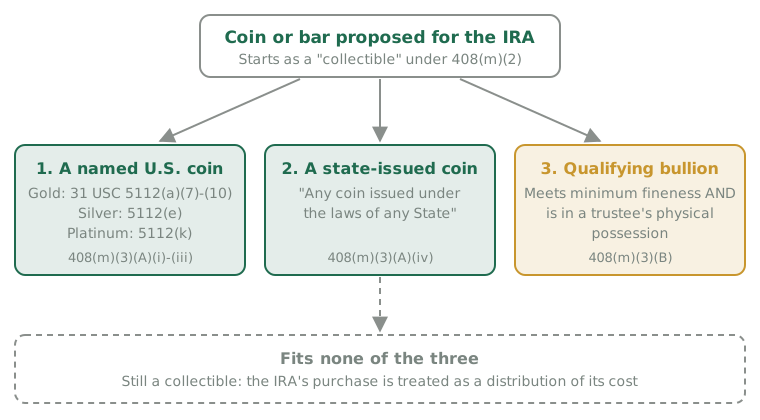
What are the three exceptions in the tax code?
Section 408(m)(1) treats an IRA's purchase of a collectible as a distribution equal to its cost. Section 408(m)(2) defines "collectible" to include "(C) any metal or gem" and "(D) any stamp or coin." Then 408(m)(3) carves out the exceptions.
The IRS summarizes them this way (IRS):
- "Certain gold, silver, or platinum coins described in 31 USC Section 5112."
- "Any coin issued under the laws of any state."
- "any gold, silver, platinum, or palladium bullion of a certain fineness if a bank or approved non-bank trustee keeps physical possession of it."
Exception 1: certain U.S. coins named in the statute
Section 408(m)(3)(A) excludes three groups of U.S. coins, each by reference to the law that sets U.S. coin specifications, 31 U.S.C. 5112:
- "a gold coin described in paragraph (7), (8), (9), or (10) of section 5112(a)"
- "a silver coin described in section 5112(e)"
- "a platinum coin described in section 5112(k)"
Here is what those paragraphs say:
| Statute | What it describes | Key words from the statute |
|---|---|---|
| 5112(a)(7) | $50 gold coin | "32.7 millimeters in diameter, weighs 33.931 grams, and contains one troy ounce of fine gold" |
| 5112(a)(8) | $25 gold coin | "27.0 millimeters in diameter, weighs 16.966 grams, and contains one-half troy ounce of fine gold" |
| 5112(a)(9) | $10 gold coin | "22.0 millimeters in diameter, weighs 8.483 grams, and contains one-fourth troy ounce of fine gold" |
| 5112(a)(10) | $5 gold coin | "16.5 millimeters in diameter, weighs 3.393 grams, and contains one-tenth troy ounce of fine gold" |
| 5112(e) | Silver coin | 40.6 mm across, 31.103 grams, "contain .999 fine silver," with an eagle on the reverse |
| 5112(k) | Platinum coins | The Secretary "may mint and issue platinum bullion coins and proof platinum coins" under specifications the Secretary prescribes |
Notice that the gold paragraphs describe four sizes, and that the platinum paragraph sets no fixed purity or size of its own. It leaves those details to the Treasury Secretary.
Exception 2: coins issued under state law
Section 408(m)(3)(A)(iv) also excludes "a coin issued under the laws of any State." We did not find an IRS list of coins that qualify under it, and we are not naming any product as an example. If a seller says a coin qualifies because a state issued it, ask for the specific state law and ask your custodian whether it accepts the coin.
Exception 3: bullion that meets a minimum fineness
The third exception covers "any gold, silver, platinum, or palladium bullion of a fineness equal to or exceeding the minimum fineness that a contract market (as described in section 5 of the Commodity Exchange Act, 7 U.S.C. 7) requires for metals which may be delivered in satisfaction of a regulated futures contract," and then adds the condition "if such bullion is in the physical possession of a trustee described under subsection (a) of this section" (26 U.S.C. 408(m)(3)).
Two things follow from that wording:
- The statute doesn't print a purity number. It borrows the minimum from regulated futures markets. The IRS page says only "of a certain fineness," so the familiar .995, .999 and .9995 figures come from the futures-market reference, not from an IRS list.
- Custody is part of the exception. For bullion, the trustee's physical possession is a condition, not a courtesy. The IRS says the same in its FAQ: "There is an exception for certain highly refined bullion provided it is in the physical possession of a bank or an IRS-approved nonbank trustee" (IRS IRA FAQs).
Fineness means how much of a coin or bar is pure metal. For example, .999 means 999 parts in 1,000. Our guide to gold fineness and purity requirements for IRAs goes deeper.
What fineness do the futures contracts require?
Because the statute points to "a contract market," the practical question is what regulated futures contracts require. We opened the current contract rules for four CME Group contracts. These are examples of the standard the statute refers to, not an IRS list:
| Metal | Futures contract rule we opened | Wording |
|---|---|---|
| Gold | COMEX Chapter 113 | "Gold delivered under this contract shall assay to a minimum of 995 fineness and must be a brand approved by the Exchange." |
| Silver | COMEX Chapter 112 | "Silver delivered under this contract shall assay to a minimum of 999 fineness" |
| Platinum | NYMEX Chapter 105 | "Platinum delivered under this contract shall be a minimum of 99.95% pure and must be a brand approved by the Exchange." |
| Palladium | NYMEX Chapter 106 | "Palladium delivered under this contract shall be a minimum of 99.95% pure" |
Sources: COMEX gold, COMEX silver, NYMEX platinum, NYMEX palladium.
In plain numbers, that is .995 for gold, .999 for silver, and .9995 for platinum and palladium. To assay means to test a metal for purity.
Three cautions apply. First, exchange rules can change, so check the current rule or ask your custodian. Second, the statute says "a contract market," and we did not find an IRS statement on which exchange's contract applies to which product. Treat this as an interpretation of how the statute works, not a legal conclusion. Third, a custodian can accept fewer products than the law allows. The IRS says that "IRA trustees are permitted to impose additional restrictions on investments" (IRS IRA FAQs).
Which U.S. Mint coins fit which exception?
The U.S. Mint sells its bullion coins only through authorized purchasers, not to the public. In its words, "The United States Mint, like other world mints, does not sell its bullion coins directly to the public" (U.S. Mint). So most buyers meet these coins through a dealer.
The table below combines the Mint's descriptions with the statute. The "route" column is our reading of how each coin fits the statute's text.
| Coin | Composition (statute or Mint) | Sizes and face value | Likely route under 408(m)(3) |
|---|---|---|---|
| American Eagle gold | 91.67% gold, 3% silver, balance copper | 1 oz ($50), 1/2 oz ($25), 1/4 oz ($10), 1/10 oz ($5) | Coin exception: matches 5112(a)(7)-(10) |
| American Eagle silver | .999 fine silver | 1 oz ($1) | Coin exception: matches 5112(e) |
| American Eagle platinum | .9995 platinum | 1 oz ($100) | Coin exception: 5112(k); bullion test is another route |
| American Buffalo gold | 99.99% gold | 1 oz ($50) | Bullion test: not among the paragraphs named in 408(m)(3)(A) |
| American Eagle palladium | 99.95% palladium | 1 oz ($25 on the collector version we checked; the Mint's bullion program page lists a different face value for palladium, so confirm on the product page) | Bullion test: no palladium coin is named in 408(m)(3)(A) |
Mint sources: bullion coin programs (gold, silver, platinum, Buffalo), 2026 palladium Eagle product page and Buffalo product page.
A few points from the table are worth slowing down on.
Why the Gold Eagle doesn't need the fineness test
At 91.67% gold, the American Gold Eagle is below the gold futures figure above. It qualifies, if at all, because it is one of the coins the coin exception names, not because of its purity. See the American Gold Eagle.
Why the Gold Buffalo relies on a different route
The Mint lists the American Buffalo at 99.99% gold. The Buffalo is authorized under a different subsection of 5112, subsection (q), which the statute describes as authority to strike "$50 gold bullion and proof coins." Paragraph (a)(11) of the same section also describes a 99.99 percent pure $50 gold coin. Neither (q) nor (a)(11) is among the paragraphs (7) through (10) named in 408(m)(3)(A)(i). On our reading, the Buffalo is not described by the paragraphs named in 408(m)(3)(A)(i), so it would have to rely on the bullion test, which means meeting the fineness test and being held by a trustee. At 99.99% gold it is above the gold figure we opened. See the American Gold Buffalo.
Platinum and palladium
The platinum paragraph, 5112(k), names both "platinum bullion coins and proof platinum coins." The Mint's American Eagle page says "Platinum coins are currently made only as proof, while palladium coins switch finishes each year" (U.S. Mint), while its bullion program page still lists a platinum bullion coin. Availability by finish changes from year to year, so ask the dealer exactly which product and finish is being offered.
The Mint's press release for the 2026 palladium coin calls it "the collector version of the official American Eagle One Ounce Palladium Bullion Coin" (U.S. Mint). That is a good example of why the exact product matters. For more, see our guides to a platinum IRA and a palladium IRA.
Do proof and uncirculated versions qualify?
This is unsettled, and we treat it as interpretation. The Mint says "Gold and silver coins are released as bullion, uncirculated, and proof finishes each year" (U.S. Mint). The coin exception refers to a coin "described in" the statute paragraph, and says nothing about finish. One reading is that a proof coin with the statutory specifications falls within the exception. A more cautious reading is that a coin made for collectors sits uneasily with a rule aimed at collectibles.
We did not find IRS guidance on this exact question, and we don't take a position. Get any proof or uncirculated proposal in writing from your custodian and ask a tax professional about it. See proof coins in a gold IRA and the collectibles rule page.
What about foreign bullion coins?
Many countries mint gold and silver bullion coins. Whether a foreign coin works in an IRA depends on the same test as any other bullion: does it meet the minimum fineness, and will a trustee hold it? A coin from a foreign government is not named in the coin exception, so it would have to qualify as bullion.
We are not listing foreign coins here as eligible, because we did not confirm each coin's stated purity on its issuer's own page. The safe approach is generic. Look up the issuer's stated purity, compare it with the fineness standard for that metal, and ask your custodian whether it accepts that exact coin. For a planned deeper look, see Canadian Gold Maple Leaf, other sovereign gold coins and coins that aren't IRA eligible, including Krugerrands.
How do I check a bar?
A bar has no statute naming it. It qualifies only under the bullion test. So the questions are about purity, origin and custody.
What should be stamped on a gold bar?
For comparison, the COMEX gold rule requires that "Each bar of eligible gold must have the weight, fineness, bar number, month and year of production (for bars produced as of January 1, 2026), and brand mark clearly incised on the bar" (COMEX Chapter 113). That is a futures-delivery rule, not an IRA rule, and an IRA bar doesn't have to meet it. But it shows what a legitimate bar normally tells you: who made it, how much it weighs and how pure it is.
Does the refiner matter?
The futures rules we opened require delivered gold, silver, platinum and palladium to be "a brand approved by the Exchange." The IRA statute does not say this. Custodians may keep their own lists of accepted refiners. Ask the dealer for the refiner's name and the stated fineness in writing, then ask the custodian whether it accepts that refiner. See accredited refiners.
What if the bar is a fraction of an ounce, or has no assay card?
As worded, the bullion test mentions fineness and custody, not bar size or packaging. A custodian may still limit the refiners, sizes and packaging it accepts, so ask before you buy. Our guide to IRA-eligible gold bars and coins vs bars go into more detail.
What doesn't qualify?
- Rare and numismatic coins valued for collector demand, unless they happen to fit one of the exceptions. See bullion vs numismatic coins.
- "Semi-numismatic" coins. FINRA and the CFTC call this "a made-up industry term that really has no special meaning" (FINRA).
- Jewelry and other items that aren't bullion.
- Bullion that you hold yourself. The exception only applies while a bank or approved trustee holds the metal (IRS IRA FAQs). The IRS FAQ question on this is titled "If my IRA invests in gold or other bullion, can I store the bullion in my home?" See home storage.
Is there an exception for older purchases?
The IRS says: "Collectibles acquired by individually-directed accounts before January 1, 1982, are grandfathered and not subject to IRC Section 408(m)." That is unlikely to matter for a new purchase, but it explains why you may see the date mentioned.
Which sales terms can mislead?
The law doesn't use marketing phrases. This table translates some you may hear.
| What you may hear | What to know |
|---|---|
| "IRS-approved coins" | The statute sets tests in 408(m); we found no IRS list of approved brands. Ask which exception applies and whether your custodian accepts it. |
| "IRA-eligible" | This may mean the custodian accepts it, which is not the same as a tax ruling. Get the claim in writing. |
| "Semi-numismatic" or "rare" | FINRA and the CFTC say such coins "typically aren't rare and carry no additional value" (FINRA). |
| "Collectible coins for your IRA" | The CFTC says: "Only certain bullion can be kept in an IRA. If someone tries to charge you more for collectible or 'semi-numismatic' coins, it's likely a scam" (CFTC). |
| "Gold IRA" | The CFTC notes: "Dealers use the 'gold IRA' label for SDIRAs when they want older workers or retirees to use their retirement savings to buy gold or silver bullion" (CFTC). It is a label, not a separate type of account. |
| "Limited edition" or "proof" | See the proof section above: eligibility is unsettled; get any price in writing and ask what premium over the metal's spot price applies. |
For more, see Gold IRA scams: warning signs and dealer premiums and markups.
How can I verify a product before the IRA buys it?
- Get the exact product in writing. Name, mint or refiner, year, weight and finish.
- Find the route. Is it a named U.S. coin, a state coin, or bullion?
- Check the stated purity. Use the Mint's or refiner's own page, and compare with the fineness standard for the metal.
- Ask the custodian. Ask whether it accepts that exact product, and where it will be held.
- Compare the price to spot. FINRA lists the spot price and the spread among the questions to ask a metals dealer (FINRA). Our melt value calculator shows how much metal you're paying for.
- Confirm the statements. The custodian, not the dealer, should be sending them.
| Question | Why it matters | Where to look |
|---|---|---|
| Is it a named U.S. coin, state coin or bullion? | Decides which exception, if any, applies | 408(m)(3) and 31 U.S.C. 5112 |
| What is the stated fineness? | Bullion must meet the futures-contract minimum | Mint, refiner or bar stamp |
| Is the exact finish and year the one offered? | Bullion, uncirculated and proof versions are different products | Mint product page, dealer invoice |
| Does the custodian accept it? | Custodians can set stricter limits | Custodian's written confirmation |
| Who will hold it? | Bullion needs a trustee's physical possession | Custodian and depository agreement |
| What is the premium over spot? | Eligible doesn't mean fairly priced | Dealer quote |
You can also try our IRA eligible metal checker when it is available.
What mistakes should I avoid?
- Assuming "gold" is enough. Every coin and metal starts out as a collectible, so the product has to fit an exception.
- Treating a custodian's approval as a tax ruling. The custodian is not the IRS.
- Confusing the Mint's "bullion coin" label with eligibility. The Mint defines a bullion coin as "an investment-grade coin that is valued by its weight and fineness of a specific precious metal" (U.S. Mint). That describes how it is valued, not how the tax code treats it.
- Mixing up eligibility and price. An eligible coin can still carry a high premium. If you want to compare physical metal with other ways to own gold, see Gold IRA vs gold ETF.
- Taking the metal yourself. The bullion exception depends on the trustee's physical possession. See in-kind distributions.
Related questions
What gold coins can go in an IRA?
The American Gold Eagle appears to fit the coin exception (our reading of the statute and the Mint's specifications). Gold bullion coins such as the American Gold Buffalo can qualify as bullion if they meet the fineness standard and a trustee holds them. Your custodian decides what it will accept. See IRA-eligible gold coins.
What gold coins are IRS approved?
The IRS doesn't publish an approved list of coins. Section 408(m) sets tests, and a coin either fits one or doesn't. See "IRS-approved" in the sales terms table above.
Can an IRA hold silver?
Yes. The American Silver Eagle appears to fit the coin exception (our reading), and silver bullion that meets the fineness minimum and is held by a trustee fits the bullion exception. See silver IRAs and silver coins and bars.
Can an IRA hold palladium?
Palladium bullion that meets the fineness standard and is held by a trustee falls under the bullion exception. No palladium coin is named in the coin exception.
Where can I learn the basics of gold itself?
Our gold basics guide covers terms such as spot price, troy ounces and fineness.
This page explains the law in general terms and isn't tax or legal advice. Product eligibility depends on the exact product and your custodian's policies, so check with the custodian and a qualified tax professional or attorney.
Guides in this section
- Gold Fineness and Purity Requirements for IRAsHow fineness is measured, the purity thresholds used for IRA bullion, why the American Gold Eagle is a statutory exception, and reading assay marks.
- IRA-Eligible Gold CoinsA reference list of commonly IRA-eligible gold bullion coins with fineness, issuer and weight, plus how to confirm eligibility with your custodian.
- American Gold Eagle in an IRA: Specs and EligibilitySpecifications of the American Gold Eagle, why it qualifies for IRAs by statute despite 22-karat purity, and premium considerations.
- American Gold Buffalo in an IRASpecifications of the 24-karat American Gold Buffalo, its IRA eligibility and how it compares with the Gold Eagle on purity and premium.
- Canadian Gold Maple Leaf in an IRASpecifications of the Canadian Gold Maple Leaf, fineness, security features and IRA eligibility considerations.
- Other Sovereign Gold Coins: Philharmonic, Britannia, KangarooSpecifications and IRA eligibility considerations for widely traded sovereign gold coins from Austria, the UK and Australia.
- IRA-Eligible Gold Bars: Refiners, Sizes and PremiumsWhich gold bars custodians typically accept, accredited refiner requirements, common sizes, and how bar premiums compare with coins.
- Coins That Are Not IRA Eligible, Including KrugerrandsCommonly asked-about coins that generally do not qualify for IRAs - Krugerrands, pre-1933 US gold, many collectibles - and why.
- Silver IRA: Eligible Silver, Rules and CostsHow Silver IRAs work, which silver coins and bars are eligible, and silver-specific cost factors like higher storage bulk and premiums.
- IRA-Eligible Silver Coins and BarsA reference list of commonly IRA-eligible silver coins and bars with specs, plus checks to run before purchase.
- Platinum IRA: Eligible Coins, Bars and ConsiderationsHow platinum fits the IRA exception, eligible coins and bars, and liquidity and price-volatility considerations specific to platinum.
- Palladium IRA: Eligible Coins, Bars and ConsiderationsHow palladium qualifies under the IRA bullion exception, available products, and liquidity considerations for a thinner market.
- Bullion vs Numismatic Coins in an IRAWhy IRA metals must generally be bullion, how 'semi-numismatic' marketing inflates prices, and CFTC warnings about collectible coins in IRAs.
- Proof Coins in a Gold IRA: Eligibility and PremiumsHow proof versions of US Mint coins are treated for IRAs, the eligibility debate, and why proof premiums matter to returns.
- Coins vs Bars for a Gold IRAA neutral comparison of coins and bars in an IRA: premiums, divisibility, liquidity, storage and verification.
- Accredited Refiners: LBMA and COMEX Approval for IRA BarsWhat refiner accreditation means (LBMA, COMEX/NYMEX), why custodians and depositories often require it, and how to check a bar's refiner.
Sources
- Investments in collectibles in individually directed qualified plan accounts, Internal Revenue Service. Accessed Invalid Date.
- 26 U.S.C. 408, Individual retirement accounts, U.S. Government Publishing Office (govinfo). Accessed Invalid Date.
- Retirement plans FAQs regarding IRAs, Internal Revenue Service. Accessed Invalid Date.
- Bullion Coin Programs, United States Mint. Accessed Invalid Date.
- Investor Bulletin: 10 Things to Ask Before Buying Physical Gold, Silver or Other Metals, FINRA and CFTC. Accessed Invalid Date.
- 31 U.S.C. 5112, Denominations, specifications, and design of coins (2023 edition), U.S. Government Publishing Office (govinfo). Accessed Invalid Date.
- Bullion Coins, United States Mint. Accessed Invalid Date.
- American Eagle Coin Program, United States Mint. Accessed Invalid Date.
- American Buffalo 2024 One Ounce Gold Proof Coin, United States Mint. Accessed Invalid Date.
- American Eagle 2026 One Ounce Palladium Uncirculated Coin, United States Mint. Accessed Invalid Date.
- American Eagle 2026 Palladium Uncirculated Coin Available on September 3 (press release), United States Mint. Accessed Invalid Date.
- Customer Advisory: 10 Things to Ask Before Buying Physical Gold, Silver, or Other Metals, Commodity Futures Trading Commission. Accessed Invalid Date.
- Chapter 113, Gold Futures (COMEX rulebook), CME Group. Accessed Invalid Date.
- Chapter 112, Silver Futures (COMEX rulebook), CME Group. Accessed Invalid Date.
- Chapter 105, Platinum Futures (NYMEX rulebook), CME Group. Accessed Invalid Date.
- Chapter 106, Palladium Futures (NYMEX rulebook), CME Group. Accessed Invalid Date.
This guide is general education, not personalized financial, tax or legal advice. See our financial disclaimer, editorial policy and advertising disclosure.