Custodian vs Dealer vs Depository: Who Does What in a Gold IRA
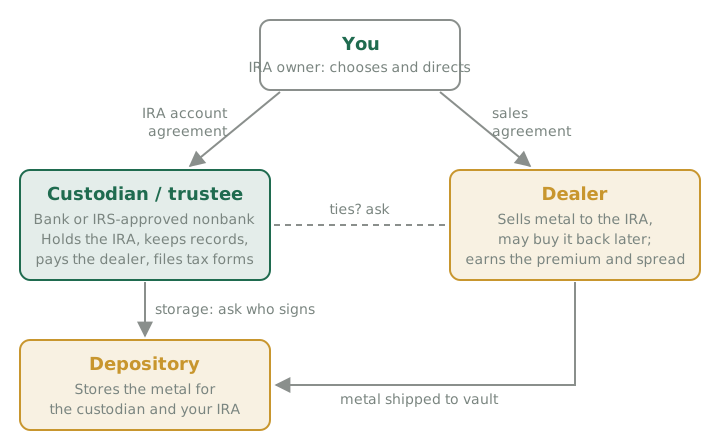
A custodian (or trustee) is the bank or IRS-approved company that holds your IRA and its records. A dealer sells the metal to the IRA and may buy it back. A depository is the vault where the metal is usually kept, under arrangements made through the custodian. You sign an account agreement with the custodian and a sales agreement with the dealer, and each party charges separately.
Three different businesses usually stand behind a Gold IRA. Each has different legal duties, paperwork and ways of getting paid. This page is part of our guide to Gold IRA custodians. If you want the step-by-step path that money and metal take, read how a Gold IRA works first. Here we go deeper into what each party is responsible for, what you sign with each, where conflicts of interest come from, and what to ask each one.
What is the difference between a custodian, a dealer and a depository?
In short: the custodian holds the account, the dealer sells the metal, and the depository stores it.
| Custodian (trustee) | Dealer | Depository | |
|---|---|---|---|
| Main job | Holds and administers the IRA | Sells metal to the IRA; may buy it back | Stores the metal |
| Who it works for | Holds the IRA's assets for you, under its account agreement | Itself, as a seller | Stores the metal; ask your custodian how the storage arrangement works |
| Who may do the job | A bank, federally insured credit union, savings and loan, or IRS-approved entity (Pub. 590-A) | Not an IRA trustee role, so no IRS trustee approval is involved | A storage company the custodian uses or approves; practice varies by custodian |
| Federal oversight | IRS approval for nonbank trustees (26 CFR 1.408-2) | "Not regulated at the federal level" as retail dealers (FINRA) | Depends on the firm; ask |
| Gives investment advice? | No, for self-directed custodians (Investor.gov) | Salespeople may recommend products but are often not licensed to advise (CFTC) | No |
| How it earns money | Account and transaction fees | Premium when it sells, spread when it buys back | Storage and insurance fees |
What does the custodian or trustee legally do?
The custodian is the only one of the three that holds your IRA. An IRA must have a trustee or custodian, and IRS Publication 590-A says it "must be a bank, a federally insured credit union, a savings and loan association, or an entity approved by the IRS to act as trustee or custodian."
Custodian vs trustee: is there a difference?
For practical purposes, no. An IRA can be set up as a trust or as a custodial account. The Treasury regulation says that for such an account, "the custodian of such account will be treated as the trustee thereof" (26 CFR 1.408-2(d)).
What a nonbank custodian has to show the IRS
A firm that isn't a bank must get IRS approval under Treas. Reg. 1.408-2(e). The regulation sets standards an applicant must meet. A few that show what the custodian's job really is:
- "The applicant cannot be an individual."
- "All employees taking part in the performance of the applicant's fiduciary duties will be adequately bonded."
- "The applicant must keep its fiduciary records separate and distinct from other records."
- "Assets of accounts requiring safekeeping will be deposited in an adequate vault. A permanent record will be kept of assets deposited in or withdrawn from the vault."
- "At least once during each period of 12 months, the applicant will cause detailed audits of the fiduciary books and records to be made by a qualified public accountant."
These quotes are from 26 CFR 1.408-2, summarized here; read the full text if a detail matters to you. The IRS publishes the names of approved firms on its approved nonbank trustees and custodians page. When we checked on October 3, 2026, it linked to a list "as of April 1, 2026." Our page on custodian requirements covers the approval rules in more detail.
Why the custodian matters most for metal
The IRS says bullion is generally a collectible, but "There is an exception for certain highly refined bullion provided it is in the physical possession of a bank or an IRS-approved nonbank trustee" (IRS IRA FAQs). That condition is tied to the custodian, not to the dealer or the vault company. FINRA puts it simply: "Metals in an SDIRA must be held by the IRA trustee or custodian" (FINRA).
What a self-directed custodian does not do
A joint alert from the SEC's investor education office, NASAA and FINRA says self-directed IRA custodians "DO NOT sell investment products or provide investment advice" and "DO NOT evaluate the quality or legitimacy of any investment in the self-directed IRA or its promoters." It adds that they "are only responsible for holding and administering the assets in the account" (Investor.gov). So a custodian accepting your purchase does not mean the price was fair.
What does the dealer do, and who oversees it?
The dealer is a seller. It sells coins or bars to your IRA and may offer to buy them back later. Prices start from the spot price, which FINRA calls "the cash price for immediate delivery of physical metal" (FINRA). The dealer charges more than spot when it sells. The CFTC says "A dealer will always sell metal above the spot price and buy it back below the spot price" (CFTC). The gap is the dealer's spread. See dealer premiums and markups.
A dealer is not a custodian, and selling metal is not an IRA trustee role. Oversight is thinner than many people expect. FINRA says "Retail metal dealers are not regulated at the federal level" and suggests checking with "your state's attorney general or securities regulator" for complaints (FINRA). The CFTC publishes warnings about precious metals fraud. Among the schemes it describes are dealers that "Charged customers extra to store bullion in far-away vaults that didn't exist" (CFTC).
What is a "Gold IRA company"?
"Gold IRA company" is a marketing label, not a legal role. A firm using it is typically selling metal, and it may help you with the custodian's forms. It is not the IRA's custodian unless it is itself a bank or other approved trustee. FINRA notes that "Dealers use the 'gold IRA' label for SDIRAs when they want older workers or retirees to use their retirement savings to buy gold or silver bullion" (FINRA). See Gold IRA companies for more on how these firms work.
What does the depository do?
The depository is a vault company. In practice, custodians usually arrange for a separate depository to hold the IRA's metal; ask your custodian how that arrangement works. You don't keep the metal at home while it stays in the IRA; see home storage Gold IRAs for why.
Depositories offer different storage terms. Some keep your IRA's own bars and coins apart; others pool identical items. See segregated vs. commingled storage. Storage and insurance are ongoing costs, and the CFTC warns that some fraudulent dealers "have charged storage and insurance fees for metal that never existed" (CFTC). More in Gold IRA storage.
Who do you sign with, and who do you pay for what?
You usually sign at least two sets of papers, with two different companies.
| Document | Signed with | What it covers | What you pay |
|---|---|---|---|
| IRA application and account (custodial) agreement | Custodian | The account, its rules, fees and what the custodian is and isn't responsible for | Setup, annual, transaction, wire and transfer-out fees |
| Buy or sell direction | Custodian | Your instruction to buy or sell a specific product from a specific dealer | Transaction fees |
| Sales or purchase agreement, invoice | Dealer | Product, quantity, price, delivery and any buyback terms | The premium over spot (and the spread if you sell back) |
| Storage arrangement | Varies: ask whether it is with the custodian, the depository or both | Where and how the metal is held, insurance | Storage and insurance fees, billed by the depository or passed through by the custodian |
Investor.gov notes that "Most custodial agreements between a self-directed IRA custodian and an investor explicitly state that the self-directed IRA custodian has no responsibility for investment performance" (Investor.gov). FINRA advises asking "for all fees, costs, commissions and agreed retail price in writing before signing a sales agreement or turning over any money" (FINRA). Our Gold IRA fees guide covers each charge.
Where do conflicts of interest come from?
Each party gets paid in a different way, and that shapes its incentives.
- The dealer earns more when you buy more, or buy higher-markup products. The CFTC says dealers "are typically salespeople who are paid commissions based on the products they sell. Unlike financial professionals who have a fiduciary responsibility to you, these dealers are not obliged to have your best interests in mind" (CFTC). It also warns that some dealers "pose as 'IRA experts'" (CFTC).
- Referrals between businesses. A dealer often suggests a custodian, and the custodian works with certain depositories. A referral can mean one firm benefits when you pick another. Ask each firm whether it pays or receives anything for referrals.
- Fees stack. The CFTC describes "one recent complaint" in which "a gold dealer and IRA custodian charged nearly $150,000 in commissions and fees to a customer who rolled over a $300,000 retirement account into a gold IRA" (CFTC). That is an allegation in one complaint, not a typical cost, but it shows how dealer and custodian charges can add up.
- Nobody in the chain checks the price for you. The custodian doesn't evaluate the investment, and the dealer is the seller. FINRA notes that in a self-directed IRA, "You no longer have fiduciaries or advisors there to help you guard against bad investments" (FINRA).
What questions should you ask each party?
These neutral checks help you compare firms on facts.
Questions for the custodian
- What is your exact legal name? Are you a bank or credit union, or on the IRS nonbank list?
- If you are a nonbank trustee, can I see your IRS notice of approval? The regulation says an applicant "must not accept a fiduciary account" until the account owner "is furnished with a copy of the written notice of approval" (26 CFR 1.408-2).
- What is your full written fee schedule, and are fees taken from the IRA or billed to me?
- Which dealers and depositories do you accept? Can I use a dealer of my choice? The IRS says "IRA trustees are permitted to impose additional restrictions on investments" (IRS IRA FAQs).
- Do you pay or receive anything from the dealer that referred me?
- How do you value the metal on my statements?
Questions for the dealer
- What is the price per ounce compared with today's spot price, in writing?
- What would you pay to buy it back tomorrow? FINRA suggests asking this (FINRA).
- How are your salespeople paid? Are their commissions included in the spread?
- Is the product eligible for an IRA, and has the custodian confirmed it? See IRA-eligible precious metals.
- Is the person advising me registered? FINRA says if someone "tries to persuade you to buy, suggests what to buy, how much or when, that's advice, and they might be required to register with the CFTC, SEC, FINRA or your state regulator" (FINRA). See how to verify a dealer.
Questions for the depository (often asked through the custodian)
- What is the depository's name and the vault location?
- Is storage segregated or commingled?
- Who carries the insurance, and what does it cover?
- How can I confirm what is held for my IRA? See how to verify your metals.
Our guide on how to evaluate a Gold IRA custodian expands on the custodian checks.
Common mistakes
- Thinking the "Gold IRA company" holds your account. Your account agreement is with the custodian.
- Not knowing the depository's name. Ask, and check it against your custodian statements.
- Treating a salesperson as an adviser. The CFTC warns against investing retirement money in precious metals "without first consulting licensed or registered financial, tax, or legal advisors" (CFTC).
Related questions
What is the difference between a custodian and a depository?
The custodian holds the IRA itself. The IRS says IRA bullion must be "in the physical possession of a bank or an IRS-approved nonbank trustee" (IRS). The depository is the vault where the metal physically sits, under arrangements made through the custodian.
Can one company be both dealer and custodian?
Only a bank, credit union, savings and loan, or IRS-approved entity can be the custodian (Pub. 590-A). If a firm says it does both, ask for its legal name for each role and check the custodian against the IRS list or its regulator.
Who owns the metal?
The IRA does, not the dealer or the depository. See who owns the gold in a Gold IRA.
This page explains general rules, not personal tax or investment advice. A qualified tax professional or fiduciary adviser can help with decisions that depend on your situation.
Sources
- Publication 590-A (2025), Contributions to Individual Retirement Arrangements (IRAs), Internal Revenue Service. Accessed Invalid Date.
- 26 CFR 1.408-2, Individual retirement accounts, Electronic Code of Federal Regulations (eCFR). Accessed Invalid Date.
- Approved nonbank trustees and custodians, Internal Revenue Service. Accessed Invalid Date.
- Retirement plans FAQs regarding IRAs, Internal Revenue Service. Accessed Invalid Date.
- Investor Alert: Self-Directed IRAs and the Risk of Fraud, SEC Office of Investor Education and Advocacy, NASAA and FINRA (Investor.gov). Accessed Invalid Date.
- Investor Bulletin: 10 Things to Ask Before Buying Physical Gold, Silver or Other Metals, FINRA. Accessed Invalid Date.
- Customer Advisory: 10 Things to Ask Before Buying Physical Gold, Silver, or Other Metals, Commodity Futures Trading Commission. Accessed Invalid Date.
- Customer Advisory: Beware of Gold and Silver Schemes Designed to Drain Your Retirement Savings, Commodity Futures Trading Commission. Accessed Invalid Date.
- Precious Metal Frauds, Commodity Futures Trading Commission. Accessed Invalid Date.
This guide is general education, not personalized financial, tax or legal advice. See our financial disclaimer, editorial policy and advertising disclosure.