Silver IRA: Eligible Silver, Rules and Costs
A Silver IRA is a self-directed IRA that holds IRS-eligible physical silver, such as American Silver Eagle coins or qualifying silver bullion. It follows the same rules as a Gold IRA: the silver must fit the tax code's exceptions for certain coins and bullion, and silver bullion must be held by a bank or IRS-approved trustee rather than by you.
A Silver IRA is the same kind of account as a Gold IRA. The difference is what it holds. An IRA can hold more than one metal, and the tax code's bullion exception is written for "gold, silver, platinum, or palladium" together, while the coin exceptions name specific coins. Our guide to IRA-eligible precious metals covers all four metals. This page covers silver: what qualifies, how the account works, what costs differ, and what to ask before you buy.
What is a Silver IRA?
A Silver IRA is a self-directed IRA that holds physical silver instead of, or alongside, stocks, bonds and funds. "Self-directed" means you choose the investments, within the IRS rules, rather than picking from a menu. Our guide to the self-directed IRA explains the term.
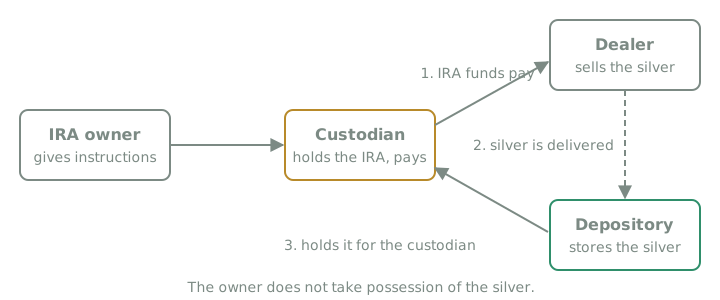
Three parties handle the account:
- a custodian, which holds the IRA, keeps the records and pays for the metal
- a dealer, which sells the silver to the IRA
- a depository, which stores the silver for the custodian
Our guide to the custodian, dealer and depository roles explains who does what.
Why do people choose silver for an IRA?
People give different reasons, and none of them is a promise of a result. Common ones include:
- Diversification. Some savers want part of a retirement account in a physical asset that is not a stock, bond or fund. Whether silver does that job for you depends on your whole portfolio.
- Purchase size. Metals are priced per ounce, so at a lower price per ounce a smaller dollar amount can buy whole coins or bars. Compare current prices.
- Having both metals. Some people want silver alongside gold in one account.
- Physical form. Some people like holding a tangible asset through a trustee, as opposed to a fund share.
Each of these has a trade-off. Silver prices can fall as well as rise, a physical metal pays no interest or dividends, and the costs described below apply whatever the metal does. Our Gold IRA risks guide covers the risks that apply to any metals IRA. Whether silver belongs in your retirement plan is a question for a qualified financial adviser who knows your situation.
Which silver can go in an IRA?
The tax code treats most metals and coins as collectibles. An IRA that buys a collectible is treated as making a taxable distribution of what it paid. For individually directed accounts in qualified plans, the IRS puts it this way (26 U.S.C. 408(m)(1) applies the same rule to IRAs): "A plan participant whose account acquires a collectible is deemed to receive a distribution in the year the collectible is acquired. The amount of the distribution is the cost of the collectible at the time it is acquired" (IRS). Our collectibles rule guide explains this in full.
The statute defines "collectible" to include "any metal or gem" and "any stamp or coin." It then carves out exceptions in section 408(m)(3). Silver can fit in two ways, and the statute and the IRS list a third that covers state-issued coins.
| Exception | What the statute says | What it means for silver |
|---|---|---|
| Certain U.S. silver coins | "a silver coin described in section 5112(e) of title 31, United States Code" | The American Silver Eagle's specifications match this paragraph, and the U.S. Mint says American Eagles can be included in IRAs |
| Bullion of the required fineness | Silver bullion "of a fineness equal to or exceeding the minimum fineness that a contract market ... requires for metals which may be delivered in satisfaction of a regulated futures contract," if it is "in the physical possession of a trustee" | Silver bars and other bullion can qualify if they meet the fineness standard and a trustee holds them |
| State-issued coins | "a coin issued under the laws of any State" | Applies only to coins that a state itself issues |
How does the American Silver Eagle qualify?
The statute describes the coin the exception covers. Under 31 U.S.C. 5112(e), silver bullion coins are 40.6 millimeters in diameter, weigh 31.103 grams, contain .999 fine silver, and carry the words "One Dollar" and "1 Oz. Fine Silver." The U.S. Mint says each coin's "weight and fineness of one troy ounce of .999 fine silver is guaranteed by the United States Government" and that "long-term savers can include American Eagles in their Individual Retirement Accounts (IRAs)" (U.S. Mint).
Two points are easy to miss:
- The coin exception is about the type of coin, not the dealer's description. A coin qualifies because it is a coin the statute describes, not because someone calls it "IRA approved."
- The bullion exception depends on physical possession by a bank or approved non-bank trustee. Don't assume you can keep any IRA silver at home. Our home storage guide explains why that is risky.
What about silver bars and other bullion?
For bars and other bullion, the statute sets a fineness test tied to the standard a regulated futures exchange requires for metal delivered against a futures contract. The statute does not list a fineness number. We have not confirmed the current exchange standard for silver on an exchange page, so this guide does not give one. Our guide to fineness and purity covers the subject, and our guide to IRA-eligible silver coins and bars goes product by product.
Fineness alone is not enough. The bullion must also be in the physical possession of the trustee, and your custodian must be willing to accept the product. Many custodians publish lists of the products they accept. Ask for the specific product name in writing, and confirm eligibility with the custodian before the IRA pays.
Silver that does not qualify
- Collector coins that fall outside the exceptions. Rare or collectible coins aren't covered by the coin or bullion exceptions. Be wary of the label "semi-numismatic." FINRA and the CFTC call it "a made-up industry term that really has no special meaning" and say such coins "typically aren't rare and carry no additional value" (FINRA). Our bullion vs numismatic guide explains the difference.
- Foreign coins that don't meet an exception. Whether a particular foreign silver coin qualifies depends on whether it meets the bullion fineness test and the custodian accepts it. Don't assume. Our guide to coins that are not IRA eligible covers common cases.
- Silver jewelry and silverware, which are not bullion coins or bars. Check with your custodian.
- Silver you already own at home. IRS Publication 590-A says "Contributions must be in the form of money (cash, check, or money order)" and "Property can't be contributed." The IRA uses money to buy the metal.
How do you set up and fund a Silver IRA?
The steps below are typical. Providers differ, so confirm each one with your custodian. Our full how to open a Gold IRA guide walks through the process and works the same way for silver.
- Choose the type of IRA. The choice between Traditional and Roth affects when tax is due, not what the IRA can hold.
- Choose a self-directed IRA custodian that accepts metals. Not every IRA custodian does. Ask which depositories and products it works with.
- Open the account and complete the paperwork.
- Fund the account. You can fund it with a contribution, a rollover from another plan such as a 401(k), or a transfer between IRA custodians. The rollover vs transfer guide explains the difference. For annual limits, see the contribution limits guide.
- Pick the silver. Choose eligible coins or bars, and get the exact product, quantity and price in writing.
- Direct the purchase. The custodian sends payment from the IRA to the dealer.
- Delivery to storage. The dealer ships the silver to the depository, which holds it for the custodian.
- Check the statements. Your holdings should appear on your custodian's statements and name the depository.
If the money moves in a way that lets you touch it, such as an indirect rollover, deadlines and tax rules apply. The 60-day rule guide covers that. A direct transfer between custodians is not an indirect rollover, so the 60-day deadline doesn't apply to it (see the IRA transfer guide).
Who must hold the silver?
For bullion, the exception only works while the metal is held by the right party. The IRS says there is "an exception for certain highly refined bullion provided it is in the physical possession of a bank or an IRS-approved nonbank trustee" (IRS IRA FAQs). The same page says the collectibles rule also applies to an indirect acquisition, such as an IRA-owned LLC buying the bullion. Ask your custodian how storage is arranged, including whether it uses a depository. Our storage guide covers how depositories work, and the guide to segregated vs commingled storage explains the choices.
What is different about silver?
Silver uses the same account and rules as gold. A few practical points change, and most of them are questions to ask rather than facts to assume.
Lower price per ounce, more ounces
At a lower price per ounce, the same dollar amount buys more ounces, which can mean more items to count, ship and store.
More metal to store
Each Silver Eagle weighs 31.103 grams under the statute. A larger dollar amount of silver therefore means many coins and a noticeable total weight. Ask your custodian and depository how storage is priced: by value, by weight, by number of items, or a flat fee. Ask what happens to the fee as your holdings grow.
Premiums and spreads
Dealers charge a premium above the spot price when they sell. The spot price, according to FINRA and the CFTC, "is the cash price for immediate delivery of physical metal." The dealer also buys back at a lower price than it sells at. FINRA and the CFTC say: "The difference between the dealer's buy and sell price is known as the dealer's spread. Each dealer sets its own spread" (FINRA).
A premium is often quoted per ounce or as a percent of spot. Ask for both the buy and the buyback numbers for the exact product, and ask whether the premium differs for coins and bars, or for large and small orders. Our guide to dealer premiums and markups explains how to compare quotes, and our spot price guide explains the base price. See also buyback costs.
Taking silver out later
If you take a distribution in kind, meaning the metal itself rather than cash, the silver is shipped or handed over. Ask your custodian and a tax professional how an in-kind distribution is valued and reported. With silver, the quantity can be large. Ask about shipping, insurance and handling charges for the full amount you hold. Our guide to in-kind distributions covers the rules.
Price swings
Silver prices can rise and fall. How much price movement fits your retirement plan is a question for a qualified adviser. Nothing on this site predicts prices.
A worked example: what a premium and spread can do
This example uses made-up round numbers. They are not real prices, and they are not a forecast.
Suppose the IRA buys silver coins and the quote says:
- spot price: $40.00 per ounce
- dealer's selling price: $44.00 per ounce, a 10% premium over spot
- dealer's buyback price: $40.80 per ounce, 2% above spot
| Step | Calculation | Result |
|---|---|---|
| Ounces bought with $10,000 | $10,000 / $44.00 | 227.27 ounces |
| Value if sold back at once, with spot unchanged | About 227.27 x $40.80 (unrounded ounces) | $9,272.73 |
| Difference | $9,272.73 - $10,000 | -$727.27, or about 7.3% |
| Spot price needed to break even at a 2% buyback premium | $44.00 / 1.02 | about $43.14, or roughly 7.8% above $40.00 |
This does not include custodian or storage fees, which would add to the amount the silver must gain to break even. The point is that the buy and sell prices differ, so an immediate sale usually returns less than the purchase price even if the spot price has not moved. Real premiums vary by product, dealer and order size. The total cost and break-even calculator lets you test your own quotes.
Weight is easy to check with the statute's figure of 31.103 grams per coin: 227.27 coins weigh about 7.07 kilograms (about 15.6 pounds) in coin metal alone. That is only an illustration of why bulk matters for storage and shipping. It excludes packaging.
What does a Silver IRA cost?
Costs to ask about:
- custodian setup and annual fees
- storage and insurance fees, and how they are calculated
- the dealer premium on the specific coin or bar
- the dealer's buyback price for the same product
- shipping, handling or transaction fees, including for an in-kind withdrawal
The CFTC says that self-directed IRAs "come with complicated tax rules, monthly administrative fees, and handling and storage charges" (CFTC). Our fee guide and melt value calculator help you compare quotes.
How are Silver IRA taxes handled?
Distributions from a Traditional or Roth IRA are generally taxed under the rules for that IRA type in IRS Publication 590-B. A purchase of a collectible that doesn't qualify is a separate issue: it is treated as a distribution of its cost, as the IRS says above. See Gold IRA taxes for the details, and ask a CPA or enrolled agent about your own situation.
What are the main risks?
- Price risk. The value of silver can fall, and the account can lose value.
- Cost drag. Premiums, the spread and fees can take a real share of a small account.
- Eligibility mistakes. Buying something that doesn't fit an exception can trigger a taxable distribution of its cost.
- Possession mistakes. Holding IRA metal yourself can defeat the bullion exception.
- Sales pressure and fraud. The CFTC warns that some dealers have "charged customers extra to store bullion in far-away vaults that didn't exist," and says it "is illegal for dealers to offer leveraged or financed purchases unless your metal is delivered within 28 days" (CFTC). The FINRA and CFTC bulletin asks: "Should I respond to a precious metals dealer who calls or emails me with an attractive offer?" and answers "No." Make sure statements come from the custodian and name the depository. See our warning signs guide.
- Liquidity. Selling means going through the custodian and a dealer, which takes time and has a cost.
What mistakes should you avoid?
- Buying before confirming in writing that the custodian accepts the exact product.
- Paying for "rare" or "semi-numismatic" silver when the IRA's purpose is bullion.
- Comparing only the spot price and ignoring the premium and buyback price.
- Ignoring how storage fees scale with the amount of silver.
- Having silver delivered to your home for an IRA purchase.
- Relying on a sales call instead of the written account documents.
Silver IRA vs Gold IRA
| Silver IRA | Gold IRA | |
|---|---|---|
| Account rules | Same IRA rules | Same IRA rules |
| U.S. Mint bullion coin example | American Silver Eagle | American Gold Eagle |
| Price per ounce | Lower | Higher |
| Items and weight for the same dollar amount | More | Fewer |
| Storage to ask about | Fee method for bulk | Fee method for value |
| Premium per ounce | Ask the dealer; premiums vary by product | Ask the dealer; premiums vary by product |
| Same tax treatment of withdrawals | Yes, by IRA type, apart from the collectibles rule | Yes, by IRA type, apart from the collectibles rule |
One IRA can hold more than one metal. See Gold IRA vs Silver IRA for a fuller comparison, and our platinum IRA guide if you are comparing other metals.
Related questions
Can I hold silver in an IRA?
Yes, if it is an eligible silver coin or qualifying silver bullion. Bullion must be held by a bank or IRS-approved trustee.
Can one IRA hold both gold and silver?
Yes. The statute's bullion exception names gold, silver, platinum and palladium, so an IRA can hold more than one metal as long as each item qualifies.
Can I buy silver jewelry or old silverware with my IRA?
Not without a tax consequence. Those items aren't bullion or qualifying coins, so buying them would be treated as a distribution of their cost (26 U.S.C. 408(m)(1)).
Can I put silver I already own into my IRA?
Generally no. Publication 590-A says "Contributions must be in the form of money (cash, check, or money order). Property can't be contributed." A transfer or rollover from another retirement account is a different process, so ask your custodian.
Are silver withdrawals taxed differently?
The IRS's distribution rules in Publication 590-B are written mainly by IRA type, Traditional or Roth; the publication also covers investments in collectibles. See Gold IRA taxes.
Is a Silver IRA right for me?
That depends on your age, goals, other savings and tolerance for risk. A fee-only financial planner or CPA can help you weigh it.
Guides in this section
Sources
- Publication 590-B (2025), Distributions from Individual Retirement Arrangements (IRAs), Internal Revenue Service. Accessed Invalid Date.
- Investments in collectibles in individually directed qualified plan accounts, Internal Revenue Service. Accessed Invalid Date.
- Retirement plans FAQs regarding IRAs, Internal Revenue Service. Accessed Invalid Date.
- 26 U.S.C. 408, Individual retirement accounts, U.S. Government Publishing Office (govinfo). Accessed Invalid Date.
- 31 U.S.C. 5112, Denominations, specifications, and design of coins, U.S. House of Representatives, Office of the Law Revision Counsel. Accessed Invalid Date.
- Publication 590-A (2025), Contributions to Individual Retirement Arrangements (IRAs), Internal Revenue Service. Accessed Invalid Date.
- Bullion Coin Programs, United States Mint. Accessed Invalid Date.
- Investor Bulletin: 10 Things to Ask Before Buying Physical Gold, Silver or Other Metals, FINRA and CFTC. Accessed Invalid Date.
- Precious Metal Frauds, Commodity Futures Trading Commission. Accessed Invalid Date.
This guide is general education, not personalized financial, tax or legal advice. See our financial disclaimer, editorial policy and advertising disclosure.