Gold IRA Rollover Guide: Process, Rules and Timing
A Gold IRA rollover moves money from a 401(k), another workplace plan or an IRA into a self-directed IRA that can buy eligible metal. With a direct rollover or trustee-to-trustee transfer, no taxes are withheld. If the money is paid to you instead, you generally have 60 days to deposit it.
Most Gold IRAs are funded with money that's already in a retirement account. Moving it the right way keeps it tax-deferred. Moving it the wrong way can mean withheld taxes, a missed deadline, and a tax bill on money you meant to keep saving.
This guide covers the mechanics of the move itself. For what a Gold IRA is and how it works once it's funded, start with the Gold IRA Guide. For the IRS rules on which metal the account can hold and who must store it, see Gold IRA Rules.
A quick word on terms. A rollover is when money leaves one retirement account and goes into another. A transfer is a move between two IRAs, from one custodian straight to the other. The two get mixed up all the time, and the difference matters for taxes and limits. Our page on the difference between a rollover and a transfer explains it in full.
What are the three ways to move the money?
The IRS describes three methods (IRS):
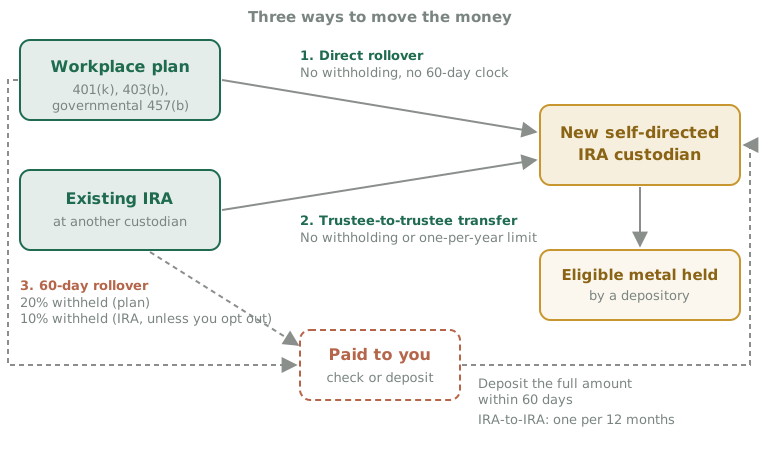
| Direct rollover | Trustee-to-trustee transfer | 60-day (indirect) rollover | |
|---|---|---|---|
| Usual source | 401(k), 403(b), governmental 457(b) or other workplace plan | Another IRA | A workplace plan or an IRA |
| Who receives the money | Your new IRA custodian | Your new IRA custodian | You |
| Tax withheld | None | None | 20% from a workplace plan; 10% from an IRA unless you choose otherwise |
| Deadline for you | None | None | 60 days from the day you receive it |
| Counts toward one-per-year limit? | No | No | Yes, if it's an IRA-to-IRA rollover |
For both direct rollovers and trustee-to-trustee transfers, the IRS says "no taxes will be withheld from your transfer amount" (IRS). For a Gold IRA, the direct methods avoid both withholding and the 60-day deadline. The one-per-year column comes from the IRS page on the one-rollover-per-year rule, covered below.
Moving an existing IRA into a Gold IRA is usually a transfer rather than a rollover. See our Gold IRA Transfer guide. For a side-by-side look at the two rollover routes, see direct vs Indirect Rollover for a Gold IRA.
How does a direct rollover into a Gold IRA work, step by step?
- Check that the money can move. Each plan sets its own rules on when money can be rolled out, so ask the plan administrator. Some plans allow in-Service Rollovers while you still work there; many only allow a rollover after you leave.
- Open the self-directed IRA first. A self-directed IRA is an IRA whose custodian allows assets such as physical metal. Choose a custodian that holds precious metals. Get the account number and its instructions for incoming rollovers.
- Match the account type. Pre-tax 401(k) money goes into a Traditional Gold IRA. Roth 401(k) money goes into a Roth Gold IRA. More on this below.
- Request a direct rollover from your plan. Ask for the payment to go to the new custodian "for the benefit of" you, not to you personally.
- Wait for the money to arrive and confirm the amount with the custodian.
- Choose the metal and approve the purchase. Only eligible coins and bullion qualify. Get the price, the spot price and the dealer's buyback price in writing before the custodian pays. Our Gold IRA fees guide explains what to ask about.
- Keep the paperwork, including any tax forms the old plan and the new custodian send you.
How long does a Gold IRA rollover take?
There's no single answer. The timeline depends on how quickly your old plan or custodian processes the request, how the money is sent, and when you approve the metal purchase. Ask each firm for its usual processing time and exactly what paperwork it needs.
Rollover paperwork isn't standard across plans yet. The IRS has issued Notice 2026-49, with sample forms meant to "simplify, standardize, facilitate, and expedite" rollovers. The notice says "use of the sample forms and proposed rollover procedures is optional." It covers rollovers that involve an employer plan. It says the forms "are not intended to be used for IRA-to-IRA rollovers or transfers."
How does the 60-day rule work?
If money is paid to you, you can still roll it over. The IRS says: "You have 60 days from the date you receive an IRA or retirement plan distribution to roll it over to another plan or IRA" (IRS). If you don't, the IRS says "it will be taxable" (other than qualified Roth distributions and any amounts already taxed). If you're under 59½, the 10% additional tax may also apply unless an exception fits (IRS).
Counting the days (illustration). Say the check arrives on June 10. Counting from June 11 as day 1, day 60 is August 9. The money needs to be in the new IRA by then. See the 60-Day Rollover Rule and One-Rollover-Per-Year Limit for more.
Why withholding makes indirect rollovers harder
- Workplace plans must withhold 20% of a distribution paid to you. The IRS says this applies "even if you intend to roll it over later" (IRS; Topic 413).
- IRA distributions paid to you are subject to 10% withholding unless you choose otherwise (IRS).
To roll over the full amount, you have to replace the withheld money from your own pocket within the 60 days. If you don't, the part you didn't replace is treated as a taxable distribution.
Worked example: $100,000 from a 401(k) paid to you
The IRS gives an example with a $10,000 401(k) distribution and $2,000 withheld (IRS). Here are the same rules at a larger size. The numbers are made up, and the account is all pre-tax money.
| Replace the withheld 20% | Don't replace it | |
|---|---|---|
| Amount taken from the 401(k) | $100,000 | $100,000 |
| Withheld by the plan (20%) | $20,000 | $20,000 |
| Check you receive | $80,000 | $80,000 |
| Deposited in the Gold IRA within 60 days | $100,000 (the $80,000 plus $20,000 of your own savings) | $80,000 |
| Reported as a nontaxable rollover | $100,000 | $80,000 |
| Reported as taxable income | $0 | $20,000 |
| Withheld amount reported as tax paid | $20,000 | $20,000 |
| 10% additional tax risk if under 59½ | None on the rollover | On the $20,000, unless an exception applies |
In the IRS's own example, the person who rolls over only the net amount reports the withheld part "as taxable income," the rest "as a nontaxable rollover," and the withheld amount "as taxes paid." The withheld money isn't lost. It's counted on your tax return for that year. But any refund comes only after you file, while the replacement cash was needed within 60 days. A direct rollover avoids this problem entirely.
What if you miss the 60-day deadline?
The IRS may waive the 60-day requirement "if you missed the deadline because of circumstances beyond your control" (IRS). Its waiver FAQs describe three routes:
| Route | When it applies | What you do |
|---|---|---|
| Automatic waiver | The financial institution got the money before the deadline, you followed its procedures, and the delay was solely its error | The funds must be deposited within 1 year from the start of the 60-day period |
| Self-certification | One of the reasons listed in the IRS model letter kept you from finishing on time | Give the model letter to the receiving custodian or plan; no IRS filing or fee |
| Private letter ruling | Other situations | Ask the IRS for a ruling, which carries a user fee |
The reasons you can self-certify are set out in Rev. Proc. 2016-47. In short, they are:
- an error by the financial institution making the distribution or receiving the deposit
- a distribution check that was misplaced and never cashed
- money deposited into an account you mistakenly thought was an eligible retirement plan
- severe damage to your main home
- a death in your family
- serious illness of you or a family member
- your incarceration
- restrictions imposed by a foreign country
- a postal error
- a distribution made on account of an IRS levy, where the proceeds were returned to you
- a delay by the paying party in providing information the receiving plan or IRA needed, despite your reasonable efforts
Rev. Proc. 2020-46 added one more: "the distribution was made to a state unclaimed property fund."
Self-certification has conditions. You must deposit the money "as soon as practicable (usually within 30 days)" after the reason stops preventing you (IRS FAQs). The IRS must not have denied you a waiver for that distribution before. It isn't a final answer either. The FAQs warn that if the IRS later audits your return, "it may determine that you do not qualify for a waiver, in which case you may owe additional taxes and penalties." Whether your situation fits is a question for a tax professional.
What is the one-rollover-per-year rule?
The IRS says: "you can make only one rollover from an IRA to another (or the same) IRA in any 12-month period, regardless of the number of IRAs you own" (IRS). All your IRAs count together for this, including "SEP and SIMPLE IRAs as well as traditional and Roth IRAs."
The limit does not apply to (IRS):
- trustee-to-trustee transfers between IRAs
- rollovers from a workplace plan to an IRA
- rollovers from an IRA to a workplace plan
- plan-to-plan rollovers
- conversions from a Traditional IRA to a Roth IRA
Breaking the rule is costly. According to the IRS, the second rollover must be included in income, may face the 10% early withdrawal tax, and, if it stays in the IRA, may be treated as an excess contribution taxed at 6% a year. This is another reason to move IRA money by transfer rather than by a check paid to you.
Which accounts can roll into a Gold IRA?
The IRS rollover chart shows which accounts can move where. Here is the part that matters for a Gold IRA:
| Moving from | Into a Traditional IRA | Into a Roth IRA |
|---|---|---|
| 401(k) or other qualified plan (pre-tax) | Yes | Yes, but must include in income |
| 403(b) (pre-tax) | Yes | Yes, but must include in income |
| Governmental 457(b) | Yes | Yes, but must include in income |
| Traditional IRA | Yes (one rollover per 12 months) | Yes, but must include in income |
| SEP IRA | Yes (one rollover per 12 months) | Yes, but must include in income |
| SIMPLE IRA | Yes, after two years | Yes, after two years, but must include in income |
| Designated Roth account (Roth 401(k), 403(b) or 457(b)) | No | Yes |
| Roth IRA | No | Yes (one rollover per 12 months) |
Each source account has its own details:
- Most people start with a 401(k); the 401 to Gold IRA Rollover guide covers plan rules and paperwork.
- Teachers and nonprofit workers often have a 403(b); see 403 to Gold IRA Rollover.
- State and local government workers may have a governmental 457(b); see 457 to Gold IRA Rollover.
- Federal workers and service members use the Thrift Savings Plan; see TSP to Gold IRA Rollover for Federal Employees and Military.
- Some pension plans offer a lump sum instead of monthly payments; see pension Lump Sum to Gold IRA.
If you'd rather keep the money in your current plan, our page on gold in a 401(k) explains what that can look like.
How do Roth and after-tax money roll over?
Keep each type of money in the right kind of account.
- Pre-tax money goes to a Traditional IRA to stay tax-deferred. If you send it to a Roth IRA instead, the chart says you "must include in income" (rollover chart; Topic 413).
- Roth 401(k) money (a "designated Roth account") can roll to a Roth IRA, but not to a Traditional IRA (rollover chart). See Roth 401 to Roth Gold IRA Rollover.
- After-tax (non-Roth) contributions in a workplace plan can be split off. Under Notice 2014-54, "distributions sent to multiple destinations at the same time are treated as a single distribution." For example, the IRS says you could take a full distribution and directly roll over the pretax amounts to a Traditional IRA and the after-tax amounts to a Roth IRA. It also says you can't take a distribution of only the after-tax amounts and leave the rest in the plan.
One catch with after-tax money: you can't pick only the after-tax dollars out of a partial withdrawal. The IRS says each plan distribution "must include a proportional share of the pretax and after-tax amounts in the account." In its example, an account holds $80,000 pre-tax and $20,000 after-tax, so a $50,000 distribution is "$40,000 pretax and $10,000 after-tax." Earnings on after-tax contributions also count as pre-tax money (IRS). See after-Tax 401 Money and Gold IRA Rollovers.
What can't be rolled over?
Not every payment from a retirement account qualifies. The IRS lists amounts that can't be rolled over (IRS; Topic 413). Among them:
- Required minimum distributions (RMDs), from IRAs or workplace plans. If you're taking RMDs, that year's required amount stays taxable even if you move the rest.
- Hardship distributions from a workplace plan.
- Substantially equal periodic payments made for life or for a set period.
- Corrective distributions of excess contributions.
- Plan loans treated as distributions.
Gold IRA buyers should know one more rule. If an IRA pays you property instead of cash, Publication 590-A says "the same property must be rolled over" (Publication 590-A). Publication 590-A describes selling distributed property and rolling over the proceeds for distributions from employer plans.
Is a Gold IRA rollover taxable?
A direct rollover or transfer between like accounts generally isn't taxable. It becomes taxable if money isn't deposited within 60 days, if part of it is a required minimum distribution, or if pre-tax money moves into a Roth IRA. See Gold IRA Rollover Taxes and Penalties.
A rollover also doesn't use up your yearly contribution room. IRS Publication 590-A explains that rollover contributions are treated separately from regular contributions.
What are the most common rollover mistakes?
- Taking a check made out to you when a direct rollover was available.
- Forgetting the withheld 20% and rolling over only the net amount.
- Mixing account types, such as sending pre-tax money into a Roth IRA without meaning to. The IRS rollover chart notes that this must be included in income.
- Doing a second IRA-to-IRA rollover within 12 months (IRS).
- Trying to roll over an RMD, which the IRS says can't be rolled over.
- Rushing the metal purchase. The CFTC warns about dealers who pose as "IRA experts" and push customers to buy as much metal as possible (CFTC).
- Buying ineligible coins, which the IRS treats as a distribution of their cost (IRS).
See Gold IRA Rollover Mistakes to Avoid.
Related questions
Do I have to roll over everything?
No. You can roll over part of an account and leave the rest where it is. The IRS says that if you don't roll over a payment, "it will be taxable (other than qualified Roth distributions and any amounts already taxed)" (IRS). Publication 590-A covers partial rollovers.
Does a rollover count toward my contribution limit?
No. IRS Publication 590-A explains that rollover contributions don't count toward the annual contribution limit.
Can I roll over metal I already own into a Gold IRA?
Rollovers move money, or the same property, from one retirement account to another. The Gold IRA Rules page explains how metal gets into the account.
Is it better to transfer or roll over an existing IRA?
That depends on your situation, but the trade-offs are clear. A trustee-to-trustee transfer has no one-per-year limit (IRS), and no withholding or 60-day clock because the money doesn't pass through your hands (IRS rollovers page). A 60-day rollover has all three. See rollover vs transfer.
Guides in this section
- 401(k) to Gold IRA Rollover: Rules, Steps and Tax TrapsHow a former-employer 401(k) can be rolled into a self-directed Gold IRA, direct vs indirect options, withholding, and what to confirm with your plan.
- 403(b) to Gold IRA RolloverWhen 403(b) money is eligible to roll into a self-directed Gold IRA, distributable events, and steps to request a direct rollover.
- 457(b) to Gold IRA RolloverRolling a governmental 457(b) into a Gold IRA: eligibility, and why moving to an IRA can change early-withdrawal penalty treatment.
- TSP to Gold IRA Rollover for Federal Employees and MilitaryHow Thrift Savings Plan withdrawals can be rolled to a self-directed Gold IRA, TSP-specific forms and rules, and Roth TSP considerations.
- Pension Lump Sum to Gold IRA: What to KnowWhen a pension lump sum can be rolled to an IRA, the trade-off of giving up lifetime income, and tax rules for the rollover.
- In-Service Rollovers: Current Employer 401(k) to Gold IRAWhether your current employer's plan allows in-service distributions, the age thresholds plans commonly use, and how to confirm with your administrator.
- Roth 401(k) to Roth Gold IRA RolloverHow designated Roth 401(k) money can move into a Roth Gold IRA, the Roth IRA five-year clock, and mistakes that can create taxes.
- Direct vs Indirect Rollover for a Gold IRADirect vs indirect rollovers into a Gold IRA: who receives the money, mandatory withholding on plan distributions, the 60-day deadline and risks.
- The 60-Day Rollover Rule and One-Rollover-Per-Year LimitHow the 60-day rollover window and the once-per-12-months IRA rollover limit work, exceptions, and self-certification for late rollovers.
- Gold IRA Rollover Taxes and Penalties: When a Rollover Becomes TaxableWhen moving money into a Gold IRA is tax-free, what turns it into a taxable distribution, and how rollovers appear on Forms 1099-R and 5498.
- Gold IRA Rollover Mistakes to AvoidCommon rollover and setup mistakes - indirect rollover timing, withholding gaps, ineligible products, storage errors and sales-pressure decisions.
- After-Tax 401(k) Money and Gold IRA RolloversHow pre-tax and after-tax 401(k) amounts can be split between traditional and Roth IRAs under IRS Notice 2014-54, and basis tracking.
Sources
- Rollovers of retirement plan and IRA distributions, Internal Revenue Service. Accessed Invalid Date.
- IRA one-rollover-per-year rule, Internal Revenue Service. Accessed Invalid Date.
- Rollover chart, Internal Revenue Service. Accessed Invalid Date.
- Topic no. 413, Rollovers from retirement plans, Internal Revenue Service. Accessed Invalid Date.
- Rollovers of after-tax contributions in retirement plans, Internal Revenue Service. Accessed Invalid Date.
- Retirement plans FAQs relating to waivers of the 60-day rollover requirement, Internal Revenue Service. Accessed Invalid Date.
- Rev. Proc. 2016-47, Internal Revenue Service. Accessed Invalid Date.
- Rev. Proc. 2020-46, Internal Revenue Service. Accessed Invalid Date.
- Guidance on Section 324 of the SECURE 2.0 Act with Respect to Rollovers (Notice 2026-49), Internal Revenue Service. Accessed Invalid Date.
- Retirement topics - Tax on early distributions, Internal Revenue Service. Accessed Invalid Date.
- Investments in collectibles in individually directed qualified plan accounts, Internal Revenue Service. Accessed Invalid Date.
- Publication 590-A (2025), Contributions to Individual Retirement Arrangements (IRAs), Internal Revenue Service. Accessed Invalid Date.
- Precious Metal Frauds, Commodity Futures Trading Commission. Accessed Invalid Date.
This guide is general education, not personalized financial, tax or legal advice. See our financial disclaimer, editorial policy and advertising disclosure.