Gold IRA Storage: Depositories, Options and Rules
IRA bullion must stay in the physical possession of a bank or IRS-approved non-bank trustee. Metal may be vaulted by the custodian or through a facility it uses, so ask which. The U.S. Tax Court has treated keeping IRA-bought coins at home as a taxable distribution. Storage options, insurance and fees vary, so get them in writing.
Where your metal is kept isn't a detail in a Gold IRA. It's one of the two rules that decide whether the metal counts as an IRA investment at all. This page is the storage hub of our Gold IRA Guide. It explains who may hold IRA metal, how depositories fit in, what to ask about insurance and audits, and how to confirm your metal is really there.
We describe rules and questions to ask. We don't name or rank storage companies, and we don't say which option suits you. That depends on your documents and your situation, so a qualified tax professional or attorney is the right person for those decisions.
The rule: a trustee must hold it
The tax code lets an IRA hold certain bullion only while it's held by a trustee. The IRS describes the exception as covering "certain highly refined bullion provided it is in the physical possession of a bank or an IRS-approved nonbank trustee" (IRS IRA FAQs). The same FAQ adds that "This rule also applies to an indirect acquisition, such as having an IRA-owned Limited Liability Company (LLC) buy the bullion."
Why the code says "trustee"
Start with the collectibles rule. Under section 408(m)(1), when an IRA acquires a "collectible," that purchase is treated as "a distribution from such account in an amount equal to the cost to such account of such collectible." The definition of collectible includes "any metal or gem" and "any stamp or coin." See the IRA collectibles rule.
Section 408(m)(3) then carves out exceptions. For bullion, it covers "any gold, silver, platinum, or palladium bullion of a fineness equal to or exceeding the minimum fineness that a contract market (as described in section 5 of the Commodity Exchange Act, 7 U.S.C. 7) requires for metals which may be delivered in satisfaction of a regulated futures contract, if such bullion is in the physical possession of a trustee described under subsection (a) of this section." So there are two tests: the metal must be pure enough, and a trustee must physically hold it. Which products meet the purity test is covered in our metals guide.
Who counts as a trustee?
Section 408(a)(2) says the trustee "is a bank (as defined in subsection (n)) or such other person who demonstrates to the satisfaction of the Secretary that the manner in which such other person will administer the trust will be consistent with the requirements of this section." Subsection (n) defines "bank" to include a bank as defined in section 581, an insured credit union, and a corporation that is subject to supervision and examination by a state banking officer. Section 408(h) applies the same standard to custodial accounts.
Publication 590-A puts it this way: "The trustee or custodian must be a bank, a federally insured credit union, a savings and loan association, or an entity approved by the IRS to act as trustee or custodian."
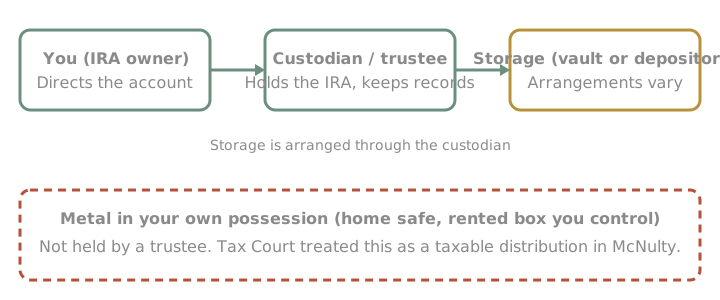
You, the account owner, are not the trustee. That's the point of the rule. For how custodians, dealers and depositories divide the work, see custodian vs dealer vs depository and our guide to Gold IRA custodians.
What the rules require of a nonbank trustee
Treasury regulations set conditions for approval of nonbank trustees. Under 26 CFR 1.408-2(e), the applicant "must keep its fiduciary records separate and distinct from other records," and "Assets of accounts requiring safekeeping will be deposited in an adequate vault. A permanent record will be kept of assets deposited in or withdrawn from the vault." The regulation also calls for adequate bonding of employees performing fiduciary duties and says "At least once during each period of 12 months, the applicant will cause detailed audits of the fiduciary books and records to be made by a qualified public accountant."
Two cautions. These are conditions for a nonbank trustee's own approval, and they concern its fiduciary books and records. We didn't find a regulator source saying they set insurance or audit standards for a separate depository company. And they don't tell you how much insurance anyone carries. Ask for specifics (see below).
Where does the metal physically sit?
Some custodians vault metal themselves, and some use a separate storage company, often called a depository. We did not find a regulator source describing how this works, so ask. The tax code requires a trustee to hold the metal; it doesn't use the word "depository." So how a particular custodian meets the possession requirement, whether it vaults the metal itself or uses an outside facility, is something to ask it and read in your agreement. Our page on IRA-approved depositories explains why "approved" is a term to examine carefully.
Can I keep IRA gold at home?
Doing so risks a taxable distribution. The IRS FAQ on this exact question says gold and other bullion "are 'collectibles' under the IRA statutes, and the law discourages the holding of collectibles in IRAs," and that the bullion exception requires physical possession by a bank or IRS-approved nonbank trustee.
In McNulty v. Commissioner, 157 T.C. No. 10 (2021), Mrs. McNulty directed her IRA to buy an interest in an LLC, which bought American Eagle gold coins. The opinion says "The coins were shipped to petitioners' personal residence and were stored in a safe there." The U.S. Tax Court held that Mrs. McNulty received "taxable distributions from her self-directed IRA equal to the cost of the AE coins upon her receipt of the coins," and stated that "an owner of a self-directed IRA may not take actual and unfettered possession of the IRA assets" (opinion). Mr. McNulty conceded that he received taxable distributions from his own IRA transactions, and the court held both petitioners liable for accuracy-related penalties.
The arguments that failed
The McNultys argued that coins aren't "bullion," so no trustee needed to hold them. The court wrote that "The flush text does not create an exception to the custodial and fiduciary requirements of section 408(a) irrespective of whether it applies to both subparagraphs (A) and (B) or whether AE coins are bullion." It also described what a custodian does: "A custodian is required to maintain custody of the IRA assets, maintain the required records, and process transactions that involve IRA assets."
The court found Mrs. McNulty "had complete, unfettered control over the AE coins and was free to use them in any way she chose." Putting the coins in an LLC didn't change that result.
Home storage and your other options
Metal that you hold personally is no longer in the IRA. One way for it to leave is an in-kind distribution, which is a withdrawal with the tax consequences described in our withdrawal guide. We don't give an opinion on any other arrangement, such as a safe deposit box you rent yourself. The statute's condition is possession by a trustee, not by you, and we found no IRS guidance approving such a box. Anyone considering a variation should get a written opinion from a tax attorney. Full details: home storage Gold IRAs and McNulty v. Commissioner.
Questions about how the metal moves
The sources we reviewed don't describe a standard process, and each custodian and depository sets its own. Questions worth asking in writing:
- Who ships the metal, to which facility, and who is responsible for it in transit?
- How is metal recorded when it arrives, and whose name is on the records?
- Do your statements come from the custodian, and do they name the facility?
- Who signs the storage terms, and who can instruct the vault?
- What happens to storage, and to the fees, when you sell, transfer, withdraw or close the account? Ask for each case in writing, along with exit fees, shipping, insurance in transit and any minimums.
Our in-kind distribution guide, the guide to transfers and the page on changing Gold IRA custodians cover those events from the tax and process side.
Segregated vs commingled storage
You may see storage described as "segregated" or "commingled." These are industry terms that we didn't find defined in the sources we reviewed, so the descriptions below are general and each provider's own definitions control.
| Segregated storage | Commingled (non-segregated) storage | |
|---|---|---|
| How it's held | Often described as: your IRA's items are kept apart from everyone else's | Often described as: your metal is pooled with the same products owned by others |
| What you get back | The exact coins or bars you bought | The same quantity of the same kind of product |
| Records | Ask how items are tracked | Ask how your share is recorded |
| Questions to ask | Is my IRA's metal in its own space or just its own records? | Whose records show my share, and how are shortfalls handled? |
Ask for the price of each option in writing. Whether getting back the exact items matters depends on your plans, for example a later in-kind withdrawal where you want the specific pieces you bought.
There's a legal question on the commingled side. Section 408(a)(5) says "The assets of the trust will not be commingled with other property except in a common trust fund or common investment fund." We didn't find IRS guidance applying that rule to pooled depository storage, and we don't claim either way. If it matters to you, ask the custodian in writing how the arrangement works and have an attorney review the storage agreement. See segregated vs commingled storage and who owns the gold in a Gold IRA.
Insurance, audits and location: what to ask
We don't state typical coverage amounts, audit schedules or locations, because no regulator source we opened sets them. Treat the items below as questions to put to your custodian and the depository, and get the answers in writing.
Insurance
- Who holds the insurance policy: the depository, the custodian, or a third party?
- Does it cover the IRA's metal specifically, for what causes of loss, and up to what total? Is the limit shared with other customers?
- Does coverage apply during shipping in and out?
- Is the cost built into storage fees or charged separately?
Two well-known protections don't appear to cover the metal. The SEC says the securities SIPC protects "do not include commodities (such as gold or silver)" (Investor.gov), and the FDIC lists "Safe deposit boxes or their contents" among items its deposit insurance doesn't cover (FDIC). More on the questions in Gold IRA storage insurance.
Audits and inventory checks
- Is inventory counted, by whom, and how often? Is the auditor independent?
- Can I get a copy of the most recent report, or confirmation of the count for my IRA's holdings?
- Does the custodian reconcile its records to the depository's?
Location and access
- Which city and state is the facility in? Can I choose?
- Can I visit or inspect my metal? Policies differ, and viewing metal at a depository isn't the same as taking it home.
- Is storage outside the United States offered? See can IRA gold be stored outside the United States?
Storage fees
Storage is an ongoing cost. FINRA and the CFTC list storage and insurance among the "other potential costs" to ask about before buying metal (FINRA). The CFTC adds that self-directed IRAs "also come with complicated tax rules, monthly administrative fees, and handling and storage charges" (CFTC).
Ask whether storage is billed by the custodian or the depository, whether it's deducted from the IRA or charged to you separately, and whether it's a flat amount, a percentage of value or based on quantity. Ask what happens to fees if your holdings change in size. See storage fees, the broader guide to Gold IRA fees and costs and the fee calculator.
Make sure the metal is real
Regulators warn of dealers who charged for storage that didn't exist. The CFTC lists among fraud tactics that some dealers "Charged customers extra to store bullion in far-away vaults that didn't exist" (CFTC), and FINRA notes that "Some fraudulent dealers have charged storage and insurance fees for metal that never existed" (FINRA). These are regulators' general descriptions of fraud patterns, not statements about any company in this guide.
Why your custodian's checks have limits
The SEC, NASAA and FINRA explain that self-directed IRA custodians "are only responsible for holding and administering the assets in the account," and that they "DO NOT evaluate the quality or legitimacy of any investment in the self-directed IRA or its promoters" and "DO NOT verify the accuracy of any financial information that is provided for an investment in the account" (Investor.gov alert). The alert's advice is, "if possible," to "take steps to independently verify information" such as prices and asset values in account statements. So an account that exists isn't proof the metal exists.
What the statement should show
The CFTC says the custodian "will provide account holders with an IRA statement that shows the 'melt' value of the metals—the total bullion weight times the metal's spot price," and advises reviewing the statement to confirm that you received the bullion you paid for and weren't overcharged (CFTC advisory).
Protect yourself:
- Make sure statements come from your custodian, not only from the dealer.
- Check that the statement names the depository and lists the products and quantities.
- Compare the quantities with your purchase invoice.
- Ask whether you can get a holdings confirmation directly from the depository.
- If storage is described as segregated, ask how individual items are identified.
- Keep every statement and confirmation. If a record looks wrong, ask in writing.
See how to verify your Gold IRA metals, our warning signs and how to verify a dealer.
Storage checklist
| Question | Why it matters | Where to look |
|---|---|---|
| Who is the trustee or custodian, and is it a bank or IRS-approved entity? | The bullion exception requires trustee possession | Account agreement; Pub. 590-A |
| Which depository, in what city? | You need a name to verify | Custodian statement and storage agreement |
| Segregated, commingled, or both? | May affect what you get back (depends on the provider's terms) | Storage terms, in writing |
| Who insures it, for what, up to how much? | SIPC and FDIC coverage don't appear to apply to physical metal (see the sources above); ask about private insurance | Written confirmation from custodian or depository |
| How is inventory audited? | Ask whether anyone counts the metal, and who | Ask for the latest report or confirmation |
| What are all storage and insurance fees? | Ongoing cost paid from the IRA or by you | Written fee schedule |
| What does exit cost? | Shipping and insurance in transit | Written fee schedule |
| Can I verify holdings directly? | Gives a check that doesn't depend only on the dealer | Custodian and depository |
Common storage mistakes
- Treating home storage as a feature. Metal in your own possession isn't held by a trustee. McNulty shows the tax cost.
- Relying on the dealer's word. Confirm with the custodian's statements.
- Not knowing the depository's name. Without it you can't check anything.
- Assuming insurance exists. Ask for who, what and how much, in writing.
- Ignoring exit costs. Shipping, insurance and fees can apply when you leave.
- Assuming "approved" means guaranteed. Our approved depositories page explains why to ask what a claim of approval refers to.
Related questions
Where is IRA gold stored?
Bullion must be in the physical possession of a bank or IRS-approved trustee; metal may be vaulted by the custodian itself or through a depository the custodian uses, so ask which.
Can I visit my IRA gold?
Policies differ, so ask your custodian and the depository.
Is IRA gold insured?
Ask the depository whether the metal is insured, by whom, for how much and against what, and get the answer in writing. SIPC and FDIC protection do not appear to apply to physical metal, based on the sources above.
Does a bank custodian make storage safer?
The sources we reviewed don't say so. The statute allows banks and IRS-approved nonbank entities as trustees. Ask any custodian the same questions about location, insurance and audits.
Can IRA silver be stored the same way?
Section 408(m)(3)(B) covers gold, silver, platinum and palladium bullion that meets its fineness test, and the trustee-possession condition applies to all of them.
Who pays for storage?
It depends on the custodian and depository. Ask whether fees come out of the IRA or are billed to you.
This page explains general rules. It is not tax, legal or investment advice. A qualified tax professional can review your custodial and storage agreements.
Guides in this section
- Home Storage Gold IRA: Is It Legal? What the IRS and Tax Court SayWhat IRS guidance and the Tax Court's McNulty decision mean for 'home storage' Gold IRAs, the tax consequences, and the legal alternative.
- Segregated vs Commingled (Non-Segregated) Gold IRA StorageHow segregated and commingled IRA storage differ in what you get back, cost and record-keeping, and how allocated vs unallocated terms are used.
- IRA-Approved Depositories: What 'Approved' Means and How to VerifyWhat 'approved depository' actually means (custodian acceptance, not an IRS list), how depositories are vetted, and a sourced list of common facilities.
- Delaware Depository: IRA Storage Options, Insurance and FeesProfile of Delaware Depository: locations, segregated and commingled storage, insurance and audit disclosures, and custodians served.
- Brink's Global Services: IRA Storage Options, Insurance and FeesProfile of Brink's Global Services: locations, segregated and commingled storage, insurance and audit disclosures, and custodians served.
- Texas Bullion Depository: IRA Storage Options, Insurance and FeesProfile of Texas Bullion Depository: locations, segregated and commingled storage, insurance and audit disclosures, and custodians served.
- CNT Depository: IRA Storage Options, Insurance and FeesProfile of CNT Depository: locations, segregated and commingled storage, insurance and audit disclosures, and custodians served.
- Gold IRA Storage Insurance: What Is and Isn't CoveredHow depository insurance works for IRA metals, why FDIC and SIPC generally do not cover physical metals, and questions to ask about coverage.
- How to Verify Your Gold IRA Metals Exist: Statements, Audits, VisitsPractical steps to verify IRA metals: custodian and depository statements, bar serial numbers, audit reports, and visiting policies.
- Can IRA Gold Be Stored Outside the United States?What custodians allow regarding non-US depositories, the legal and practical considerations, and why most IRA metals are stored domestically.
Sources
- Retirement plans FAQs regarding IRAs, Internal Revenue Service. Accessed Invalid Date.
- Investments in collectibles in individually directed qualified plan accounts, Internal Revenue Service. Accessed Invalid Date.
- Publication 590-A (2025), Contributions to Individual Retirement Arrangements (IRAs), Internal Revenue Service. Accessed Invalid Date.
- McNulty v. Commissioner, 157 T.C. No. 10 (2021), United States Tax Court (opinion copy hosted by KPMG). Accessed Invalid Date.
- Precious Metal Frauds, Commodity Futures Trading Commission. Accessed Invalid Date.
- Investor Bulletin: 10 Things to Ask Before Buying Physical Gold, Silver or Other Metals, FINRA and CFTC. Accessed Invalid Date.
- 26 U.S.C. 408, Individual retirement accounts (2021 edition), U.S. Government Publishing Office (govinfo). Accessed Invalid Date.
- 26 CFR 1.408-2, Individual retirement accounts, Legal Information Institute, Cornell Law School (copy of the Code of Federal Regulations). Accessed Invalid Date.
- Investor Alert: Self-Directed IRAs and the Risk of Fraud, U.S. Securities and Exchange Commission (Investor.gov), NASAA and FINRA. Accessed Invalid Date.
- Customer Advisory: 10 Things to Ask Before Buying Physical Gold, Silver, or Other Metals, Commodity Futures Trading Commission. Accessed Invalid Date.
- Investor Bulletin: SIPC Protection, Part 1 - SIPC Basics, U.S. Securities and Exchange Commission (Investor.gov). Accessed Invalid Date.
- Understanding Deposit Insurance, Federal Deposit Insurance Corporation. Accessed Invalid Date.
This guide is general education, not personalized financial, tax or legal advice. See our financial disclaimer, editorial policy and advertising disclosure.