Gold IRA Taxes: How Contributions, Growth and Withdrawals Are Taxed
A Gold IRA is taxed like any other IRA of the same type. Buying or selling metal inside the account generally isn't a distribution to you. Traditional Gold IRA withdrawals are generally taxed as ordinary income, and Roth Gold IRA withdrawals can be tax-free if they're qualified. Early withdrawals before 59½ may also face a 10% additional tax.
The metal in a Gold IRA doesn't change how it's taxed. What matters is whether the account is a Traditional or Roth IRA, and when and how you take money out. This guide walks through each stage, with worked examples, the forms you'll see, and the mistakes that turn a tax-advantaged account into a taxable event. For the basics of the account itself, start with the Gold IRA guide.
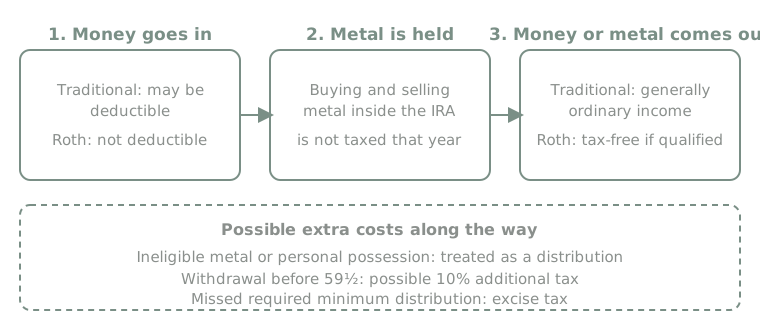
How is a Gold IRA taxed at each stage?
| Stage | Traditional Gold IRA | Roth Gold IRA |
|---|---|---|
| Putting money in | Contributions may be deductible | Contributions aren't deductible |
| Rollovers and transfers in | Generally not taxed when done correctly | Generally not taxed when done correctly |
| Buying and selling metal inside the IRA | Generally not taxed | Generally not taxed |
| Taking money out | Generally taxed as ordinary income | Qualified distributions are tax-free |
| Early withdrawal before 59½ | Tax plus a possible 10% additional tax | Your contributions come out first, tax- and penalty-free; earnings in a nonqualified withdrawal may be taxed and face the 10% additional tax |
| Required minimum distributions | Generally start at age 73 or 75, depending on when you were born | None while the owner is alive |
The two account types move the tax bill to different points in time. Traditional accounts can give a deduction now and are taxed later. Roth accounts give no deduction now, and qualified withdrawals aren't taxed later. Which is better depends on facts about your own income, now and in retirement, that no article can know. See Traditional Gold IRA and Roth Gold IRA for each account in depth, and Gold IRA vs Traditional or Roth IRA for how a metals account compares with a brokerage IRA.
Are Gold IRA contributions tax deductible?
Traditional IRA contributions may be tax-deductible. Whether you can deduct them in full depends on your income and whether you or your spouse are covered by a retirement plan at work. Publication 590-A says "Your deduction may be further limited" if you or your spouse were covered by an employer plan (Publication 590-A). Anyone with taxable compensation can contribute to a Traditional IRA; the limits apply to the deduction, not to the right to contribute (same publication).
Roth contributions are made with after-tax money. The IRS says "You cannot deduct contributions to a Roth IRA" (IRS Roth IRAs page). Roth contributions also have income limits.
For 2026, the IRS says "The limit on annual contributions to an IRA is increased to $7,500 from $7,000," and the catch-up amount for people 50 and over is $1,100 (IR-2025-111). The same release gives the 2026 income ranges:
| 2026 income range (IRS) | Filing status |
|---|---|
| Traditional IRA deduction phases out between $81,000 and $91,000 | Single, covered by a workplace plan |
| Traditional IRA deduction phases out between $129,000 and $149,000 | Married filing jointly, contributing spouse covered by a workplace plan |
| Traditional IRA deduction phases out between $242,000 and $252,000 | Married filing jointly, contributing spouse not covered but married to someone who is |
| Roth contribution phases out between $153,000 and $168,000 | Single or head of household |
| Roth contribution phases out between $242,000 and $252,000 | Married filing jointly |
Publication 590-A says "Contributions must be in the form of money (cash, check, or money order)" (Publication 590-A). For a Gold IRA that means cash goes in, and the IRA then buys the metal. Deadlines and what happens with an excess contribution are in Gold IRA contribution limits for 2026. Contributions can be made "by the due date for filing your return for that year, not including extensions" (Publication 590-A).
Rollovers and transfers aren't deductions. They simply move money that's already in a retirement account. See are Gold IRA contributions tax deductible? and Gold IRA Transfer.
What if a Traditional contribution isn't deductible?
You can still contribute, and the money is then "basis" in your IRA. Publication 590-A says you must file Form 8606 if you make nondeductible contributions (Publication 590-A). The Form 8606 instructions define basis this way: "Your basis in traditional IRAs is the total of all your nondeductible contributions and your nontaxable amounts included in rollovers made to these IRAs minus the total of all your nontaxable distributions, adjusted if necessary," and tell filers to "Keep track of your basis to figure the nontaxable part of your future distributions" (Instructions for Form 8606).
Basis matters because it keeps you from paying tax twice on the same dollars. Publication 590-B says: "Distributions from a traditional IRA are taxed as ordinary income, but if you made nondeductible contributions, not all of the distribution is taxable" (Publication 590-B). The nontaxable share is worked out on Form 8606 across your traditional IRAs together, not account by account. The Form 8606 instructions for line 6 say to enter "the total value of all your traditional IRAs as of December 31" plus any outstanding rollovers.
Penalties apply to the paperwork. The instructions say that if you must file Form 8606 for a nondeductible contribution and don't, "you must pay a $50 penalty, unless you can show reasonable cause," and overstating nondeductible contributions carries a $100 penalty on the same terms (Instructions for Form 8606).
Example: a withdrawal when you have basis
This is a simplified illustration with made-up numbers, not a calculation for your return. Suppose a person has $100,000 in total across all Traditional IRAs (counting a withdrawal made during the year), including $10,000 of basis from nondeductible contributions. In that simplified case, 10% of any withdrawal is a return of basis ($10,000 ÷ $100,000). A $20,000 withdrawal would then be $2,000 nontaxable and $18,000 taxable. The actual figure comes from Form 8606 and the instructions, so have a tax preparer check it.
Is metal taxed while it's inside the IRA?
Tax is generally figured when money or metal is distributed to you, which is covered below, and not when the IRA buys eligible metal. That's the main tax difference from owning gold personally.
If you own coins outside an IRA and sell them at a profit, the gain is a collectibles gain: "Net capital gains from selling collectibles (such as coins or art) are taxed at a maximum 28% rate" (IRS Topic 409). The same page says that if you hold an asset more than one year, the gain or loss is long-term, and one year or less, short-term. Inside an IRA, gains and earnings generally aren't taxed as they happen: "Generally, amounts in your IRA, including earnings and gains, aren't taxed until they are distributed" (Publication 590-A). The exemption can be lost, for example through a prohibited transaction (26 U.S.C. 408(e)). Withdrawals are taxed under the IRA distribution rules in Publication 590-B. See IRA gold vs taxable gold.
Example: the same sale inside and outside an IRA
Illustration only, with round numbers and no fees. Say metal bought for $50,000 is later sold for $60,000, a $10,000 gain.
| Held personally | Held in a Traditional Gold IRA | Held in a Roth Gold IRA | |
|---|---|---|---|
| Tax when sold | Gain of $10,000 taxed as a collectibles gain, at a maximum 28% rate (up to $2,800) | None | None |
| Tax when $60,000 is later withdrawn | None, the money is already yours | $60,000 generally added to ordinary income (less any basis) | None, if the withdrawal is qualified |
The table shows why "no tax inside the IRA" is not the same as "no tax." In a Traditional IRA the whole withdrawal, not just the gain, is generally ordinary income. Whether that costs more or less than the personal route depends on your tax brackets in the year you withdraw. A tax professional can run the numbers for your situation.
What if the IRA buys the wrong product?
The tax-free treatment depends on following the rules. The IRS page on collectibles describes this rule for individually directed accounts in 401(a) qualified plans, and 26 U.S.C. 408(m)(1) applies the same rule to IRAs. The plan page says "A plan participant whose account acquires a collectible is deemed to receive a distribution in the year the collectible is acquired." The distribution is "generally taxed as ordinary income and the 10% additional tax on early withdrawals may apply if the participant is under age 59½," and its amount is "the cost of the collectible at the time it is acquired," reported on Form 1099-R (IRS). The IRS lists the exceptions for certain coins and for "gold, silver, platinum, or palladium bullion of a certain fineness if a bank or approved non-bank trustee keeps physical possession of it" (same page). See the IRA collectibles rule and Gold IRA rules.
Illustration: if an IRA bought $15,000 of a coin that isn't eligible, the cost would be treated as a $15,000 distribution that year. For an owner under 59½ with no exception, the 10% additional tax would be up to $1,500 on top of income tax.
Taking personal possession of IRA metal can have the same result. In McNulty v. Commissioner (2021), the Tax Court held that "Mrs. McNulty received taxable distributions from her self-directed IRA equal to the cost of the AE coins upon her receipt of the coins," and that the couple were liable for section 6662(a) accuracy-related penalties for substantial understatements of income tax. The facts of that case involved an IRA-owned LLC and coins kept at home, so it isn't a rule about every storage arrangement. See home storage Gold IRAs.
How are Traditional Gold IRA withdrawals taxed?
IRS Publication 590-B says: "Distributions from a traditional IRA are taxed as ordinary income, but if you made nondeductible contributions, not all of the distribution is taxable." Federal law says amounts distributed from an IRA are included in income "in the manner provided under section 72" (26 U.S.C. 408(d)(1)). Ordinary income means the amount is added to your other income and taxed at your regular rates. It does not get the collectibles rate.
How are Roth Gold IRA withdrawals taxed?
A qualified Roth distribution isn't taxed. The law says "Any qualified distribution from a Roth IRA shall not be includible in gross income" (26 U.S.C. 408A(d)(1)). A distribution is qualified when both of these are true:
- It meets one of the listed events: made on or after age 59½, made after the owner's death, attributable to disability, or a qualified special purpose distribution such as a first home purchase (up to $10,000, per the first-time homebuyer rules in 26 U.S.C. 72(t)).
- It is not made "within the 5-taxable year period beginning with the first taxable year for which the individual made a contribution to a Roth IRA" (408A(d)(2)).
If a Roth withdrawal isn't qualified, it isn't automatically all taxable. Treasury regulations say a distribution "is not includible in the owner's gross income if it is a qualified distribution or to the extent that it is a return of the owner's contributions," and that amounts come out in this order: "(1) From regular contributions; (2) From conversion contributions, on a first-in-first-out basis; and (3) From earnings" (26 CFR 1.408A-6). Tax and the 10% additional tax can apply to earnings. The five-year clock, ordering and conversion details are covered in Roth Gold IRA.
How is metal taxed when you take it out instead of cash?
If your custodian allows it, you can take the coins or bars themselves as an in-kind distribution. It's taxed like a cash distribution of the metal's value, even though you receive no cash. The custodian reports it on Form 1099-R; the IRS reporting instructions call for the fair market value of property distributed: "If you distribute employer securities or other property, include in box 1 the FMV of the securities or other property on the date of distribution" (Instructions for Forms 1099-R and 5498). FMV means fair market value.
That value is based on the distribution date, not on what the IRA paid. Ask the custodian how it determines the value it will report for coins or bars. Because there's no cash from a sale, the tax usually has to be paid from money outside the IRA.
Example: an in-kind distribution
Illustration only. Suppose a Traditional Gold IRA owner takes coins with a fair market value of $30,000 on the distribution date and has no basis. The custodian would report $30,000 in box 1 of Form 1099-R, and that amount would generally be ordinary income for the year. If the owner is under 59½ and no exception applies, the 10% additional tax could add up to $3,000. If the owner later sells the coins, how that later sale is taxed is a separate question for a tax professional. See taking physical possession of Gold IRA metal and Gold IRA Withdrawal Rules.
What happens if you withdraw before age 59½?
Before age 59½, a 10% additional tax can apply on top of regular income tax. The IRS says "To discourage the use of IRA distributions for purposes other than retirement, you'll be assessed a 10% additional tax on early distributions from traditional and Roth IRAs, unless an exception applies" (IRS Topic 557). The statute puts it as an increase of "10 percent of the portion of such amount which is includible in gross income" (26 U.S.C. 72(t)(1)). So the additional tax applies to the taxable part of a withdrawal, not to basis or Roth contributions you get back.
The IRS exceptions page lists these exceptions for IRAs: age 59½, birth or adoption, death, disability, disaster recovery, domestic abuse victim, education, emergency personal expense, equal (substantially equal periodic) payments, homebuyers, IRS levy, unreimbursed medical expenses, health insurance premiums while unemployed, military, returned IRA contributions, rollovers, and others (IRS). Each has its own conditions and limits, so a tax professional can confirm whether one fits. The additional tax is reported on Form 5329, and Topic 557 says you don't need to file Form 5329 if your Form 1099-R shows distribution code 1 in box 7. See early withdrawal rules.
How do required minimum distributions work in a Gold IRA?
Traditional Gold IRA owners generally must start required withdrawals at a set age. The IRS RMD page says you generally must start when you reach age 73. Under 26 U.S.C. 401(a)(9)(C)(v), the applicable age is 73 for people who reach age 73 before 2033, and 75 for people who reach age 74 after 2032. Check which applies to you with the IRS or a tax professional. The IRS says "You generally have to start taking withdrawals from your IRA... when you reach age 73," with the first one due by April 1 of the year after the year you reach the starting age. Roth IRAs don't require withdrawals while the owner is alive (IRS RMD page). Missing an RMD can lead to a 25% excise tax on the amount not distributed, reduced to 10% if withdrawn within two years (same page). Form 5329 is used to report it, and the IRS says it can waive the tax if the shortfall "was due to reasonable error and you are taking reasonable steps to remedy the shortfall" (Instructions for Form 5329).
The IRS says the RMD is figured by "dividing the prior December 31 balance of that IRA or retirement plan account by a life expectancy factor." An IRA owner "must calculate the RMD separately for each IRA they own but can withdraw the total amount from one or more of the IRAs" (IRS RMD FAQs). Custodians report account values to the IRS on Form 5498 (Instructions for Forms 1099-R and 5498).
RMDs need planning in a metals IRA because the account may hold no cash. You may have to sell metal, take coins in kind, or take the amount from another Traditional IRA. Each choice is taxed as ordinary income in the year of the distribution.
Illustration with an assumed factor. Say the December 31 balance is $180,000 and the life expectancy factor is 26.0 (a made-up number; the real one comes from the IRS tables). The RMD would be $180,000 ÷ 26.0, or about $6,923. Coins and bars come in fixed sizes, so the shipped or sold amount rarely matches exactly. See Gold IRA RMDs for valuation and payment options.
Can you convert a Traditional Gold IRA to a Roth?
Yes. The converted amount is generally taxable in the year of the conversion. Treasury rules say "Any amount that is converted to a Roth IRA is includible in gross income as a distribution according to the rules of section 408(d)(1) and (2)." See Roth Gold IRA for how converted amounts are treated when withdrawn (26 CFR 1.408A-4). Any basis from nondeductible contributions is accounted for on Form 8606, Part II. Publication 590-A says there are "No recharacterizations of conversions made in 2018 or later" (Publication 590-A), so a completed conversion can't be undone that way.
For metal, the practical question is value. As with an in-kind distribution, the IRS reporting instructions call for the fair market value of property on the date of distribution. Taxes on a conversion are usually paid from money outside the IRA. Whether a conversion makes sense depends on your current and expected future tax rates, which is a question for a qualified professional. See converting a Traditional Gold IRA to a Roth IRA.
What are the tax rules for an inherited Gold IRA?
The IRS says "Withdrawals of contributions from an inherited Roth are tax free. Most withdrawals of earnings from an inherited Roth IRA account are also tax-free" with an exception for accounts under five years old (IRS beneficiary page). Beneficiaries who are not "eligible designated beneficiaries" must "Empty the entire account by the end of the 10th year following the year of the account owner's (or eligible designated beneficiary's) death," while eligible designated beneficiaries, such as a spouse or minor child of the owner, may stretch payments over their life expectancy (same page). Beneficiaries of Roth IRAs are also subject to required distribution rules (see the IRS RMD page).
A metals-only inherited account raises the same liquidity question as an owner's RMD: something must be sold or distributed in kind. The details depend on the beneficiary type and the date of death. See inherited Gold IRAs and naming beneficiaries.
What about state taxes?
This guide covers federal tax. Whether and how a state taxes IRA withdrawals, conversions or in-kind distributions depends on the state, and rules differ. Check your state tax agency's guidance or ask a tax professional. See state taxes and Gold IRAs.
What are common Gold IRA tax mistakes?
- Buying ineligible metal. The cost is treated as a distribution, as described above.
- Keeping IRA metal at home without a proper distribution. McNulty shows the risk.
- Skipping Form 8606. Without it, you may have no record of your basis, and a penalty can apply.
- Missing the RMD. The excise tax is 25% of the shortfall, or 10% if corrected within two years.
- Taking a withdrawal before 59½ without checking exceptions. The 10% additional tax applies unless an exception fits.
- Forgetting the tax bill on an in-kind distribution or conversion. There is no cash from a sale to pay it.
- Exceeding contribution limits. Form 5329 covers excess contributions, and the instructions describe a 6% annual excise tax on amounts over the limit.
- Assuming an indirect rollover is automatically tax-free. Moves must follow the rollover or transfer rules. See rollovers vs transfers.
See Gold IRA tax mistakes that trigger taxes or penalties for more.
Which tax forms will you see?
| Form | Who sends it | What it shows |
|---|---|---|
| Form 5498 | Your IRA custodian | Information about your IRA, including its value |
| Form 1099-R | Whoever paid out the money | Distributions, including direct rollovers and in-kind withdrawals; trustee-to-trustee transfers between IRAs generally aren't reported on it |
| Form 8606 | You file it | Nondeductible contributions and basis |
| Form 5329 | You file it | Additional taxes, such as the 10% early distribution tax, a missed RMD or an excess contribution |
Form 1099-R also carries a distribution code in box 7. Code 1 marks an early distribution with no known exception, and code G marks a direct rollover (Instructions for Forms 1099-R and 5498). See Gold IRA tax forms.
Can a Gold IRA make a charitable gift?
Some IRA owners can send money directly from an IRA to a charity. Rules and limits apply that we haven't covered here. See qualified charitable distributions from a Gold IRA.
Get professional help for your situation
Taxes depend on your income, filing status and state. A tax professional can tell you how these rules apply to you, especially before a large rollover, conversion or withdrawal.
Related questions
Is a Gold IRA tax deductible?
Traditional IRA contributions may be deductible, depending on income and workplace plan coverage. Roth contributions aren't.
Do I pay tax when my IRA sells gold?
Generally no. Gains and earnings inside an IRA aren't taxed as they happen (Publication 590-A), but the exemption can be lost, for example through a prohibited transaction. Tax generally applies when you take money or metal out.
Is a Gold IRA taxed at the 28% collectibles rate?
No. That rate applies to collectibles you own personally. IRA withdrawals are taxed under the IRA rules.
Are gold ETFs in an IRA taxed differently?
Inside an IRA, the IRA tax rules are the same whether the account holds metal or an exchange-traded product. See Gold IRA vs gold ETF in a regular IRA.
Is a Gold IRA rollover taxable?
Not when done correctly. See Gold IRA Transfer and rollovers vs transfers.
Guides in this section
- Are Gold IRA Contributions Tax Deductible?When Traditional Gold IRA contributions are deductible, income phase-outs if covered by a workplace plan, and why rollovers are not deductions.
- Gold IRA vs Owning Gold Outside an IRA: Tax ComparisonHow gains on physical gold held personally can be taxed at collectibles rates, versus ordinary-income or Roth treatment of IRA distributions.
- Converting a Traditional Gold IRA to a Roth IRAHow Traditional-to-Roth conversions work when the IRA holds metals, valuation of in-kind conversions, and reporting on Forms 1099-R and 8606.
- Gold IRA Tax Forms: 5498, 1099-R, 8606 and 5329The IRS forms Gold IRA owners encounter, who issues each one, when, and what the key boxes and distribution codes mean.
- Gold IRA Tax Mistakes That Trigger Taxes or PenaltiesTax errors that commonly affect Gold IRA owners - excess contributions, deemed distributions, missed RMDs and misreported rollovers - and corrections.
- State Taxes and Gold IRAs: Distributions and Sales TaxHow state income tax treats IRA distributions and why sales-tax treatment of bullion varies by state, with pointers to official state sources.
- Qualified Charitable Distributions from a Gold IRAHow qualified charitable distributions work from an IRA that holds metals, including liquidation or in-kind considerations and QCD limits.
- Do Dealers Report Gold Sales to the IRS? Form 1099-B for BullionWhen a dealer must send the IRS a Form 1099-B for a precious metals sale, what the IRS says about quantity and aggregation, and why you report a gain either way.
Sources
- 26 U.S.C. 401, Qualified pension, profit-sharing, and stock bonus plans (see (a)(9)(C)), Legal Information Institute, Cornell Law School (U.S. Code). Accessed Invalid Date.
- Publication 590-B (2025), Distributions from Individual Retirement Arrangements (IRAs), Internal Revenue Service. Accessed Invalid Date.
- Publication 590-A (2025), Contributions to Individual Retirement Arrangements (IRAs), Internal Revenue Service. Accessed Invalid Date.
- Topic no. 409, Capital gains and losses, Internal Revenue Service. Accessed Invalid Date.
- Retirement topics - Tax on early distributions, Internal Revenue Service. Accessed Invalid Date.
- Retirement topics - Required minimum distributions (RMDs), Internal Revenue Service. Accessed Invalid Date.
- Instructions for Forms 1099-R and 5498, Internal Revenue Service. Accessed Invalid Date.
- Investments in collectibles in individually directed qualified plan accounts, Internal Revenue Service. Accessed Invalid Date.
- McNulty v. Commissioner, 157 T.C. No. 10 (Nov. 18, 2021), opinion text, United States Tax Court (copy hosted by KPMG). Accessed Invalid Date.
- 401(k) limit increases to $24,500 for 2026, IRA limit increases to $7,500 (IR-2025-111), Internal Revenue Service. Accessed Invalid Date.
- Roth IRAs, Internal Revenue Service. Accessed Invalid Date.
- 26 U.S.C. 408A, Roth IRAs (2023 edition), U.S. Government Publishing Office (govinfo). Accessed Invalid Date.
- 26 CFR 1.408A-6, Distributions, Legal Information Institute, Cornell Law School. Accessed Invalid Date.
- 26 CFR 1.408A-4, Converting amounts to Roth IRAs, Legal Information Institute, Cornell Law School. Accessed Invalid Date.
- 26 U.S.C. 72, Annuities; certain proceeds of endowment and life insurance contracts, Legal Information Institute, Cornell Law School. Accessed Invalid Date.
- 26 U.S.C. 408, Individual retirement accounts, Legal Information Institute, Cornell Law School. Accessed Invalid Date.
- Topic no. 557, Additional tax on early distributions from traditional and Roth IRAs, Internal Revenue Service. Accessed Invalid Date.
- Instructions for Form 8606 (2025), Internal Revenue Service. Accessed Invalid Date.
- Instructions for Form 5329 (2025), Internal Revenue Service. Accessed Invalid Date.
- Retirement plan and IRA required minimum distributions FAQs, Internal Revenue Service. Accessed Invalid Date.
- Retirement topics - Beneficiary, Internal Revenue Service. Accessed Invalid Date.
This guide is general education, not personalized financial, tax or legal advice. See our financial disclaimer, editorial policy and advertising disclosure.