How a Gold IRA Works: Dealer, Custodian and Depository Roles
A Gold IRA works through three parties. You fund a self-directed IRA held by a custodian. On your instructions, the custodian pays a dealer from the IRA for eligible metal. The dealer ships the metal to a depository, which stores it for the IRA. You never hold it while it stays in the account.
A Gold IRA is a regular individual retirement account that owns physical metal instead of, or alongside, stocks and funds. For the basics, start with what is a Gold IRA? How precious metals IRAs work. This page follows the money and the metal from start to finish. It shows who does what at each step and where costs come in. The same flow applies to a Silver IRA.
Who are the three parties in a Gold IRA?
Every Gold IRA involves you plus three businesses:
- The custodian (also called the trustee). This is the financial institution that holds your IRA, keeps its records, moves its money and files its tax forms. IRS Publication 590-A says an IRA's trustee or custodian "must be a bank, a federally insured credit union, a savings and loan association, or an entity approved by the IRS to act as trustee or custodian" (Pub. 590-A). The IRS keeps a list of nonbank entities "approved, under Treas. Reg. §1.408-2(e), to serve as nonbank trustees or custodians" (IRS). Custodians that allow physical metal typically do so through a self-directed IRA, meaning you choose the investments. More in Gold IRA custodians.
- The dealer. A precious metals company that sells coins and bars to the IRA, and may buy them back later. The dealer is not the custodian and does not hold your account.
- The depository. A secure vault company that stores the metal on behalf of the custodian and your IRA. See Gold IRA storage.
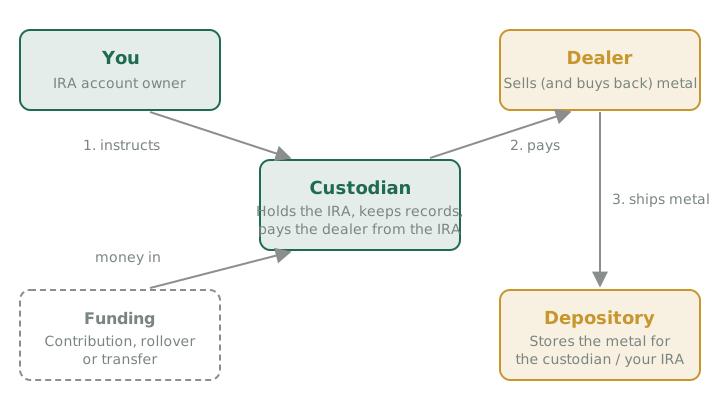
The key point in the diagram: money flows through the custodian, and metal flows to the depository. Neither passes through your hands while the metal stays in the IRA. A deeper look at each role is in custodian, dealer and depository roles.
How does a Gold IRA work step by step?
Here is the whole process in one table. Each step is explained below.
| Step | Who acts | Typical paperwork | Costs that may apply |
|---|---|---|---|
| 1. Open the account | You and the custodian | Self-directed IRA application | Custodian setup fee |
| 2. Fund it | You, your old plan or IRA, and the custodian | Contribution, rollover or transfer forms | Possible fees from the old provider; taxes if a rollover goes wrong |
| 3. Choose metal and price | You and the dealer | Dealer quote or purchase agreement | Dealer premium over spot |
| 4. Direct the purchase | You and the custodian | Buy direction (purchase authorization) | Custodian transaction or wire fees |
| 5. Ship and store | Dealer and depository | Depository receipt; custodian statement | Storage and insurance fees |
| 6. Hold and report | Custodian | Account statements; Form 5498 each year | Annual custodian fee; ongoing storage |
| 7. Sell or take a distribution | You, custodian, dealer, depository | Sell or distribution request; Form 1099-R | Spread on sale; transaction or shipping fees; income tax |
Form names for steps 1 and 4 vary by custodian. Ask each firm for its own fee schedule and forms. For the opening process in detail, see how to open a Gold IRA.
How does money get into a Gold IRA?
You can't fund an IRA by handing over metal you already own. Publication 590-A says: "Contributions must be in the form of money (cash, check, or money order). Property can't be contributed" (Pub. 590-A). So the IRA first receives money, then buys metal.
There are three common ways to get money in:
- New contributions. For 2026, the IRS says "the limit on annual contributions to an IRA is increased to $7,500," and the catch-up amount for people aged 50 and over is $1,100 (IR-2025-111).
- Rollovers from a workplace plan such as a 401(k). With a direct rollover, the plan administrator pays the money straight to the new IRA. If the plan pays you instead, the IRS says the payment "is subject to mandatory withholding of 20%, even if you intend to roll it over later." You then have 60 days to deposit it in an IRA (IRS). See Gold IRA rollover.
- Trustee-to-trustee transfers from an existing IRA. The old IRA's financial institution pays the new custodian directly. The IRS generally allows only one IRA-to-IRA rollover per year, but it says a direct transfer between trustees doesn't count, "because this type of transfer isn't a rollover" (IRS). See Gold IRA transfer.
A move between accounts is generally not taxed when it's completed correctly. Mistakes, such as missing the 60-day deadline, can make the money taxable. A tax professional can confirm which route fits your accounts.
How is gold bought inside an IRA?
This is the step people most often misunderstand. You don't buy the gold and then put it in the IRA. The IRA buys it.
- You pick a dealer and a product. The dealer quotes a price. Dealer prices are based on the spot price, which FINRA defines as "the cash price for immediate delivery of physical metal" (FINRA). Dealers sell above spot. The difference is the premium (or markup). It varies by product and dealer.
- You confirm the product is eligible. Metals and coins are generally treated as "collectibles" under the tax code, with exceptions. If an IRA acquires one, the IRS treats the cost as a distribution to you, "generally taxed as ordinary income," with a possible 10% additional tax before age 59½ (IRS). The exceptions include certain gold, silver and platinum coins described in 31 U.S.C. 5112, coins issued under state law, and bullion "of a certain fineness" held by a bank or approved non-bank trustee. See IRA-eligible precious metals.
- You send the custodian a buy direction. This is a signed instruction naming the dealer, product, quantity and price.
- The custodian pays the dealer from the IRA's cash. The money goes from the IRA to the dealer, not through you.
- The dealer ships the metal to the depository, titled to the IRA. It does not ship to your home.
Why the custodian has to be in the middle
The IRS IRA FAQs say there is an exception for certain highly refined bullion "provided it is in the physical possession of a bank or an IRS-approved nonbank trustee" (IRS IRA FAQs). The same FAQ says that requirement also applies when the bullion is bought indirectly, such as through an IRA-owned LLC. In practice, custodians typically meet it by arranging storage at a depository. Storing IRA metal at home is covered in home storage Gold IRAs.
The FAQs also note that a custodian can set its own limits on what it will hold, beyond federal law. So not every custodian will hold physical metal.
What happens while the metal is stored?
The depository keeps the metal for the IRA. Depending on the storage agreement, storage may be segregated (your IRA's specific bars and coins kept apart) or commingled (pooled with identical items owned by others). See segregated vs. commingled storage.
Each year the custodian files Form 5498 for your IRA. Box 5 shows "the FMV of all investments in your account at year end" (Form 5498). FMV means fair market value. Your copy is for your records. It says the information "is submitted to the IRS by the trustee or issuer" of your IRA. For metal, that value moves with metal prices, so your statement may rise and fall.
FINRA notes that the custodian's IRA statement shows the "melt" value of the metals (total bullion weight times the spot price), and suggests reviewing it carefully to make sure you received all the bullion you paid for and didn't pay an inflated price (FINRA). Our melt value calculator can help. See also how to verify your metals.
How do you sell gold or take money out?
You have two main choices.
Sell the metal inside the IRA. You direct the custodian to sell. A dealer buys the metal back, usually below spot, and the cash goes into the IRA. FINRA notes dealers sell above the spot price and buy back below it; the gap is the spread (FINRA). The cash stays in the IRA until you ask for a distribution. See selling gold in an IRA.
Take the metal itself (an in-kind distribution). The depository ships the coins or bars to you, and they leave the IRA. That counts as a distribution. For property distributed this way, the IRS tells custodians to "include in box 1 the FMV of the securities or other property on the date of distribution" on Form 1099-R (IRS instructions). See in-kind distributions.
How the distribution is taxed depends on the type of IRA:
| IRA type | General tax treatment of a distribution |
|---|---|
| Traditional | "Distributions from a traditional IRA are taxed as ordinary income, but if you made nondeductible contributions, not all of the distribution is taxable" (Pub. 590-B) |
| Roth | "Distributions from a Roth IRA aren't taxed as long as you meet certain criteria" (Pub. 590-B) |
| Either, before age 59½ | "A 10% additional tax generally applies if you withdraw or use IRA assets before you reach age 59½," unless an exception applies (Pub. 590-B) |
Traditional IRA owners also face required minimum distributions. Publication 590-B says people who reach age 72 after December 31, 2022 must begin them by April 1 of the year after they reach age 73 (Pub. 590-B). The starting age is different for people who reach age 74 after 2032; see RMDs from a Gold IRA. With metal, that means the IRA needs cash or metal that can be sold or distributed in time. See Gold IRA withdrawals and RMDs from a Gold IRA.
Where do the fees come from?
Each party charges for its part. The CFTC notes that self-directed IRAs "come with complicated tax rules, monthly administrative fees, and handling and storage charges" (CFTC).
| Party | Types of cost | When it applies |
|---|---|---|
| Custodian | Setup, annual administration, transaction, wire and closing or transfer-out fees | Opening, each year, each purchase or sale, leaving |
| Dealer | Premium over spot when you buy; spread when you sell back | Every purchase and sale |
| Depository | Storage and insurance | Every year the metal is held |
Fee amounts and how they're calculated differ from firm to firm, so ask for each schedule in writing. The CFTC warns that high transaction costs, ongoing storage and insurance "may require you to earn well above the rate of inflation just to break even" (CFTC). For a full breakdown, see Gold IRA fees.
Common mistakes in the process
- Taking delivery yourself. Keeping IRA bullion at home, even through an LLC, conflicts with the IRS custody condition described above.
- Buying ineligible coins. A collectible bought by the IRA is treated as a distribution of its cost (IRS). Confirm eligibility with the custodian before you sign.
- Taking a check instead of a direct move. An indirect rollover from a plan means 20% withholding and a 60-day clock (IRS).
- Not knowing who you're dealing with. The CFTC warns that some dealers "pose as 'IRA experts'" to persuade people to roll over retirement savings (CFTC). The dealer, custodian and depository are separate roles. Know which company is which.
- Comparing only one fee. A low annual fee doesn't help much if the premium is high. Compare the total cost.
Related questions
Can I buy gold myself and put it in my IRA?
No. Publication 590-A says property can't be contributed to an IRA. The IRA has to buy eligible metal with its own money, through the custodian (Pub. 590-A).
Does a Gold IRA have different tax rules from a regular IRA?
The contribution, rollover and distribution rules are the same as for any traditional or Roth IRA. The differences are which metals the IRA may hold and who must hold them. See Gold IRA rules.
Who actually owns the gold?
The IRA does. The custodian holds the account for your benefit, and the depository stores the metal for the IRA. For more, see who owns the gold in a Gold IRA.
Can the dealer also be my custodian?
They are different roles, and IRA trustees and custodians must be banks, certain other financial institutions, or IRS-approved entities (Pub. 590-A). You can check a nonbank custodian against the IRS list.
Is a Silver IRA set up the same way?
Yes. The same three parties, funding routes, custody condition and tax rules apply. See Silver IRA.
This page explains general rules, not personal tax or investment advice. Whether a Gold IRA fits your situation is a question for a qualified tax professional or fiduciary adviser.
Sources
- Investments in collectibles in individually directed qualified plan accounts, Internal Revenue Service. Accessed Invalid Date.
- Retirement plans FAQs regarding IRAs, Internal Revenue Service. Accessed Invalid Date.
- Approved nonbank trustees and custodians, Internal Revenue Service. Accessed Invalid Date.
- Publication 590-A (2025), Contributions to Individual Retirement Arrangements (IRAs), Internal Revenue Service. Accessed Invalid Date.
- Publication 590-B (2025), Distributions from Individual Retirement Arrangements (IRAs), Internal Revenue Service. Accessed Invalid Date.
- Rollovers of retirement plan and IRA distributions, Internal Revenue Service. Accessed Invalid Date.
- IR-2025-111: 401(k) limit increases to $24,500 for 2026, IRA limit increases to $7,500, Internal Revenue Service. Accessed Invalid Date.
- Instructions for Forms 1099-R and 5498 (2026), Internal Revenue Service. Accessed Invalid Date.
- Form 5498, IRA Contribution Information, Internal Revenue Service. Accessed Invalid Date.
- Investor Bulletin: 10 Things to Ask Before Buying Physical Gold, Silver or Other Metals, FINRA. Accessed Invalid Date.
- Precious Metal Frauds, Commodity Futures Trading Commission. Accessed Invalid Date.
This guide is general education, not personalized financial, tax or legal advice. See our financial disclaimer, editorial policy and advertising disclosure.