Do You Own the Gold in Your IRA? Title, Custody and Control
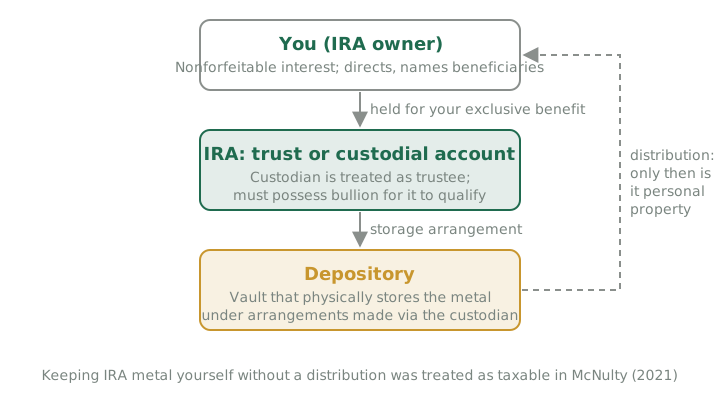
A Gold IRA is a trust or custodial account, held by a bank, other qualifying institution, or IRS-approved nonbank trustee, for your exclusive benefit. The IRA, through that trustee or custodian, holds the metal, and your interest in it is nonforfeitable. You direct purchases and sales and name beneficiaries, but personal possession can be treated as a taxable distribution.
"Is the gold mine or not?" is one of the first questions people ask about a Gold IRA. The honest answer has layers. The account is legally a trust (or a custodial account treated as one), the trustee or custodian holds the metal, and you are the person the account exists to benefit. This page walks through what the law says about each layer and what it means for access and control. For the basics of how these accounts work, start with What Is a Gold IRA? How Precious Metals IRAs Work.
This is a legal topic, so we quote the statute, regulations, the IRS and the Tax Court directly. Where a point is our reading of those sources rather than something they state, we label it our interpretation. Nothing here is legal advice.
Who legally owns the metal in a Gold IRA?
The tax code defines an individual retirement account as "a trust created or organized in the United States for the exclusive benefit of an individual or his beneficiaries" (26 U.S.C. 408(a)). A trust is an arrangement where one party (the trustee) holds property for the benefit of another.
An IRA can also be set up as a custodial account rather than a formal trust. The law treats the two the same way. Under section 408(h), a qualifying custodial account "shall be treated as a trust," and "the custodian of such account shall be treated as the trustee thereof." The Treasury regulation repeats this: "the custodian of such account will be treated as the trustee thereof" (26 CFR 1.408-2(d)).
Two more requirements describe your position:
- Your interest can't be taken away. "The interest of an individual in the balance in his account is nonforfeitable" (408(a)(4)).
- The trustee must be qualified. The trustee or custodian "must be a bank, a federally insured credit union, a savings and loan association, or an entity approved by the IRS to act as trustee or custodian" (IRS Publication 590-A).
Our interpretation: Put together, the IRA (acting through its trustee or custodian) holds the metal, and you hold the beneficial interest. That is why people commonly call the account owner the "beneficial owner." The sources above don't use that phrase, and the exact way title is recorded depends on your custodial agreement and storage paperwork. A tax or ERISA attorney can read those documents for you.
Why must a trustee physically hold IRA bullion?
Because the tax code says so. Gold and silver start out as collectibles, and when an IRA buys a collectible, the purchase "shall be treated ... as a distribution from such account in an amount equal to the cost to such account of such collectible" (408(m)(1)). See the IRA collectibles rule for details.
The exception for bullion in 408(m)(3)(B) covers gold, silver, platinum or palladium bullion that meets the minimum fineness a regulated futures market requires, but only "if such bullion is in the physical possession of a trustee described under subsection (a) of this section."
The IRS collectibles page puts it in plain terms: the exception covers bullion "of a certain fineness if a bank or approved non-bank trustee keeps physical possession of it."
So custody isn't a paperwork detail. It is part of what keeps the metal inside the IRA's tax treatment.
What did the Tax Court say about owners holding IRA metal?
In McNulty v. Commissioner, 157 T.C. No. 10 (Docket No. 1377-19, filed Nov. 18, 2021), an IRA owner had her IRA buy units of an LLC. The LLC bought American Eagle coins, which were then kept at her home. The court concluded: "Mrs. McNulty's possession of the AE coins is a taxable distribution." (opinion)
Several passages from the opinion speak directly to ownership and control:
- "An owner of a self-directed IRA may not take actual and unfettered possession of the IRA assets."
- "A custodian is required to maintain custody of the IRA assets, maintain the required records, and process transactions that involve IRA assets."
- "Independent oversight by a third-party fiduciary to track and monitor investment activities is one of the key aspects of the statutory scheme."
- At the same time, the court said an owner "is entitled to direct how her IRA assets are invested."
The full facts, penalties and arguments are covered in our pages on home storage Gold IRAs and the McNulty v. Commissioner decision. We don't repeat them here.
What control do you have over the gold in your IRA?
More than many people expect, but all of it runs through the custodian.
- Directing purchases and sales. McNulty confirms an owner "is entitled to direct how her IRA assets are invested." In practice, you sign a buy or sell direction and the custodian carries it out. A self-directed custodian won't judge the deal for you: an SEC, NASAA and FINRA alert says such custodians "DO NOT evaluate the quality or legitimacy of any investment in the self-directed IRA or its promoters" and are "only responsible for holding and administering the assets in the account" (Investor.gov). See what a self-directed IRA is.
- Choosing and changing the custodian. You pick the custodian, and you can move the account. The IRS says you can ask the institution holding your IRA "to make the payment directly from your IRA to another IRA," and that this kind of transfer "isn't a rollover" (IRS rollovers page). See changing Gold IRA custodians.
- Naming beneficiaries. The IRS describes a beneficiary as "any person or entity the account owner chooses to receive the benefits of a retirement account or an IRA after they die," and says "The owner must designate the beneficiary under procedures established by the plan" (IRS). See naming beneficiaries on a Gold IRA.
- Taking the metal out. You can have the IRA distribute the metal itself, called an in-kind distribution. It is a distribution like any other: under 408(d)(1), "any amount paid or distributed out of an individual retirement plan shall be included in gross income by the payee or distributee," in the manner set by section 72. See taking an in-kind distribution.
What can't you do with the gold in your IRA?
You can't treat IRA metal as personal property while it stays in the IRA.
- Take possession without a distribution. Bullion qualifies only while a trustee physically holds it (408(m)(3)(B)), and McNulty treated the owner's receipt of coins as a taxable distribution.
- Use it personally or deal with it yourself. The tax code's prohibited transaction rules in 26 U.S.C. 4975 apply to "an individual retirement account described in section 408(a)." Among the listed transactions is any direct or indirect "transfer to, or use by or for the benefit of, a disqualified person of the income or assets of a plan." The IRS gives IRA examples including "Selling property to it," "Using it as security for a loan," and "Buying property for personal use (present or future) with IRA funds" (IRS prohibited transactions page).
The consequence can be severe. The IRS says that if an owner engages in a prohibited transaction, "the account stops being an IRA as of the first day of that year" (IRS). The IRS collectibles page also notes that "Acquiring a collectible may also be a prohibited transaction under IRC Section 4975(c)" (IRS). Whether a specific arrangement is a prohibited transaction depends on its facts. More in prohibited transactions.
You vs the custodian vs the depository
| You (IRA owner) | Custodian or trustee | Depository | |
|---|---|---|---|
| Legal role | Person the account is for; interest is nonforfeitable (408(a)(4)) | Holds the IRA; treated as trustee (408(h)) | Vault company that stores the metal |
| Physically holds the metal? | No, not while it's in the IRA | Must have physical possession for bullion to qualify (408(m)(3)(B)); often arranges storage at a depository | Yes, day to day |
| Directs buying and selling | Yes | Carries out your directions | No |
| Judges whether a purchase is a good deal | Your responsibility | Self-directed custodians "DO NOT evaluate" investments (Investor.gov) | No |
| Names beneficiaries | Yes, on the custodian's forms | Keeps the designation on file | No |
| Can take the metal out | Only by a distribution | Processes the distribution and reporting | Ships on the custodian's instruction |
| Your agreement is with | Not applicable | You sign the custodial agreement | Varies; ask who signs the storage terms |
For how these three parties are paid and where conflicts arise, see custodian vs dealer vs depository.
Does segregated or commingled storage change who owns the metal?
Depositories usually offer two kinds of arrangement, though names and terms vary:
- Segregated storage: specific bars and coins are set aside and tracked for your account.
- Commingled (pooled) storage: your holdings are stored alongside identical items held for other accounts, and the records track the type and quantity owed to your account.
These are contract terms between the depository and the custodian (and sometimes you). We haven't found an IRS or Treasury source that says how either option affects legal title, so we don't make a claim either way. The statute does separately require that "The assets of the trust will not be commingled with other property except in a common trust fund or common investment fund" (408(a)(5)). We did not find IRS guidance applying that rule to pooled depository storage. If it matters to you, ask the custodian in writing what you will receive back under each option, and have an attorney review the storage agreement. Our guide to segregated vs commingled Gold IRA storage covers costs and trade-offs.
What happens to your gold if the custodian fails?
We found no federal guidance written specifically about a precious metals IRA custodian failing. Here is what the sources do establish.
Rules nonbank custodians must accept to be approved. Under 26 CFR 1.408-2(e), a nonbank applicant must meet standards that include:
- "The applicant must keep its fiduciary records separate and distinct from other records."
- "Assets of accounts requiring safekeeping will be deposited in an adequate vault. A permanent record will be kept of assets deposited in or withdrawn from the vault."
- "All employees taking part in the performance of the applicant's fiduciary duties will be adequately bonded."
- Annual "detailed audits of the fiduciary books and records" by "a qualified public accountant."
- Trust instruments must provide that "the grantor is to substitute another trustee upon notification by the Commissioner that such substitution is required because the applicant has failed to comply" with the requirements.
What government insurance does not cover. SIPC protects certain customer assets at brokerage firms, but the SEC says "Protected securities do not include commodities (such as gold or silver)" (Investor.gov). FDIC deposit insurance covers deposits such as checking, savings and CDs; its list of things not covered includes "Safe deposit boxes or their contents" (FDIC). Our interpretation: physical metal held for an IRA is not a bank deposit, so FDIC deposit insurance wouldn't be expected to protect it, even if the custodian is a bank.
Practical protections. Because neither program covers the metal, the records matter. Keep your statements, know the depository's name, and confirm what it holds for your IRA. The CFTC advises: "Review the SDIRA account statement carefully to ensure you received all the bullion you paid for" (CFTC). See how to verify your Gold IRA metals, Gold IRA storage insurance and custodian requirements.
Common misunderstandings
- "The dealer holds my gold." The dealer sells metal to the IRA. The custodian holds the account, and a depository usually stores the metal.
- "It's titled to my LLC, so I can keep it." McNulty rejected that result for coins kept at home through an IRA-owned LLC.
- "My IRA gold is insured by the government." SIPC excludes gold and silver, and FDIC doesn't cover safe deposit box contents. Ask the custodian and depository what private insurance applies and who holds it.
- "I own specific bars." That depends on the storage terms. Ask whether your storage is segregated or pooled.
Related questions
Can I visit or see the gold in my IRA?
Policies differ by custodian and depository. Ask in writing. Viewing metal at the depository is different from taking it home.
Is a Gold IRA the only way to own gold for retirement?
No. Some people hold metal outside any retirement account, or use other investments with gold exposure. See alternatives to a Gold IRA. Employer plans have their own rules; see Can You Hold Gold in a 401(k)? Plan Options Explained.
What happens to the gold when I die?
The IRS describes a beneficiary as the person or entity the owner "chooses to receive the benefits of a retirement account or an IRA after they die" (IRS). Special distribution rules then apply. See inherited Gold IRA rules.
Where can I look up the terms used here?
Our Gold IRA glossary defines trustee, custodian, depository and related terms.
This page explains general rules. It is not legal, tax or investment advice. Questions about title, storage agreements or a specific arrangement depend on your documents, so a qualified tax or ERISA attorney or CPA is the right person to ask.
Sources
- 26 U.S.C. 408, Individual retirement accounts (2021 edition), U.S. Government Publishing Office (govinfo). Accessed Invalid Date.
- 26 CFR 1.408-2, Individual retirement accounts, Electronic Code of Federal Regulations (eCFR). Accessed Invalid Date.
- Investments in collectibles in individually directed qualified plan accounts, Internal Revenue Service. Accessed Invalid Date.
- McNulty v. Commissioner, 157 T.C. No. 10 (Nov. 18, 2021), opinion text, United States Tax Court (copy hosted by KPMG). Accessed Invalid Date.
- 26 U.S.C. 4975, Tax on prohibited transactions (2021 edition), U.S. Government Publishing Office (govinfo). Accessed Invalid Date.
- Retirement topics - Prohibited transactions, Internal Revenue Service. Accessed Invalid Date.
- Retirement topics - Beneficiary, Internal Revenue Service. Accessed Invalid Date.
- Rollovers of retirement plan and IRA distributions, Internal Revenue Service. Accessed Invalid Date.
- Publication 590-A (2025), Contributions to Individual Retirement Arrangements (IRAs), Internal Revenue Service. Accessed Invalid Date.
- Investor Alert: Self-Directed IRAs and the Risk of Fraud, U.S. Securities and Exchange Commission (Investor.gov), NASAA and FINRA. Accessed Invalid Date.
- Investor Bulletin: SIPC Protection (Part 1: SIPC Basics), U.S. Securities and Exchange Commission (Investor.gov). Accessed Invalid Date.
- Know Your Risk - Protect Your Money, Federal Deposit Insurance Corporation. Accessed Invalid Date.
- Customer Advisory: 10 Things to Ask Before Buying Physical Gold, Silver, or Other Metals, Commodity Futures Trading Commission. Accessed Invalid Date.
This guide is general education, not personalized financial, tax or legal advice. See our financial disclaimer, editorial policy and advertising disclosure.