Gold IRA Fees and Costs: Every Charge Explained
A Gold IRA has two kinds of cost: account fees, such as custodian setup, annual and storage fees, and the cost built into the metal's price, meaning the dealer's premium over spot when you buy and the lower buyback price when you sell. Regulators warn that markups, commissions and spreads can be large, so get every number in writing.
A Gold IRA has more moving parts than a typical IRA, and each one can charge something. Knowing every cost lets you compare offers properly and see how much the metal price has to rise before you're ahead. This guide is part of our Gold IRA Guide and covers each charge, who sets it, and how to add them up. It gives no "average" cost. No regulator source we reviewed publishes one, so we explain how to find your own numbers instead.
How much does a Gold IRA cost?
It depends on three separate parties and on the metal you buy. Each can charge on its own:
- The dealer sells you the metal and sets the price you pay and the price it will pay to buy back.
- The custodian runs the IRA account and keeps its records.
- The depository stores the metal. See how custodians, dealers and depositories fit together.
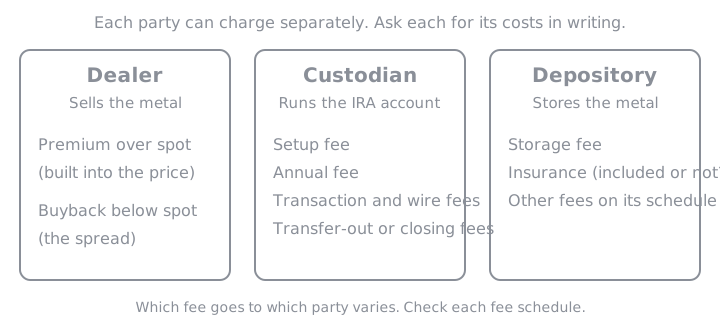
The total is the sum of all three, plus the price costs built into buying and selling. The sections below take each in turn. Which party charges which fee can differ from one arrangement to the next, so check every fee schedule you are given.
The two kinds of cost
| Kind | Examples | When you pay |
|---|---|---|
| Account fees | Custodian setup fee, annual custodian fee, storage and insurance, transaction and wire fees, closing or transfer-out fees | Once, yearly or per transaction |
| Price costs | Dealer premium over spot when you buy; the gap between selling price and buyback price when you sell | Built into each purchase and sale |
Ask for the custodian's and depository's fee schedules in writing. Price costs are part of the price you agree to, so ask the dealer for them directly.
What fees does a Gold IRA have?
The table lists the charges you may meet. It is a checklist of questions, not a list of what every provider charges. Whether a fee exists, and how much it is, depends on the provider.
| Fee type | Charged by | How it may be charged | What to ask |
|---|---|---|---|
| Account opening (setup) | Custodian | One time | Is it one-time? Is it waived, and for how long? |
| Annual administration | Custodian | Yearly, flat or based on account value | Is it flat or a percentage? What counts toward the value? |
| Transaction fee | Custodian | Each purchase or sale | Is there a fee on every buy and every sell? |
| Wire, check or shipping fee | Custodian or others | Each movement of cash or metal | Which movements carry a charge? |
| Storage | Depository | Ask how it is calculated and how often it is billed | Which method? Does the fee change as value rises? |
| Insurance | Depository or others | Ask whether it is included or charged separately | What does the coverage cover, and who pays for it? |
| Transfer-out, closing or distribution | Custodian, depository | One time, when you leave or take metal out | What will it cost to leave, or to take metal out? |
| Dealer premium | Dealer | Built into the price per item | What is the price per ounce versus spot at the same moment? |
| Dealer spread (buyback gap) | Dealer | Built into the sale price when you sell | What would you pay for this item today? |
FINRA and the CFTC say "Other potential costs are storage, insurance, administrative fees, and possibly additional taxes and penalties if you take money from a qualified retirement account" (CFTC). The SEC, NASAA and FINRA alert on Investor.gov about self-directed IRAs makes the same point in general terms: "In addition to transaction fees, there may be account opening fees, annual account fees, administrative fees and asset specific fees in the account" (Investor.gov).
Once you have the fee schedules, our Gold IRA fee calculator adds up the account fees for the years you plan to hold. For a catalog of what providers publish, see the planned Gold IRA fee database.
Account fees
Custodian fees
A custodian's fee schedule may include:
- a setup fee for opening the self-directed IRA
- an annual administration fee
- transaction fees for purchases or sales, and wire or check fees
- closing or transfer-out fees if you leave
A custodian is the bank or approved trustee that holds the IRA. It is not a vetting service. Investor.gov says self-directed IRA custodians "DO NOT evaluate the quality or legitimacy of any investment in the self-directed IRA or its promoters" (Investor.gov). A fee paid to a custodian is for administration, not a check on the dealer or the product. See Gold IRA custodians and custodian fees.
Storage and insurance
Eligible bullion must be held by a bank or IRS-approved trustee (IRS IRA FAQs), so storage is an ongoing cost while you hold metal. Ask how it's calculated and whether insurance is included. Keeping IRA metal at home to avoid storage fees is not a safe shortcut; see home storage and the IRA rules. See also Gold IRA storage and storage fees.
The regulators also warn about storage charges that are not real. FINRA and the CFTC report that "Some fraudulent dealers have charged storage and insurance fees for metal that never existed" (FINRA). Ask where your metal is held and how you can confirm it.
Minimums and other charges that don't show up as "fees"
Providers may set a minimum purchase or account size, so ask. A minimum is not a fee, but it can change what you pay per dollar if a flat fee is spread over a smaller account. See Gold IRA minimum investment requirements. For charges that are easy to overlook, see hidden Gold IRA fees.
Flat fees and value-based fees
Annual fees can be structured in different ways, for example as a flat dollar amount or as a percentage of the account's value. Ask which applies.
| Flat fee | Value-based fee | |
|---|---|---|
| How it works | The same dollar amount each year | A percentage of the account or metal value |
| When the account is small | Can be a large share of the account | Can be small in dollars |
| When the account is large | Can be a small share of the account | Grows in dollars as value grows |
| When the metal's price rises | Doesn't change | Rises with it |
| Main question | Is it truly the same every year? | What value is the percentage applied to, and how often is it measured? |
Neither is better in general. Which costs less depends on the size of your account and how long you hold. Ask how your storage fee is set. Whatever the method, convert it to dollars per year for your own account before you compare offers.
Price costs
The dealer's premium
FINRA and the CFTC define the spot price as "the cash price for immediate delivery of physical metal" (FINRA). Dealers sell coins and bars for more than spot; the difference is the premium or markup. It varies by product and by dealer, so ask for it on the exact item.
FINRA and the CFTC list "What's the spot price?", "What's the spread?" and "What fees and commissions will I be charged?" among the ten questions to ask before buying metal (FINRA).
The spread when you sell
FINRA explains that a dealer will always sell metal above the spot price and buy it back below the spot price (FINRA). The gap between the two prices is the spread. Even if the spot price doesn't move, buying and then selling the same coin loses money to the premium and the spread. See buyback costs.
How big can the spread be?
We don't quote a typical figure, because we found no regulator source for one. The CFTC says only that the range is wide. Its IRA fact sheet says the spread "can range anywhere from 30 to 300 percent or more" (CFTC, Lies Versus Facts). Its advisory says some fraudulent dealers have charged spreads of more than 300 percent, while other dealers may charge less (CFTC). Those are warnings about the range, not predictions of what you'll pay.
Collector coins cost more
Be careful with coins sold as "rare," "numismatic" or "semi-numismatic." FINRA calls "semi-numismatic" "a made-up industry term that really has no special meaning", adding that such coins "typically aren't rare and carry no additional value" (FINRA). The CFTC says numismatic coins "typically carry higher markups than bullion and are much less liquid" (CFTC). Only certain coins and certain bullion fit the IRA exceptions listed on the IRS collectibles page; see IRA-eligible precious metals and the collectibles rule. For more, see bullion vs. numismatic coins and dealer premiums and markups.
How fees interact with how long you hold
The premium and the spread are paid once on the round trip, however long you hold. Yearly fees keep adding up. That changes how the two kinds of cost weigh against each other over time:
- A short hold is dominated by the premium and spread. Yearly fees have little time to add up.
- A long hold spreads the one-time price costs over more years, but the yearly fees keep building.
- A value-based fee grows with the value of the metal. A flat fee does not.
The CFTC makes the same point: "high transaction costs (commissions and fees when you buy and sell), ongoing storage costs, and insurance, may require you to earn well above the rate of inflation just to break even" (CFTC). It adds: "Often the costs are so high that buyers never see a profit from their metals 'investments.'"
Worked example: total cost over 1, 5 and 10 years
Every number below is made up to show the arithmetic. They are not typical, average or current figures, and they are not offers from any company.
Assumptions:
- An IRA buys $50,000 of metal from a dealer at a 5% premium over spot. The metal is then worth about $47,619 at spot.
- The dealer's buyback price is 3% below spot, so a sale at unchanged spot returns about $46,190.
- That leaves a round-trip price cost of about $3,810 (7.6% of $50,000), before any account fees.
- Account fees are billed separately from the $50,000. Fee Plan A: $100 setup, a flat $250 a year for custodian and storage combined, and a $50 fee when selling. Fee Plan B: the same $100 setup and $50 selling fee, but a yearly fee of 0.8% of the metal's value at spot (about $381 a year).
- The spot price never changes. This isn't a forecast. It isolates the cost.
| Holding period | Plan A: account fees | Plan A: total cost | Plan B: account fees | Plan B: total cost |
|---|---|---|---|---|
| 1 year | $400 | about $4,210 (8.4%) | about $531 | about $4,340 (8.7%) |
| 5 years | $1,400 | about $5,210 (10.4%) | about $2,055 | about $5,864 (11.7%) |
| 10 years | $2,650 | about $6,460 (12.9%) | about $3,960 | about $7,769 (15.5%) |
Total cost is the round-trip price cost plus account fees. The percentage is of the $50,000.
To get back to $50,000 plus the fees, spot would have to rise (with the same premium and buyback gap):
| Holding period | Plan A: needed rise in spot | Plan B: needed rise in spot |
|---|---|---|
| 1 year | about 9.1% | about 9.4% |
| 5 years | about 11.3% (about 2.2% a year) | about 12.7% (about 2.4% a year) |
| 10 years | about 14.0% (about 1.3% a year) | about 16.8% (about 1.6% a year) |
Two things stand out. In the first year, the premium and spread make up most of the cost. Over ten years, the yearly fees add up to a large part of it. Neither result says anything about where gold prices will go. Spot can fall as well as rise, which would move the break-even further away. For your own quote, use the break-even calculator or read about total cost of ownership.
How are fees paid?
Some fees may come out of the IRA's cash. Others may be billed to you. Providers differ, so ask each one. Where the money comes from matters in two ways.
- Inside the IRA: fees paid from the account reduce the money left to invest.
- Outside the IRA: the IRS says "Trustees' administrative fees that are billed separately and paid in connection with your traditional IRA aren't deductible as IRA contributions. You are also not able to deduct these fees as an itemized deduction" (IRS Publication 590-A (2025)). That passage is about traditional IRAs. A tax professional can explain how this applies to you.
Ask each provider: "Which of these fees are taken from the IRA, and which are billed to me?"
"Free" offers and fee waivers
Promotions such as "free silver" or waived fees are still part of the deal. FINRA suggests you "Ask how the company earns its profit, especially if it appears to be giving away precious metal or offering other big freebies" (FINRA). A waiver might apply to one fee, for a set time, or only above a certain purchase amount. Ask what is waived, for how long, what happens afterward, and whether the price of the metal changes. Comparing the all-in price shows the full cost. See free silver and fee-waiver promotions and hidden fees.
What regulators have seen
The CFTC describes "one recent complaint" in which "a gold dealer and IRA custodian charged nearly $150,000 in commissions and fees to a customer who rolled over a $300,000 retirement account" (CFTC). A CFTC advisory describes a case with the same figures as an allegation: "In one case, a customer rolled over a $300,000 IRA, and the dealer allegedly took $150,000" (CFTC). That's an allegation in one complaint, not a typical cost, but it shows why every number should be in writing.
Red flags about fees
- Fees not in writing. The CFTC says "If fees are not available in writing before your purchase, that is a red flag" (CFTC).
- No buyback price. The FINRA and CFTC bulletin advises asking for the dealer's buyback price. The bulletin advises asking for the buyback price; without one you can't see what a sale would return.
- Charges for storage you can't confirm. See the storage warning above.
- Pressure toward higher-priced collector coins for an IRA. See overpriced coin upsells and Gold IRA scam warning signs.
- Unsolicited calls with an attractive offer. The first of the ten questions in the FINRA and CFTC bulletin is whether to respond to a dealer who contacts you that way. See how to verify a dealer.
How to estimate your total cost
- Get the custodian's and depository's fee schedules. Add the setup fee to the yearly fees for the number of years you plan to hold.
- Get the dealer's price per ounce and the spot price at the same time, in writing. The difference is your premium.
- Ask the dealer's current buyback price for the same product. The gap to the selling price is the spread.
- Put the numbers into a calculator. Our fee calculator totals the account fees, and the break-even calculator shows how much the price must rise each year to cover everything. To check the metal content of a coin or bar, use the melt value calculator.
- Compare offers on the same basis. Use the same dollar amount, the same holding period and the same product. Then compare the total in dollars, not the headline fee.
Example (illustration only, not typical figures): You move $50,000 into metal at a 5% premium over spot. On day one, the metal is worth about $47,600 at spot. If the dealer's buyback is 3% below spot, selling right away would return about $46,200, before any account fees. The price has to rise just to get you back to $50,000.
Questions to ask before you buy
- What is the price per ounce, and what was spot when you quoted it?
- What would you pay me to buy this same product back today?
- What are the custodian's setup, annual and transaction fees?
- Is the annual fee flat or a percentage, and of what?
- What are the storage and insurance fees, and how are they calculated?
- Are fees taken from the IRA or billed to me?
- Is any part of the fee waived, and what does that cost me elsewhere?
- What will it cost to transfer out, close the account or take metal out?
- Can I have all of this in writing before I sign?
The CFTC says to "Ask for all fees, costs, commissions, and agreed retail price in writing BEFORE signing a sales agreement or turning over any money" (CFTC). For a wider checklist, see how to evaluate a Gold IRA company and our guide to Gold IRA companies compared.
Common mistakes
- Comparing only the annual fee. A low annual fee means little if the metal is priced far above spot. Compare the total cost.
- Ignoring the buyback side. The premium is only half of the spread.
- Overlooking exit costs. Ask about transfer-out and closing charges before you open the account.
- Assuming "free" means no cost. See the section on promotions.
- Comparing quotes taken at different times. Spot moves during the day.
- Treating the custodian as a check on the deal. Custodians don't vet the investment or the dealer.
- Skipping the question of how fees are paid. It affects both what is left in the IRA and your tax paperwork.
Related questions
What does a Gold IRA cost per year?
It depends on the custodian and depository. Add the annual custodian fee and the storage fee from their published schedules, then add any per-transaction fees. If a fee is a percentage, convert it to dollars for your account size.
What is the average cost of a Gold IRA?
We don't publish an average because we found no regulator source for one, and an average of provider marketing would mislead. Use the steps above to build your own total from written quotes.
Why can self-directed Gold IRAs cost more than regular IRAs?
FINRA notes that self-directed IRA fees are typically higher than fees for regular (directed) IRAs (FINRA). Investor.gov says "Fees for self-directed IRAs may be significantly higher than those for other types of investment accounts" (Investor.gov). A Gold IRA also pays for storing physical metal, plus the dealer's premium and spread on each trade. See Gold IRA vs. regular IRA and the self-directed IRA guide.
Are there Gold IRAs with no fees?
Promotions may waive certain fees; ask what is waived and for how long. Compare the premium and buyback price too, so you see the total cost.
How do the costs compare with a gold ETF in an IRA?
The fee structure is different. A fund's costs are described in its own documents, while physical metal carries the premium, spread, custodian and storage charges covered here. See Gold IRA vs. gold ETF for sourced detail.
Who can help me judge the numbers?
A fee-only financial planner or a tax professional can look at the figures for your situation. The costs here are general information, not advice on what to buy.
Guides in this section
- Gold IRA Custodian Fees: Setup, Annual, Transaction and Closing FeesThe fees custodians charge on precious-metals IRAs - setup, annual administration, per-transaction and closing - and flat vs value-based structures.
- Gold IRA Storage Fees: Segregated vs Commingled CostsHow depository storage fees are charged for IRA metals, flat vs value-based pricing, segregated vs commingled cost differences, and insurance.
- Dealer Premiums, Markups and Spreads in Gold IRAsHow dealer premiums, markups and bid-ask spreads work, why they are often the largest Gold IRA cost, and how to request a written price breakdown.
- Gold IRA Buyback Policies and Liquidation CostsHow dealer buyback programs work, what 'buyback guarantee' usually means in practice, and how spreads determine what you receive when selling.
- Hidden Gold IRA Fees: Shipping, Wire, Termination and MoreLess-visible Gold IRA charges - wire, shipping, insurance, termination, paper statements, and markups inside 'free' offers - and where to find them.
- Gold IRA Minimum Investment RequirementsWhy minimums come from dealers rather than law, how they compare across companies (sourced table), and how fixed fees affect small accounts.
- Gold IRA Total Cost of Ownership and Break-Even AnalysisWorked examples of total Gold IRA cost over multiple years, including premiums and spreads, and the price change needed to break even.
- 'Free Silver' and Fee-Waiver Gold IRA Promotions: How to Evaluate ThemHow promotional offers like free silver or waived fees are typically funded, and how to compare the all-in price of a promoted purchase.
- Gold IRA Fee Database: Published Fees by Company and CustodianA sourced, dated database of published Gold IRA fees by company, custodian and depository, with methodology and 'not disclosed' flags.
Sources
- Investor Bulletin: 10 Things to Ask Before Buying Physical Gold, Silver or Other Metals, FINRA and CFTC. Accessed Invalid Date.
- Precious Metal Frauds, Commodity Futures Trading Commission. Accessed Invalid Date.
- Retirement plans FAQs regarding IRAs, Internal Revenue Service. Accessed Invalid Date.
- Customer Advisory: 10 Things to Ask Before Buying Physical Gold, Silver, or Other Metals, Commodity Futures Trading Commission. Accessed Invalid Date.
- Lies Versus Facts: The Truth Behind Gold and Silver IRA Scams, Commodity Futures Trading Commission. Accessed Invalid Date.
- Investor Alert: Self-Directed IRAs and the Risk of Fraud, SEC Office of Investor Education and Advocacy, NASAA and FINRA (Investor.gov). Accessed Invalid Date.
- Publication 590-A, Contributions to Individual Retirement Arrangements (IRAs) (2025), Internal Revenue Service. Accessed Invalid Date.
This guide is general education, not personalized financial, tax or legal advice. See our financial disclaimer, editorial policy and advertising disclosure.