The 60-Day Rollover Rule and One-Rollover-Per-Year Limit
When a retirement account pays you directly, you generally have 60 days from the day you receive the money to deposit it into an IRA. Miss it and the amount is generally taxable. The IRS can waive the deadline for circumstances beyond your control. Separately, you can make only one IRA-to-IRA rollover in any 12-month period.
This page covers two separate IRS limits that trip people up when they move retirement money into a gold IRA by hand. One is a deadline. The other is a cap on how often you can do it. If you want the full picture of moving money into a metals IRA, start with the Gold IRA Rollover Guide. This page is general education, not tax advice. A CPA or enrolled agent can tell you how these rules apply to your own situation.
What is the 60-day rollover rule?
The IRS says: "You have 60 days from the date you receive an IRA or retirement plan distribution to roll it over to another plan or IRA" (IRS).
This applies to an indirect rollover. That is when your old plan or IRA pays the money to you, and you deposit it into the new IRA yourself. A direct rollover, where the money goes straight from one institution to the next, has no 60-day clock for you to watch. The differences are covered in direct vs indirect rollover for a gold IRA.
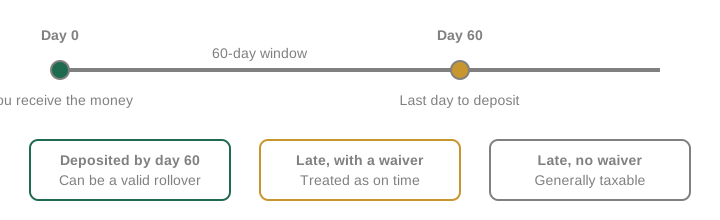
When is the deadline for an indirect rollover?
The clock runs from "the date you receive" the distribution, according to the IRS page above. The deadline is the 60th day after that date. Keep the check stub, bank record or plan statement that shows the day the money reached you, and the date the new IRA received it.
Do I have to roll over everything?
No. The IRS says you can roll over "all or a portion" of a distribution. The part you keep is generally taxable. See Gold IRA Rollover Taxes and Penalties for how that works.
What about the 20% withholding?
If the money comes from an employer plan and is paid to you, the IRS says it "is subject to mandatory withholding of 20%, even if you intend to roll it over later." That matters for the 60-day rule, because depositing the full amount means making up the withheld part from other money. The 401(k) to gold IRA guide works through an example.
What happens if I miss the 60-day deadline?
The IRS says that if you don't roll over your payment, "it will be taxable (other than qualified Roth distributions and any amounts already taxed) and you may also be subject to additional tax unless you're eligible for one of the exceptions to the 10% additional tax on early distributions" (IRS).
The same page says the IRS may waive the deadline "if you missed the deadline because of circumstances beyond your control." A waiver is not automatic for everyone. There are three routes.
The three ways to get a waiver
The IRS waiver FAQ lists "three ways to obtain a waiver of the 60-day rollover requirement" (IRS waiver FAQs).
| Route | What it is | Key points from the IRS |
|---|---|---|
| Automatic waiver | Applies when a financial institution's error caused the delay | All of these must be true: the institution received the funds for you before day 60; you followed its deposit procedures; the funds weren't deposited in time solely because of the institution's error; the funds are deposited within 1 year from the start of the 60-day period; and it would have been a valid rollover had the institution deposited as instructed |
| Private letter ruling | You ask the IRS for a ruling | The IRS says "the appropriate user fee of $10,000 must accompany every request" |
| Self-certification | You give a signed letter to the receiving plan or IRA trustee | Allowed only if you meet six conditions, and it is not an IRS decision (see below) |
How does self-certification work?
Rev. Proc. 2020-46 lets you tell the receiving plan or IRA trustee, in writing, that you qualify for a waiver. The IRS FAQ says you must meet all of these:
- The rollover meets every other rollover requirement apart from the 60-day timing.
- You can show one of the qualifying reasons prevented a timely rollover.
- The money came from an eligible IRA or retirement plan.
- The IRS has not previously denied a waiver request for a rollover of that distribution.
- You complete the rollover "as soon as practicable (usually within 30 days)" after the reason no longer prevents you.
- What you state in the Model Letter is accurate.
Rev. Proc. 2020-46 says the timing requirement is "deemed to be satisfied" if you deposit within 30 days after the reasons stop preventing you. The Model Letter, in an appendix to the Revenue Procedure, includes statements that the certification concerns only the 60-day requirement, that the IRS has not previously denied a waiver, and that you may owe income and excise taxes, interest and penalties if the certification turns out to be wrong.
What are the qualifying reasons?
Section 3.02 of Rev. Proc. 2020-46 lists twelve reasons. The wording below is shortened. The Revenue Procedure itself has the exact conditions.
| Reason listed | Short description |
|---|---|
| Financial institution error | A mistake by the bank or other institution |
| Misplaced check | A check that was lost and never cashed |
| Wrong account | The money was deposited in an account mistakenly thought to be an eligible retirement plan |
| Home damage | Your principal residence was severely damaged |
| Death in the family | A family member died |
| Serious illness | You or a family member had a serious illness |
| Incarceration | You were incarcerated |
| Foreign restrictions | Restrictions were imposed by a foreign country |
| Postal error | A mail error |
| IRS levy | The distribution was an IRS levy and the proceeds were returned |
| Unclaimed property | The distribution went to a state unclaimed property fund |
| Delayed information | The party making the distribution delayed giving the receiving plan or IRA information it needed, despite your reasonable efforts to get it |
Is self-certification a waiver?
No. The IRS FAQ states: "No, a self-certification is not a waiver by the IRS of the 60-day rollover requirement." The IRS can still decide on audit that you did not qualify. Rev. Proc. 2020-46 says a plan administrator or IRA trustee may rely on your self-certification when deciding whether you met the waiver conditions. It also says they may not rely on it for other purposes, or if they know it is untrue. Whether to use it, and whether your reason fits the list, is a question for a tax professional.
What is the one-rollover-per-year rule?
The IRS says: "Beginning in 2015, you can make only one rollover from an IRA to another (or the same) IRA in any 12-month period, regardless of the number of IRAs you own" (IRS one-per-year page). Publication 590-A states the same limit (Pub. 590-A).
The IRS treats your IRAs as one group for this purpose. The limit covers traditional, Roth, SEP and SIMPLE IRAs together.
Where did the rule come from?
In Announcement 2014-15, the IRS said the Tax Court in Bobrow v. Commissioner held that the limit applies on an aggregate basis, not IRA by IRA. The IRS said it would not apply that reading to rollovers involving IRA distributions made before January 1, 2015. That is why the rule is described as starting in 2015.
What counts toward the limit, and what does not?
| Transaction | Counts toward the one-per-year limit? |
|---|---|
| IRA-to-IRA rollover that you receive and deposit yourself | Yes |
| Trustee-to-trustee (direct) transfer between IRAs | No. The IRS says these "are not limited" |
| Traditional-to-Roth conversion | No. The IRS says conversions "are not limited" |
| Rollover from an employer plan (such as a 401(k)) to an IRA | The IRS one-per-year page doesn't list this as limited |
Check with your custodian how a particular move will be reported.
What if I break the one-per-year rule?
The IRS says distributions must be "included in gross income" and may trigger the 10% early withdrawal tax. It also says amounts paid into an IRA may be treated as an excess contribution, taxed at 6% per year (IRS).
Common mistakes to avoid
- Treating the 60 days as a suggestion. The deadline is firm unless one of the waiver routes applies.
- Forgetting the withholding. An employer plan that pays you must withhold 20%. Depositing only the net amount leaves the rest taxable.
- Doing two IRA-to-IRA rollovers in 12 months. A direct transfer avoids the limit because it is not a rollover.
- Assuming a self-certification letter ends the question. It isn't an IRS waiver.
- Not keeping records. Dates, statements and any letters matter if the IRS asks.
Related questions
Does the 60-day rule apply to a direct rollover?
No. The 60-day period applies when a distribution is paid to you. With a direct rollover, the money moves between institutions. See direct vs indirect rollover for a gold IRA.
Does the rule change when the new IRA buys gold?
The 60-day clock is about getting the money into an IRA. What the IRA then buys is a separate set of rules, covered in the Gold IRA Rollover Guide.
Who can help with a missed deadline?
A CPA, enrolled agent or tax attorney can review your facts. Your IRA custodian can tell you what paperwork it needs for a self-certification.
Sources
- Rollovers of Retirement Plan and IRA Distributions, Internal Revenue Service. Accessed Invalid Date.
- IRA Rollover One-Per-Year Rule, Internal Revenue Service. Accessed Invalid Date.
- Announcement 2014-15, Internal Revenue Service. Accessed Invalid Date.
- Retirement plans FAQs relating to waivers of the 60-day rollover requirement, Internal Revenue Service. Accessed Invalid Date.
- Rev. Proc. 2020-46, Internal Revenue Service. Accessed Invalid Date.
- Publication 590-A (2025), Contributions to Individual Retirement Arrangements (IRAs), Internal Revenue Service. Accessed Invalid Date.
This guide is general education, not personalized financial, tax or legal advice. See our financial disclaimer, editorial policy and advertising disclosure.