Direct vs Indirect Rollover for a Gold IRA
In a direct rollover, your old plan or IRA pays the new IRA custodian, so you never receive the money. In an indirect rollover, the payment comes to you and you must deposit it within 60 days. Plan payments to you have 20% withheld, which you must replace from other funds to roll over the full amount.
When you move retirement savings into a self-directed IRA that holds gold or silver, the money can travel two ways. In one, you never touch it. In the other, it passes through your hands. The choice affects withholding, deadlines and how easily a mistake can turn into a tax bill. This page compares the two. For the full process, see the Gold IRA Rollover Guide.
What is the difference between a direct and an indirect rollover?
The difference is who receives the money.
- Direct rollover. The IRS describes it as asking "your plan administrator to make the payment directly to another retirement plan or to an IRA" (IRS). The payment goes from the old account to the new one.
- Indirect rollover. The IRS says that if a distribution "is paid directly to you, you can deposit all or a portion of it in an IRA." This is also called a 60-day rollover.
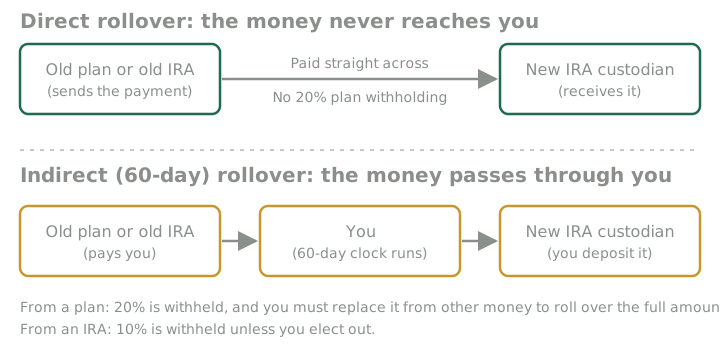
Both can be tax-free when done right. The risks are different, which is why the next sections go through them one at a time.
How do the two methods compare side by side?
| Direct rollover | Indirect (60-day) rollover | |
|---|---|---|
| Who receives the money | The new IRA custodian | You |
| Withholding on a plan distribution (such as a 401(k)) | None. Topic 413 says mandatory withholding "doesn't apply in a direct rollover" | 20% mandatory, "even if you intend to roll it over later" |
| Withholding on an IRA distribution | Not applicable to a direct payment to the new IRA | 10%, unless you elect out |
| Deadline | None for you to meet | 60 days from the date you receive it |
| Rolling over the full amount | Nothing extra needed | You must use other funds to replace anything withheld |
| One-rollover-per-year limit | Does not apply to plan-to-IRA rollovers or to IRA-to-IRA trustee-to-trustee transfers | Applies to IRA-to-IRA rollovers, but not to plan-to-IRA rollovers |
| Main risk | Paperwork or payee errors | Missing the deadline or the withheld amount, which can make money taxable |
Sources: IRS rollovers page and Topic no. 413.
How does withholding differ between a plan and an IRA?
Withholding is the biggest practical difference.
Withholding on a 401(k) or other plan payment
A retirement plan payment made to you "is subject to mandatory withholding of 20%, even if you intend to roll it over later," according to the IRS. Topic 413 adds that if you want to defer tax on the whole taxable amount, "you'll have to add funds from other sources equal to the amount withheld" (IRS Topic 413).
Withholding on an IRA payment
The IRS says an IRA distribution paid to you "is subject to 10% withholding unless you elect out of withholding." So the default is lower than for a plan, and you have a choice. Still, any amount you don't deposit within 60 days is generally taxable.
A simple example
This is an illustration, not advice. It follows the pattern of the IRS's own example, in which a $10,000 plan distribution has $2,000 withheld.
Say a plan pays you $50,000 directly. It withholds $10,000 and sends you $40,000.
| What you deposit within 60 days | Rolled over | Treated as taxable | Tax withheld counts as paid |
|---|---|---|---|
| $50,000 ($40,000 plus $10,000 from your own savings) | $50,000 | $0 | $10,000 |
| $40,000 only | $40,000 | $10,000 | $10,000 |
In the second row, the $10,000 you kept is income for the year. If you're under 59½, the IRS says the taxable part not rolled over "may be subject to a 10% additional tax on early distributions unless an exception applies" (IRS Topic 413). A direct rollover would have avoided the problem. See taxes and penalties on a Gold IRA rollover.
How does the 60-day clock work?
The IRS says you have "60 days from the date you receive an IRA or retirement plan distribution to roll it over." The clock applies only to the indirect route. With a direct rollover, there's no deadline for you to meet, though your old plan and new custodian will have their own processing times.
You can roll over "all or a portion" of the distribution. Anything you keep is generally taxable.
If you miss the deadline, the IRS has waiver routes for circumstances beyond your control, including self-certification. Those are covered in the 60-Day Rollover Rule and One-Rollover-Per-Year Limit.
Does the one-rollover-per-year rule apply?
It depends on where the money comes from. This is where people often get confused.
The IRS says "you can make only one rollover from an IRA to another (or the same) IRA in any 12-month period." The IRS's 2014 announcement explains that the limit applies across all of your IRAs combined, not account by account (Announcement 2014-15).
The IRS says the limit does not apply to:
- rollovers from traditional IRAs to Roth IRAs (conversions)
- trustee-to-trustee transfers to another IRA
- IRA-to-plan rollovers
- plan-to-IRA rollovers
- plan-to-plan rollovers
So rolling a former employer's 401(k) into a Gold IRA doesn't use up your one rollover. Taking money from one IRA yourself and depositing it in another does.
What is a trustee-to-trustee transfer, and is it the same as a rollover?
No. For IRAs, the IRS says you can ask the institution holding your IRA "to make the payment directly from your IRA to another IRA." The 2014 announcement states that "a transfer is not a rollover and, therefore, is not subject to the one-rollover-per-year limitation." Publication 590-A also treats a trustee-to-trustee transfer as a separate option from a rollover.
In plain terms, moving an existing IRA to a new Gold IRA custodian by transfer is the IRA version of a direct rollover. The money goes between institutions and doesn't count toward the one-per-year limit. Moving money out of a workplace plan is called a direct rollover. Moving between two IRAs is usually called a transfer. People use the words loosely, so ask each firm exactly which one it means.
Which method has more room for error?
The IRS doesn't rank the methods, but the rules show where problems arise:
- Indirect from a plan: 20% is withheld, so rolling over the full amount means finding that cash elsewhere. A late or partial deposit leaves part of the money taxable.
- Indirect from an IRA: the one-per-year limit adds another trap. A second IRA-to-IRA rollover within 12 months is a problem a transfer would avoid.
- Direct: fewer deadlines, but you still need the right payee name and account details. If a check is sent, ask how it should be made out. Both firms can tell you.
Some people use an indirect rollover on purpose, for example to have short-term access to cash. That is a personal decision with real tax risk. A tax professional (CPA or enrolled agent) can look at your situation.
What about Roth money and gold?
The method works the same way, but the account types must match. Designated Roth account money goes to a Roth IRA. See Roth 401(k) to Roth Gold IRA Rollover.
Choosing how the money moves is only the first step. Once it's in the IRA, the metals you buy must meet IRS rules, and a bank or approved trustee must hold them. For the former-employer 401(k) case, see 401(k) to Gold IRA rollover.
Related questions
Is a direct rollover always tax-free?
Not always. A direct rollover avoids withholding and the deadline. Whether it's taxable depends on the type of money and where it goes. Pre-tax money into a Traditional IRA isn't taxed when it moves. Pre-tax money into a Roth IRA is a conversion that counts as income.
Does 20% withholding mean I'm taxed 20%?
No. It's an advance payment toward your tax for the year. The IRS says if you roll the money over in full, the withheld amount is still counted as tax paid. Your actual tax depends on your return.
Can I choose a direct rollover from any plan?
Not necessarily. Rules vary by plan and by whether the payment is an eligible rollover distribution. The IRS lists some payments that can't be rolled over, such as required minimum distributions. Ask your plan administrator.
Sources
- Rollovers of retirement plan and IRA distributions, Internal Revenue Service. Accessed Invalid Date.
- Topic no. 413, Rollovers from retirement plans, Internal Revenue Service. Accessed Invalid Date.
- Publication 590-A (2025), Contributions to Individual Retirement Arrangements (IRAs), Internal Revenue Service. Accessed Invalid Date.
- Application of One-Per-Year Limit on IRA Rollovers, Announcement 2014-15, Internal Revenue Service. Accessed Invalid Date.
This guide is general education, not personalized financial, tax or legal advice. See our financial disclaimer, editorial policy and advertising disclosure.