Changing Gold IRA Custodians or Moving Metals In-Kind
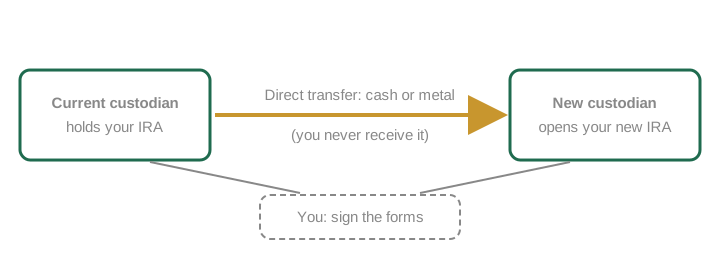
To change Gold IRA custodians, you open an account with the new custodian and ask it to request a direct trustee-to-trustee transfer from the old one. The money or metal moves between the two institutions, not through you. The IRS says no tax is withheld on such a transfer, and the one-rollover-per-year limit does not apply.
You can change the company that holds your Gold IRA without paying tax, if the move is done the right way. The right way is a direct transfer between the two companies. This page explains how that works, what to confirm before you start, and where the tax traps are. For the bigger picture, see the Gold IRA Transfer guide.
A note on terms. The custodian is the bank or trust company that holds your IRA and handles the paperwork. The depository is the vault where the metal is stored. The dealer is the company that sells you the metal. Those are often three different firms. See custodian, dealer and depository for how they fit together.
How do I change my Gold IRA custodian?
The IRS describes the basic move this way: you can ask "the financial institution holding your IRA to make the payment directly from your IRA to another IRA" (IRS). This is called a trustee-to-trustee transfer. Here is the usual order of steps.
- Pick the new custodian first. Ask whether it accepts the metals you hold and whether it works with your current depository or a different one.
- Open the new IRA. You sign the new account application.
- Ask for the transfer. The new custodian usually supplies a transfer request form. Confirm with both firms what they need from you.
- Do not take possession. The assets should move from one institution to the other. A check made out to you is a different process, and it starts a 60-day rollover clock.
- Check the result. When the transfer finishes, compare the new account statement to what you expected: the metals, the quantities and the cash.
This page does not state timelines or each firm's steps, because we could not confirm them from an authoritative source. Ask both firms for a written estimate.
Why does a direct transfer matter for taxes?
The IRS says "no taxes will be withheld from your transfer amount" in a trustee-to-trustee transfer, and the once-per-12-months rollover limit does not apply to "trustee-to-trustee transfers to another IRA" (IRS). The IRS instructions for Form 1099-R also say that, generally, a transfer between trustees "that involves no payment or distribution of funds to the participant, including a trustee-to-trustee transfer from one IRA to another IRA" is not reported on that form. Some exceptions apply, such as Roth conversions (IRS instructions).
Compare that with a 60-day rollover, where the money is paid to you first. Our rollover vs transfer page explains the difference in detail.
Can I move the metal itself, or must it be sold first?
There are two broad ways to move a Gold IRA to a new custodian. We could not confirm from an authoritative source which of them any given custodian offers, so treat the table as a list of questions, not a statement about the industry.
| Move the metal "in kind" | Sell the metal, then transfer cash | |
|---|---|---|
| What it means | The coins or bars themselves are retitled or moved to the new custodian's account | The metal is sold inside the IRA and the cash is transferred |
| Who must agree | Both custodians, and possibly the depository | The old custodian, plus whoever buys the metal |
| Ask the old custodian | Does it release metal in kind? What does it charge to do so? | What price will the metal be sold at, and what are the selling costs? |
| Ask the new custodian | Will it accept this exact metal, and will it be stored where it is now or somewhere else? | Will it accept cash and let you buy metal later? |
| Tax reporting to confirm | That the transfer is coded as a direct transfer, not a distribution | That the cash goes directly between custodians, not to you |
| Main risk | Paperwork errors that turn the move into a distribution | Selling costs and price changes while the cash is in transit |
| Who to ask | Your CPA or enrolled agent | Your CPA or enrolled agent |
The tax-reporting rows come from the IRS rules above: a direct transfer between IRA trustees is not a distribution and is not generally reported on Form 1099-R. Whether a particular firm handles an in-kind transfer that way is a question for that firm, so ask for written confirmation.
What if the metal is sent to me?
Do not have the metal shipped to you. The IRS says the exception that lets an IRA hold certain highly refined bullion applies only if it is "in the physical possession of a bank or an IRS-approved nonbank trustee" (IRS IRA FAQs). The rule also reaches indirect acquisitions through IRA-owned entities. See the IRA collectibles rule for the details. Because the answer depends on your facts, talk to a tax professional before any step that puts metal in your hands.
Does changing custodians mean changing depositories?
Not necessarily, but it might. The custodian and the depository are separate roles. After a change, the metal could stay in its current vault or move to another one. Whether the new custodian can use your current depository is a question for the new custodian. Ask the following:
- Will my metal stay where it is, or move? If it moves, who arranges and insures the shipment?
- Is my metal stored separately in my name, or pooled with others' metal? Ask each firm to explain its terms in writing. See Gold IRA storage for the storage options.
- What does the depository itself charge, and is it billed through the custodian?
What fees should I ask about?
We have not verified any custodian's or depository's fee schedule for this page, and fees differ from firm to firm. Ask both firms for their current written fee schedules, and compare these items.
| Item to ask about | Old custodian | New custodian |
|---|---|---|
| Account closing or transfer-out fee | Ask | Not usually relevant |
| Charge to release metal in kind | Ask | Not usually relevant |
| Account opening or setup fee | Not usually relevant | Ask |
| Annual custodian fee | Ask what is owed up to the closing date | Ask what starts and when |
| Storage fee and who bills it | Ask about final bill | Ask |
| Shipping and insurance if metal moves | Ask | Ask |
| Selling costs if metal is sold | Ask about any spread or commission | Ask about buying costs later |
Also ask whether any fee is charged per item or as a flat amount, and whether it is paid from the IRA or from your own money. Ask a tax professional how paying fees from outside the IRA is treated.
What if I want to change dealers, not custodians?
The dealer sells you the metal. The custodian holds your IRA. In many cases you can keep your custodian and buy from a different dealer, but that depends on the custodian. Ask the custodian whether it limits which dealers or products you can use. We could not confirm industry practice here.
What should I do before I sign anything?
- Get both firms' instructions in writing. Ask exactly which form each one needs.
- Ask how the transfer will be reported to the IRS and who will tell you if something is coded as a distribution.
- Do not let an unexpected check come to you without asking why. If one arrives, call the custodian before you cash or deposit it.
- Keep copies. Save the transfer request, confirmation letters and statements from both firms.
- Think about timing. If you have a required minimum distribution (RMD) due, ask a tax professional how it interacts with a transfer. This page does not cover the RMD rules.
- Do not pay for pressure. If a salesperson says you must move quickly, slow down and compare the written terms.
Related questions
How do I move my Gold IRA to another company?
Open an account with the new company and request a trustee-to-trustee transfer, as described above. Do not take payment yourself.
Can I change custodians if my IRA is a Roth?
The same transfer idea applies to a Roth IRA moving to another Roth IRA. If you are moving traditional money into a Roth, that is a conversion with its own tax rules. See Roth IRA to Roth Gold IRA transfer.
Is changing custodians a taxable event?
A direct trustee-to-trustee transfer between IRAs is not withheld on and is generally not reported on Form 1099-R, according to the IRS sources above. A tax professional can confirm how your own transfer will be treated.
This page is general information, not tax or legal advice. A CPA, enrolled agent or other qualified professional can review your specific accounts before you move them.
Sources
- Rollovers of retirement plan and IRA distributions, Internal Revenue Service. Accessed Invalid Date.
- Retirement plans FAQs regarding IRAs, Internal Revenue Service. Accessed Invalid Date.
- Instructions for Forms 1099-R and 5498, Internal Revenue Service. Accessed Invalid Date.
This guide is general education, not personalized financial, tax or legal advice. See our financial disclaimer, editorial policy and advertising disclosure.