Augusta Precious Metals Review: Fees, Minimums, Custodians, Complaints
Augusta Precious Metals is a precious metals dealer that says it was formed in 2012 and lists offices in Casper, Wyoming and Beverly Hills, California. Its website states a $50,000 minimum and $285 in first-year account fees. It does not publish the spread between its buy and sell prices. These are company statements.
Our relationship with this company. Augusta Precious Metals is our affiliate partner. If you request its Free Gold & Silver IRA Info Kit through a link on this site, we may earn a commission. The kit belongs to Augusta, and we don't write it or describe what is in it. We hold this page to the same standard as every other company page: we use the same fields, we label company statements as claims, and we don't rank companies or call any of them "best." You can read the full terms in our advertising disclosure, and the steps we follow are in our company research methodology. Because of the partnership, we have tried to be especially careful to show where the evidence is thin.
This page is a research summary. It is not a recommendation to open, or to avoid opening, an account with Augusta or anyone else.
Is Augusta Precious Metals legitimate, and what does it charge?
Those are the two questions most people type into a search box, so here is the short version.
"Legitimate" is a hard word to answer for any company, because it asks for a verdict. What we can do is show you what Augusta says about itself, what independent records we could open, and what we could not check. Where we found no complaint in a database, we say exactly which database and on what day. A search that finds nothing is not a clean bill of health.
On fees, Augusta's website states a one-time $50 account setup fee, a $125 annual custodian fee and a $110 annual depository storage and insurance fee. Add them up and you get $285 for the first year and $235 each year after. The website also says every account receives up to 10 years of custodian and depository fees paid by Augusta. The part that matters even more than those flat fees is the price you pay for the metal itself, and that price is not published on the pages we read. We come back to that below.
Who is Augusta Precious Metals?
According to Augusta's FAQ, the company was formed in January 2012 by founder and CEO Isaac Nuriani. Its home page says "Trusted by American Retirees Since 2012" and lists two offices: 5830 East 2nd Street in Casper, Wyoming, and 8484 Wilshire Boulevard in Beverly Hills, California.
Augusta sells gold and silver for Individual Retirement Accounts (IRAs) and for cash purchases. Its website offers Gold IRA and Silver IRA pages. Everything in this section comes from Augusta's own pages, so treat it as the company describing itself.
Two details about how Augusta describes its staff are worth knowing. The website says customers receive one-on-one education from "salaried, no-commission educators." And its compliance page says Augusta collaborates with attorneys who specialize in areas important to its operations, works with an on-staff editor and writer with compliance experience, and carries out periodic internal audits. That page does not name any individual, does not name a regulator, and does not list any registration or license.
That is not a criticism. It does mean that this page, by itself, gives you no registration number to look up, which is why we explain below which other kinds of records we checked and which we could not.
Quick facts at a glance
| Field | What we found | How to read it | Source (accessed 2026-10-12) |
|---|---|---|---|
| Partner relationship | Affiliate partner of this site | Disclosed by us | Advertising disclosure |
| Business type | Precious metals dealer that sells metals for IRAs and for cash purchases | Company claim | Augusta home page and FAQ |
| Founded | January 2012, by Isaac Nuriani (founder and CEO) | Company claim | Augusta FAQ |
| Offices | Casper, WY and Beverly Hills, CA | Company claim | Augusta home page |
| Entity details | BBB profile lists business started 12/31/2011, incorporated 6/28/2021, type "Corporation," CEO Isaac Nuriani | Listed on BBB; BBB says it does not verify business-supplied information | BBB profile (screenshot) |
| BBB standing | A+ rating; BBB Accredited since 2/16/2015; 4.93 average from 136 customer reviews | BBB figures, viewed through screenshots | BBB profile and reviews pages (screenshots) |
| Products for IRAs | Gold IRA, Silver IRA | Company claim | Augusta Gold IRA and Silver IRA pages |
| Minimum purchase | $50,000, for both IRA and cash purchases | Company claim | Augusta FAQ |
| Account fees | $50 setup, $125 custodian, $110 storage and insurance | Company claim | Augusta FAQ |
| Custodian named | Equity Trust Company | Company claim | Augusta Gold IRA page, FAQ |
| Depository named | Delaware Depository | Company claim | Augusta Gold IRA and Silver IRA pages |
| Spread (buy/sell gap) | Not published on the pages we read | Gap in the disclosures | Augusta FAQ |
| Buyback terms | Described in general terms; "subject to change without notice" | Company claim | Augusta FAQ |
| Dispute process | Binding arbitration and a class action waiver in the website Terms of Use | Company terms | Augusta Terms of Use |
| Regulatory and court records | Partly checked; see the records section below | Public records and gaps | See below |
How does a Gold IRA with Augusta work?
A Gold IRA is a self-directed IRA that holds physical metal instead of mutual funds or stocks. Three different companies usually play three different roles, and Augusta is only one of them.
- The dealer sells you the metal. Here, that is Augusta.
- The custodian is the company that legally holds your IRA, keeps the records and sends the tax forms. Augusta says it works with Equity Trust Company.
- The depository is the secure vault where the metal is kept. Augusta says it stores metals at Delaware Depository.
Our guide to the custodian, the dealer and the depository explains why this matters. The short version is that the company selling to you is not the company that holds your account, so you will have agreements and fee schedules from more than one place.
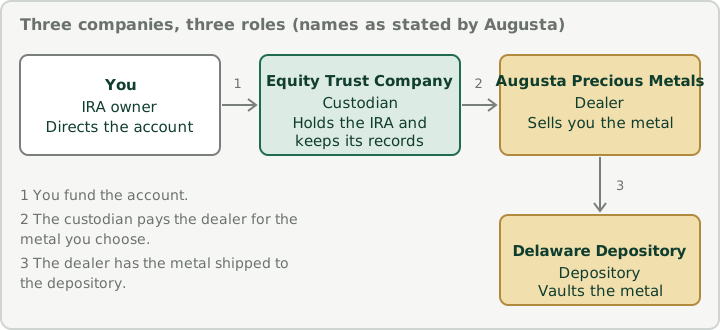
Augusta's FAQ describes the process this way. You open and fund the account, which it says typically takes one to two weeks. Once the money arrives, you receive education before deciding whether to buy and what to buy. Before any purchase, Augusta says it provides a written Transaction Agreement. After the purchase, the metal ships to a U.S. depository. For how rollovers into a Gold IRA work in general, see our overview, and for the paperwork that moves money from an old employer plan, see our guide on rolling a 401(k) into a Gold IRA.
One more claim from Augusta's FAQ is about shipping. It says that with a qualifying purchase, Augusta covers shipping and liability insurance, and ships by USPS Ground, fully insured, with a signature required on delivery. It also says IRA metals go to secure depositories in the United States. We did not see what counts as a "qualifying purchase."
What does Augusta say the fees are?
Here are the fee numbers as Augusta states them on its FAQ page.
| Fee | Amount Augusta states | Notes from Augusta's page |
|---|---|---|
| Account setup | $50, one time | Included in the $285 total Augusta states |
| Custodian fee | $125 per year | Described as a flat fee |
| Depository storage and insurance | $110 per year | Described as a flat fee |
| First-year total | $285 | $50 + $125 + $110 |
| Each later year | $235 | $125 + $110 |
| Management or performance fees | None | "Augusta does not charge annual management or performance fees" |
| Fees paid by Augusta | Up to 10 years of custodian and depository fees on every account | The page does not explain how "up to" works |
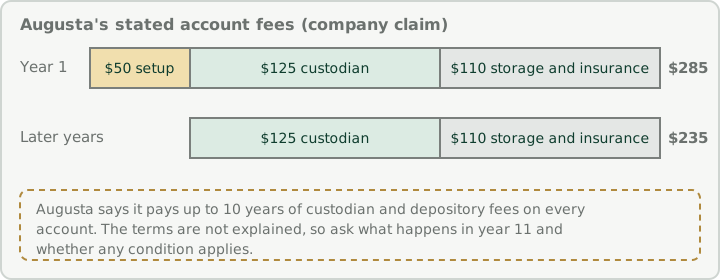
The page also says these fees do not increase based on the amount held in the IRA or how much the account grows in value. By comparison, the custodian's Universal schedule (covered below) charges a higher yearly fee as the account value rises through its tiers.
A few honest questions follow from the table, and you can put them to Augusta in writing:
- When it says "up to 10 years" of fees are paid, which years, and which fees? Is there any condition, such as a minimum balance or a requirement to keep the account open?
- What happens in year 11? Under Augusta's own numbers, that is when $235 a year would start to come out of your account.
- Are the fees paid by Augusta shown as a credit on your statement, or are they simply not billed?
If you want to see how these costs fit with the rest of a Gold IRA's costs, our guides to custodian fees, storage fees and hidden fees cover each in plain language.
Do the custodian's published fee schedules match?
This is where we spent the most time, because the custodian is the company that sets the account fees you'll see on your statement.
Equity Trust Company publishes fee schedules as PDF files. We opened three of them. They are not identical, and they apply to different groups of accounts. Equity Trust's fee page describes the "Legacy Retail" schedule as applying to retail accounts opened before August 2024 that are not managed by a financial advisor or other professional.
| Schedule (as printed on the PDF) | Account setup (online) | Annual fee for a $50,000 to $99,999 account | Annual fee, "Precious Metals" account on Flex schedule | Precious metals storage |
|---|---|---|---|---|
| Universal IRA Fee Schedule (FS-0001-01, "Rev. 110625") | $50 | $500 | Not listed | $160 segregated, $110 non-segregated |
| Legacy Retail Client Fee Schedule ("Rev. 081726") | $50 | $425 | Not listed | $160 segregated, $110 non-segregated |
| Institutional "Flex" schedule (FS-0004-02, "Rev. 1104625" as printed) | $50 (listed as "Account Set-up") | Varies by account value and by the number of accounts the representative has | $125 flat | $160 segregated, $110 non-segregated |
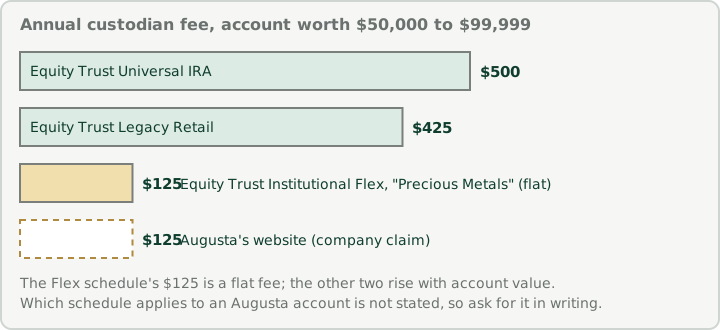
Three things stand out.
First, Augusta's $125 custodian fee matches a figure on Equity Trust's Institutional Flex schedule. That schedule lists a flat $125 annual fee for a "Precious Metals" account. We do not know which schedule applies to accounts opened through Augusta, and neither Augusta's page nor Equity Trust's pages told us. It may well be this one. But it is an inference, so we are not stating it as fact.
Second, other Equity Trust schedules show a different yearly fee for an account of this size. On the Universal schedule, an account worth $50,000 to $99,999 is charged $500 a year. On the Legacy Retail schedule, it is $425. The Institutional schedule's footnote says that if the number of accounts for a designated representative is zero to three, you should see the Institutional Standard Fee Schedule instead.
Third, storage has two prices. Equity Trust lists segregated storage at $160 and non-segregated storage at $110, and says depositories may charge their own fees as well. Augusta's $110 storage figure matches the lower of the two, though Augusta's page does not say which type it means. Our guide to segregated and commingled storage explains the difference.
This does not show that anyone has done something wrong. Fee schedules differ for good reasons, and a dealer may have an arrangement with a custodian. But it is a clear example of why we tell readers to ask for the schedule that will apply to their own account, in writing, with its revision date, before moving money. Equity Trust's own schedule also says its fees are "effective from January to January of any given calendar year" and are "subject to change."
Equity Trust's other fees may matter later, too. On the Universal schedule, for example, we saw $10 per asset (up to $30) to liquidate precious metals, $50 for an in-kind distribution or transfer out, $30 per wire, and $250 for a full termination. The Legacy Retail schedule shows different amounts for some of these, such as $30 per transaction to liquidate and $125 per transaction for in-kind transfers and distributions. Augusta says it charges no separate liquidation fee when it repurchases your metals, but that statement concerns Augusta's own fees. It does not say what the custodian charges.
Who is Equity Trust, and is it on the IRS list?
Augusta says it works with Equity Trust Company, which is the company that would hold your account. A few facts about the custodian are useful.
Equity Trust's website says it is "regulated as a South Dakota trust company," and that the South Dakota Division of Banking regulates it. It also says its financial statements are audited annually by an independent certified public accountant.
The IRS publishes a list of nonbank trustees and custodians it has approved. The version we opened was headed "Nonbank Trustees Approved as of April 1, 2026." In two separate searches of that list, we did not find Equity Trust Company. We did not find Augusta Precious Metals either, which is expected, since Augusta is a dealer and not a custodian.
Equity Trust addresses this on its own regulatory page. It says the IRS list "does not include entities that qualify as an IRA custodian under state law, which includes Equity Trust," and adds that the IRS approved its predecessor business as a custodian in 1983. Those are the company's statements. We did not confirm them with the South Dakota Division of Banking or the IRS, and we are not offering a legal conclusion about how the rules apply. A tax professional or the custodian itself can answer that for your situation.
The practical lesson is simple. If you want to know who is allowed to hold your IRA, ask the custodian directly and in writing. Our guide on custodian requirements explains what the law asks for, and our planned profile of Equity Trust will go into the custodian itself.
What is the minimum, and who does it leave out?
Augusta's FAQ states a minimum initial purchase of $50,000, for both IRA purchases and cash purchases. It adds that this is the amount needed to purchase precious metals through Augusta and that it is not a fee. Its Silver IRA page says Augusta "typically" requires $50,000 to open a silver IRA.
There is a second number on the Gold IRA page. It says a one-on-one web conference is available to retirement savers with $100,000 or more in savings. The two figures are not the same thing: one is a purchase minimum, the other is a savings level for access to a certain kind of meeting. But a reader could easily mix them up, so we mention both.
A $50,000 minimum means that, for some savers, an account like this would use a large share of their retirement money. Our pages on minimum investment and allocation and concentration risk explain why the size of a position matters. We cannot tell you what share is right for you. A fee-only financial planner or tax professional can help with that.
What do you pay for the metal itself?
For most people, the biggest cost in a Gold IRA is not an account fee. It is the gap between what a dealer charges you for metal and what it would pay to buy that metal back.
Two terms help here. The spot price is the current market price for one troy ounce of the metal. A dealer sells above spot (the added amount is called the premium or markup) and buys back below spot. The difference between the selling price and the buyback price is the spread. The Commodity Futures Trading Commission (CFTC) makes the same point in its customer advisory on buying physical metals: "A dealer will always sell metal above the spot price and buy it back below the spot price." The advisory also says that if fees are not available in writing before purchase, that is a red flag, and it suggests asking how much you would receive if you sold the metal back the next day.
What does Augusta's website say about this? Here are its statements:
- "No additional commission is added to prices listed by Augusta."
- "Prices quoted to you by the Augusta order desk are the prices you will pay."
- Augusta's sale prices and potential buyback prices "are determined and controlled by Augusta in its sole discretion."
- Prices lock once your order is confirmed by phone and payment is received, and, for low mintage products, you have a one-time option to revise your order to a lower price within seven days, which the page calls its 7-Day Price Protection Program.
And what is missing? The FAQ page does not give a spread figure or a premium over spot. It says high-mintage products trade closer to the underlying spot price, and that buyback bids can sometimes land "at or below melt value." The Gold IRA page says Augusta publishes its fees and walks through all costs, including the spread, before any transaction. So the website's position is that you will see the spread before you buy, in the sales process, rather than on a public price list.
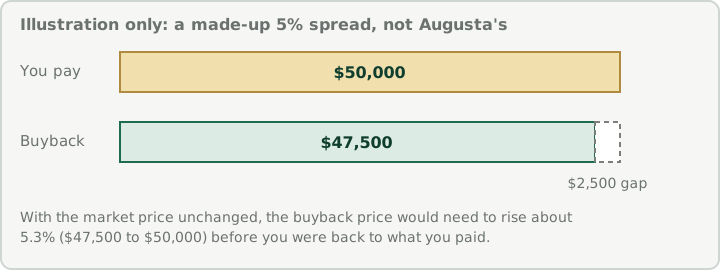
Here is a simple example to show why it matters. This is a made-up illustration, not Augusta's actual spread. Suppose you buy $50,000 of coins, and on the day you sell, the dealer's buyback price for the same coins is 5% below what you paid, with the market price of gold unchanged. You would receive $47,500. To get back to $50,000, the buyback price would have to rise by about 5.3%. If the spread were 2%, the break-even point would be much closer. That is why we suggest asking for the sale price, the spot price at the time of the quote, and the current buyback price, all in writing, for every product you are quoted. Our guide to dealer premiums, markups and spreads shows how to compare quotes.
What does Augusta say about buying back your metals?
Augusta's FAQ has a fairly detailed section on buybacks. It makes these statements:
- "Augusta has never declined a buyback."
- Augusta's buyback policy "is subject to change without notice."
- Augusta "cannot legally guarantee it will purchase or trade metals you own, or repurchase metals it sells."
- There is "no separate liquidation fee when Augusta agrees to repurchase your metals."
- "You're never required to sell back to Augusta."
- A buyback typically takes about three weeks, depending on Equity Trust and the depository's own processing.
Read those together and you have an honest picture, with some tension in it. The first statement is a track-record claim, which we cannot verify from the outside. The next two say there's no legal promise to buy back, and that the policy can change. That is fair and common, and it is also exactly why a buyback is not the same as a guarantee. Our guide on buyback policies and liquidation costs explains what a "buyback guarantee" can and cannot promise. Our page on liquidity risk covers the case where you need cash quickly.
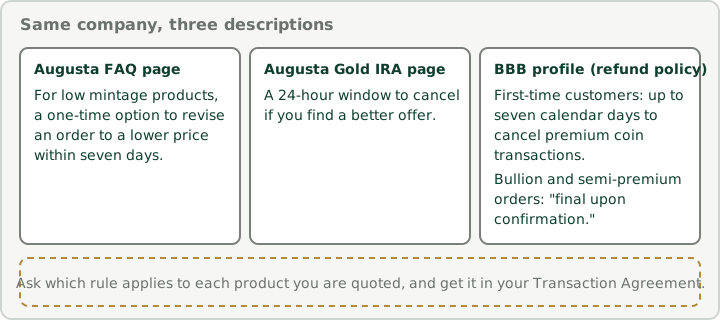
We also noticed that Augusta's cancellation and price terms are described in three different ways. The FAQ describes a one-time option, for low mintage products, to revise an order to a lower price within seven days. The Gold IRA page says Augusta "offers a 24-hour window to cancel if you find a better offer." And the "Refund and Exchange Policy" on Augusta's BBB profile says that for first-time customers, the cancellation period for premium gold and silver coin transactions is extended to up to seven calendar days after a transaction is confirmed, unless the law in the customer's state says otherwise. It adds that subsequent orders are final once the recorded confirmation call is complete, and that all bullion and semi-premium orders are "final upon confirmation." The profile does not explain what Augusta counts as "premium," "semi-premium" or "bullion." They may describe different rights, or one may be out of date. Because bullion coins and bars are what many IRA buyers purchase, ask Augusta in writing which category each product you are quoted falls into, and put the exact terms in your Transaction Agreement.
Where is the metal stored, and is it insured?
Augusta says it stores metals at Delaware Depository, and its FAQ links to the depository it recommends (the link points to Delaware Depository's website) while saying storage is available in several U.S. cities, including Los Angeles, Salt Lake City, Las Vegas, Dallas and Wilmington, and that you should contact Augusta for a current list. Equity Trust's own page lists several depositories its clients can choose from, including Brink's, Delaware Depository, International Depository Services, Texas Bullion Depository and A-Mark Global Logistics (listed with Loomis International), and says you and your dealer will discuss the depository options, after which you select one.
On Augusta's Silver IRA page, the company says silver is held in "fully allocated storage" and cites "$1 billion in all-risk insurance backed by leading London underwriters." Those are Augusta's statements. On Delaware Depository's home page we read an address in Wilmington, Delaware and another in Boulder City, Nevada, and a statement that it is an "SSAE18 - SOC1 Type1 audited organization." We did not find an insurance statement on that page. That doesn't mean there is no insurance. It means we could not confirm it from the depository's own page, so you may want to ask for the policy details in writing. Our guides to IRA metals insurance and to how to verify your metals list what to request.
"Allocated" is a word that can be easy to read past. Our guide on segregated and commingled storage explains how storage types differ. Equity Trust's schedules charge more for segregated storage ($160) than non-segregated storage ($110), so it's reasonable to ask which one your Augusta account would use and what each is billed at.
What does Augusta say about education and reviews?
Augusta puts a lot of weight on education. Its website describes a process that starts with a free information kit, includes a call with an educator, and invites you to "Move forward only if it makes sense for you." We don't know what the kit contains, and we don't describe it. The company also says it is "not qualified" and does not offer financial, investment, legal or tax advice.
Its reviews page cites ratings from several platforms. The table shows what the company reports, and the page gives dates only for the first row.
| Platform | What Augusta's page reports | Date shown on the page |
|---|---|---|
| Better Business Bureau | 4.93 out of 5 from 134 reviews, and "0 complaints on file" | 7/16/26 |
| 4.9 out of 5 from 736 reviews | None | |
| ConsumerAffairs | 4.9 out of 5; 92% five-star | None |
| Business Consumer Alliance | AAA rating; 144 reviews | None |
| TrustLink | 4.9 out of 5 from 317 reviews | None |
| 96% recommend, from 81 reviews | None | |
| Home page (several platforms combined) | "Trustpilot, Google & More — 4,000+ 5-Star Ratings"; no per-platform score or collection date given | None |
A separate ratings graphic associated with Augusta shows BBB with an A+ rating and 4.9 stars, Google 4.9, Business Consumer Alliance 5.0 and ConsumerAffairs 4.9, next to a Money magazine badge. We could not find that graphic on the Augusta pages we opened, so we cannot give its date or source page. Its Google and ConsumerAffairs numbers match the reviews page, and its BBB figure is a rounded version of the reviews page's 4.93. Its Business Consumer Alliance figure (5.0 stars) is shown differently from the reviews page, which reports a "AAA" rating, and the Gold IRA page also says "AAA BCA rating." These are different scales, so we show each as the company displays it.
Notice also that these are star ratings from other websites, reported by Augusta. They are not a rating from us. We don't score or rate companies, and we give every company the same treatment (see our methodology).
The page also lists awards from Money, Investopedia and CBS News. We did not open those publishers' pages, so we can't say how any award was chosen or whether money changed hands. Its home page says it holds an A+ rating from the Better Business Bureau, and its FAQ gives "As of August 4, 2026" as the date for that statement.
Please read the table above as self-reported. The BBB's own pages are covered in the next section. Augusta's reviews page also does not explain how reviews are gathered or checked. It shows ten written reviews identified by a first name and last initial (one by first name only), plus two video testimonials, none of them dated. Testimonials chosen by the company tell you little about the full range of customer experiences. Our guides on how review sites make money and on fake and incentivized reviews explain how to read them. Keep in mind that we are one of those sites, with a commission relationship, so check what you read here against the primary sources we link.
What does Augusta's BBB profile show?
The Better Business Bureau (BBB) is a nonprofit that publishes business profiles, customer reviews and complaint records. Its website does not allow automated tools to open its pages, so we did not open it ourselves. The details below come from screenshots of Augusta's BBB profile and customer-review pages that the owner of this site viewed on October 12, 2026 and shared with us. We list the BBB web addresses in our sources, but our fact-checker could not open them either, so treat these figures as unverified by us beyond what the screenshots show.
| BBB profile item | What the screenshot shows |
|---|---|
| Accreditation and rating | "BBB Accredited Business," with an A+ rating |
| Accredited since | 2/16/2015 |
| BBB file opened | 2/5/2014 |
| Years in business | 14 |
| Business started | 12/31/2011 |
| Business incorporated | 6/28/2021 |
| Type of entity | Corporation |
| Business management | Isaac Nuriani, CEO |
| Local BBB | BBB of Los Angeles & Silicon Valley |
| Address | 8484 Wilshire Blvd #515, Beverly Hills, CA 90211 |
| Payment method listed | Wire transfer |
| Customer reviews | 4.93 average from 136 customer reviews, spread over 14 pages of reviews |
A few points help you read this table. BBB says on the page that it does not verify the accuracy of information provided by third parties, and that it does not guarantee the accuracy of any information in a business profile. Much of a profile, such as the "About This Business" text and the refund policy, is supplied by the business. BBB also says accreditation is not an endorsement, that businesses are under no obligation to seek it, and that the nature of complaints and a company's responses to them are often more important than the number of complaints.
On the reviews page, the ten most recent reviews we could see on page one were all rated five stars, and Augusta had posted a public reply under several of them. That page one is not a sample of all 136 reviews, so we do not draw conclusions from it. The BBB customer-review average is also a different measure from the BBB letter grade, which BBB calculates separately. We did not see the Complaints tab, so we have no BBB complaint counts to report. Augusta's own reviews page said "0 complaints on file" as of 7/16/26, but that is the company's statement.
The profile lists both a business start date in 2011 and an incorporation date in 2021, and describes the entity only as a "Corporation." It does not give a legal name or state of incorporation, and Augusta's website Terms of Use name the contracting party only as "Augusta Precious Metals." That may have a simple explanation, such as a change in legal structure, but it is worth asking: which legal entity would you be contracting with, and in which state is it incorporated?
What do the website terms say?
When you use a company's website, you agree to its Terms of Use. These are not the same as the Transaction Agreement you sign to buy metal, which Augusta's Terms say is a separate document. We did not see the Transaction Agreement, so we can only describe the website terms.
The Terms of Use say that disputes are to be resolved through "final and binding Arbitration" administered by National Arbitration and Mediation, after an attempt at informal resolution. They include a class action waiver. They state that Wyoming law governs, and that exclusive venue is the courts of Casper, Wyoming, subject to the arbitration clause. They also say claims must be brought within one year after the cause of action accrues, and they disclaim warranties on the website's services. Terms like these can limit your options if there is a dispute, so read them before you agree. We aren't lawyers, and none of this is legal advice. If you are about to sign an agreement, a lawyer you trust can review it.
What public records did we check?
Our methodology lists the records we look for on every company. Here is what happened for Augusta, with the date we searched. We want to be as clear about what we could not do as about what we did.
| Source | What we did | Result | Date |
|---|---|---|---|
| CFPB Consumer Complaint Database | Searched the text "augusta precious metals" through the database's search function | 0 results | 2026-10-12 |
| IRS nonbank trustees list (April 1, 2026) | Searched for Equity Trust Company and Augusta Precious Metals | Neither name found | 2026-10-12 |
| Web search of CFTC, SEC, FTC and CFPB sites | Searched for "Augusta Precious Metals" | No enforcement release or order naming the company turned up | 2026-10-12 |
| Web search for court cases | Searched for dockets naming the company | No court docket naming the company turned up; results were general web pages, which we did not rely on | 2026-10-12 |
| BBB profile and customer-review pages | Reviewed screenshots shared by the site owner (our tools are blocked from bbb.org) | A+ rating, BBB Accredited since 2/16/2015, 4.93 average from 136 reviews; Complaints tab not reviewed, so complaint counts are not checked | 2026-10-12 |
| FINRA BrokerCheck | Tried a search | The tool did not return results to us; not checked | 2026-10-12 |
| SEC EDGAR company search | Tried to open | Blocked to automated tools; not checked | 2026-10-12 |
| SEC Investor.gov, NFA BASIC, state regulators, PACER and state courts | Not searched | Not checked | n/a |
Two cautions apply. First, a zero in the CFPB database means that no complaint under that name appeared in that database on that day. The CFPB database covers complaints about certain financial products and services, and a precious metals dealer may fall outside what people file there. Second, a general web search is not a search of a court docket or a regulator's records. A search that finds nothing does not prove nothing exists.
We make no claim that Augusta has, or has not, been the subject of a lawsuit, regulatory action or complaint outside the records above. To be careful, we did not repeat claims from articles whose sources we could not open. If you want to run these checks yourself, our guide on how to verify a dealer walks through BrokerCheck, NFA BASIC, state regulators and court records step by step, and our enforcement database will list any cases we find in orders and complaints we have read.
What should you ask Augusta before you sign anything?
Whichever dealer you consider, these questions come from regulators' own advice and from the gaps we found above. Ask for answers in writing.
- What are the sale price, the spot price and the buyback price for each product I'm quoted? Ask for all three at the same time.
- Which Equity Trust fee schedule applies to my account, and what is its revision date? Ask for a copy.
- What does "up to 10 years of fees paid" mean in my case? Ask what happens in year 11.
- Is my storage segregated or non-segregated, and what does the depository charge? Ask for the depository's fee schedule and its insurance details.
- What are the exact cancellation and price-revision rights, and do they differ for bullion, premium and semi-premium products? Ask Augusta to reconcile the seven-day, 24-hour and "final upon confirmation" statements.
- What will the custodian charge when I sell, take a distribution or close the account? These are separate from any dealer fee.
- How are your educators and salespeople paid? The CFTC suggests asking this directly.
- Which legal entity am I contracting with, and where is it incorporated? The Terms of Use name only "Augusta Precious Metals."
- May I see the Transaction Agreement before I send any money? Read it, including any arbitration terms, before you decide.
Our full checklist is in the guide on how to evaluate a Gold IRA company.
What are the risks that apply no matter which company you pick?
No dealer, custodian or depository can remove the basic risks of owning physical metal. Gold and silver prices go up and down, and our guide on price volatility explains how large the swings have been. A Gold IRA also has costs that a stock or bond fund may not, and you can only sell at the dealer's buyback price or through another buyer. Counterparty risk, meaning the chance that a company you depend on fails to do its part, is discussed in our counterparty risk guide. We do not predict prices, and nothing on this page should be read as a forecast.
How does this compare with other companies?
We publish every company review on the same set of fields so you can read them side by side, and we don't rank them. If you want to compare, our Goldco review uses the same structure, and a set of side-by-side pages is planned, including Augusta Precious Metals vs Goldco and Augusta Precious Metals vs Birch Gold Group. For the wider picture of how dealers, custodians and depositories fit together, start at Gold IRA Companies Compared.
How was this page researched, and when will it be updated?
We opened Augusta's home, FAQ, Gold IRA, Silver IRA, reviews, Terms of Use and compliance pages on October 12, 2026. We opened three Equity Trust fee schedules, its regulatory page and its precious metals client page, the Delaware Depository home page, the IRS page on approved nonbank trustees and the list dated April 1, 2026, the CFTC's customer advisory, and the CFPB complaint database. We also reviewed screenshots of Augusta's BBB profile and customer-review pages that the site owner viewed and shared with us. Each is cited above with the access date. Anything that came only from Augusta is written as Augusta's statement. We left out facts we could not confirm from a page we opened.
Fees, terms and company information are reviewed every three months under our update policy, and sooner if a regulator announces an action or a reader reports an error. If you see something here that is out of date, please tell us through our corrections page.
This page is general information, not personalized advice. Decisions about your retirement savings depend on your own situation, so talk with a qualified financial planner, tax professional or attorney before you act.
Sources
- Augusta Precious Metals (home page), Augusta Precious Metals. Accessed Invalid Date.
- Augusta Precious Metals FAQ, Augusta Precious Metals. Accessed Invalid Date.
- Gold IRA, Augusta Precious Metals. Accessed Invalid Date.
- Silver IRA, Augusta Precious Metals. Accessed Invalid Date.
- Reviews, Augusta Precious Metals. Accessed Invalid Date.
- Terms of Use, Augusta Precious Metals. Accessed Invalid Date.
- Augusta Compliance Team, Augusta Precious Metals. Accessed Invalid Date.
- Universal IRA Fee Schedule (FS-0001-01), Equity Trust Company. Accessed Invalid Date.
- Legacy Retail Client Fee Schedule, Equity Trust Company. Accessed Invalid Date.
- Institutional Fees Schedule, Equity Trust Company. Accessed Invalid Date.
- Account Fee Schedule, Equity Trust Company. Accessed Invalid Date.
- Equity Trust Precious Metals Client Resource Center, Equity Trust Company. Accessed Invalid Date.
- How We are Regulated, Equity Trust Company. Accessed Invalid Date.
- Delaware Depository, Delaware Depository. Accessed Invalid Date.
- Approved nonbank trustees and custodians, Internal Revenue Service. Accessed Invalid Date.
- Nonbank Trustees Approved as of April 1, 2026 (list), Internal Revenue Service. Accessed Invalid Date.
- Customer Advisory: 10 Things to Ask Before Buying Physical Gold, Silver, or Other Metals, Commodity Futures Trading Commission. Accessed Invalid Date.
- Augusta Precious Metals business profile (viewed through a screenshot), Better Business Bureau. Accessed Invalid Date.
- Augusta Precious Metals customer reviews (viewed through a screenshot), Better Business Bureau. Accessed Invalid Date.
- Consumer Complaint Database, Consumer Financial Protection Bureau. Accessed Invalid Date.
This guide is general education, not personalized financial, tax or legal advice. See our financial disclaimer, editorial policy and advertising disclosure.